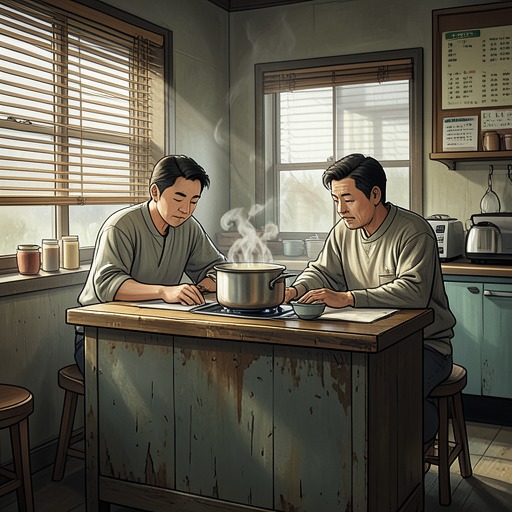
Teiji Matsuda and Soutaro
The Earthquake BirdTeiji Matsuda and Soutaro are uncle and nephew whose bond is built through family succession and shared work rather than through open conversation. Soutaro gives Teiji a place in the noodle shop and imagines him as its future owner, but Teiji’s departure for Hokkaido breaks that expectation. The photographs he leaves behind offer no explanation, making the shop and its abandoned film the last material traces of their connection.
Family and the Shop
Soutaro’s connection to Teiji begins with Teiji’s mother, Soutaro’s sister. After growing up in northern Tokyo, Soutaro was evacuated to the mountains of Gumma during the war and escaped the firebombing that destroyed most of his family. His father and younger sister survived. Soutaro returned to Tokyo determined to take part in rebuilding it, and he and his father opened a small noodle restaurant in Takadanobaba. The work gave him a way to serve the people of the city to which he felt so strongly attached.
His sister married and moved to Kyushu. Nineteen years later, a span that seemed to Soutaro scarcely longer than nineteen months, she returned with her son. Teiji struck his uncle as spindly and unlikely to be suited to a day’s work. That first impression did not hold. Teiji worked hard, grew strong, and took on the unglamorous routines of the restaurant: mopping its floors, throwing out old food, and preparing ingredient orders. Soutaro’s judgment of his nephew changed through the evidence of daily labor.
Work and Inheritance
Teiji appeared content with the work, staying through the day before wandering off in the evenings. His mother’s death made his place in the shop more definite: Soutaro saw no question about his nephew continuing there. Soutaro had never married and liked the prospect that, after his own death, the business would pass to his sister’s son. The shop therefore held more than a job for Teiji. It was the family’s practical legacy and the future Soutaro had begun to imagine for them both.
That expectation coexisted with growing unease. Soutaro wondered why Teiji spent so much time with his camera and had no friends apart from the sullen foreign girl he associated with him. He was preparing to speak to Teiji about marriage, and did not want him to marry a foreigner, when events interrupted that plan. The contrast is telling: Soutaro could see Teiji’s diligence and imagine his future in the restaurant, yet the nephew’s private life remained difficult for him to read. Their connection was close in work and inheritance, but not in knowledge of what Teiji did beyond the shop.
Departure and the Empty Photographs
Teiji went away for a weekend to Sado Island. When he returned, Soutaro found him jumpy and nervous. A couple of weeks later, Teiji left a note on the restaurant counter saying he was going north to Hokkaido to try his luck. A roll of undeveloped film held the note down. The abruptness of the departure left Soutaro with a message but no fuller account of what had changed, and the nephew he had counted on continuing the family business was gone.
Soutaro could not keep the shop going without Teiji. His back was bad, and he was ready to retire. Hoping that the film might contain a clue, he had it developed. Instead, the photographs showed deserted beaches, railway tracks without trains, boarded-up buildings, and abandoned trash cans. Soutaro examined them from different angles, turned them upside down, and even put on old three-dimensional glasses from a wildlife magazine to look again. None of that scrutiny made the images explain Teiji’s departure. He eventually threw the photographs away and sold the shop to a stranger.
Separation and Retrospective Meaning
After the sale, Soutaro sketched flowers and birds against backgrounds of deserted places in his apartment. The shift from the busy, inherited work of the restaurant to these images echoes the emptiness he had found in Teiji’s film, without resolving what the photographs meant. Soutaro concluded that he would not see his nephew again. The story does not give him a reunion or an explanation: the relationship ends in distance, a relinquished business, and images that disclose absence rather than a message.
The account also reaches Lucy Fly through a belated discovery. Teiji’s uncle is her only remaining link with Teiji, and learning that the man is called Matsuda makes her reconsider how little she knew of him. Soutaro’s history supplies a family and working life that Teiji had not made legible to her: a mother who returned to Tokyo with him, a restaurant where he labored, and an uncle who expected him to inherit it. Yet even this added knowledge does not close the gap. Teiji’s note gives a destination, and the film gives a sequence of empty places, but neither tells Soutaro—or Lucy Fly—why he left.