Teiji–Sachi Former Romantic Relationship
The Earthquake BirdTeiji and Sachi’s former relationship is known chiefly through photographs, a brief account from Teiji, and Lucy’s uncertain reconstruction of the images. It began around a theater, where Teiji’s attention fixed on Sachi as a performer; it ended with her departure and his refusal to look for her. For Lucy, Sachi is more than a person in Teiji’s past: she becomes a possible preview of Lucy’s own eventual disappearance from his life.
Origins and Encounter
Before meeting Sachi, Teiji worked in his uncle’s noodle shop and went to small theaters to watch plays and dance. Lucy later imagines that a regular customer’s accounts of theatrical performances drew Teiji toward that world. The imagined customer was a man who wept at performances, but Lucy explicitly admits that she made this explanation up and knows nothing about him. The photographs cannot verify the story behind Teiji’s interest; they do show that the theater became the setting for his first encounter with Sachi.
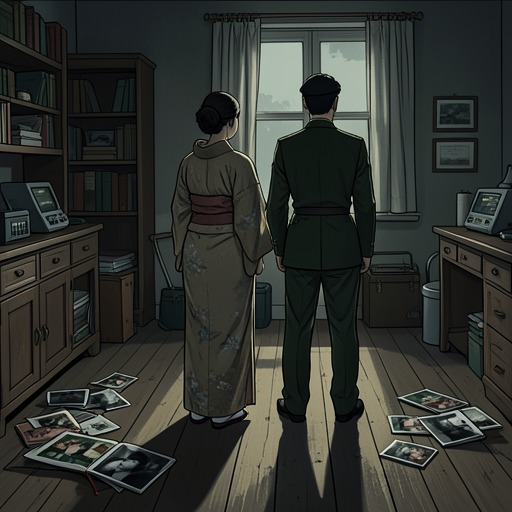
Teiji went to a little-known venue to see a one-woman show. Sachi, then a student actress, appeared alone onstage in a brown military uniform. Teiji photographed her once from the back of the audience, struck by the contrast between her young, soft-looking face and the aggression of her performance. Afterward, he waited by the stage door and looked at her through his camera. Sachi smiled when she saw him. She wanted to be photographed by newspapers and magazines throughout Japan, so his picture seemed to her a beginning; they went to a nearby bar and stayed all night.
Intimacy and Decline
Offstage, Sachi was sullen and unhappy, but she was glad to be with Teiji. He did not require her to perform or even to speak. His interest lay in her presence and in the image she left in his eyes, while Sachi trusted him and, as she grew weaker, came to need him. Their closeness developed alongside her theatrical work: Teiji visited performances and rehearsals between shifts, and photographed her in varied roles and costumes, including as a princess, a secretary, and a concubine. He attended less for the plots than for Sachi herself—her costume, voice, face, and gestures.
After performances, they met outside the stage door or in nearby coffee shops and bars. Sachi chain-smoked; behind the cigarette haze she alternated between laughter and tears, sometimes coughing harshly. She did not care for the theater world, yet felt she belonged nowhere else. Parties became an especially destructive extension of that conflict. She drank too much, cried in bathrooms, struggled with small talk, and nevertheless felt compelled to remain among actors and actresses. Sometimes, after Teiji took her home, she called a taxi and returned to a party she had hated. Teiji thought she wanted to destroy herself, but he could not rescue her from the gatherings she was drawn back to.
Her capacity to work diminished. Sachi stopped attending rehearsals and getting up during the day; soon directors no longer wanted to cast her. The relationship’s surrounding record is therefore not simply a sequence of theatrical portraits: it shows the narrowing of a life that had once been organized around the stage. The photographs trace a movement from performance toward parties, exhaustion, and withdrawal, though they do not explain all that happened between Sachi and Teiji or establish precisely when their relationship ended.
The Photographs and Lucy’s Reconstruction
Lucy encounters Sachi indirectly when she enters Teiji’s apartment using a spare key and searches through his photographs. She passes over the childhood pictures and the images from his first days in Tokyo, looking instead for the years before he met Lucy. Among photographs of water, pavements, stations, and tunnels, she finds Sachi looking through a bus window: a young woman with a chin-length bob, tired eyes, and an angry expression. The image prompts Lucy to wonder whether Sachi had been Teiji’s lover before her.
Following the photographs backward, Lucy finds Sachi’s first image in the collection: the distant figure onstage in the military uniform, mouth open in a silent shout. She then follows the sequence forward. There are more theaters and different costumes, but also coffee shops, parks, a riverside, parties, worn tatami, and a bed. Sachi becomes less often an actress in the pictures and more often a partygoer. Her face appears fuller and paler; her clothes are crumpled and stained, and her expression grows increasingly unhappy. In the last image Lucy sees, Sachi lies face-down on the pavement, her head turned to one side and the corners of her mouth raised in an expression that might be a grimace or a smile. Lucy cannot tell whether she is drunk, asleep, or in some other condition.
Teiji returns while Lucy is looking through the private collection and finds her with the open box. When Lucy asks who the woman is, he identifies her as Sachi. He says he does not know where she is: she is gone. He explains that their relationship ended, that Sachi left, and that he did not try to find her. He tells Lucy that he found her and no longer thinks of Sachi. His account closes the immediate question of their separation but does not resolve the mystery of Sachi’s later life or the meaning of the last photograph.
Lucy’s Fear of Replacement
The photographs become a structure through which Lucy measures her own place in Teiji’s life. She understands the archive spatially: Sachi occupies its middle, while Lucy’s pictures are at the top. Lucy tells herself that her position is better, even the best, and denies being jealous in the simple sense of believing Teiji still loves Sachi. Yet she cannot stop thinking about her. What frightens Lucy is not only that Sachi preceded her, but that a new layer of photographs could one day displace her, sending her into the same apparent darkness and nothingness.
Lucy begins inventing stories about Sachi and soon imagines her as someone she has always known, almost a sister. This imagined kinship gives emotional shape to an absence that Teiji does not fill with further explanation. At the same time, Lucy recognizes the limits of her own account: she never asks Teiji about Sachi again, and she admits that the picture of Sachi on the pavement could mean several different things. The archive provides a visible sequence, but not a reliable biography or a confirmed fate.
Later, after Lucy feels abandoned by Teiji and Lily, she walks through Tokyo overnight and thinks again of Sachi. Passing through Shinjuku, near the place where she first saw Teiji, she wonders how little time may have separated Sachi’s departure from her own arrival. She imagines that Teiji might have moved from Sachi to Lucy and then from Lucy to Lily, as if they were successive stations on one track. This is Lucy’s conjecture, not a fact established by Teiji. Its force comes from the route itself: as she walks, the earlier relationship becomes a pattern through which she interprets her own loss.
Narrative Significance
Sachi’s relationship with Teiji is presented through a deliberate gap between what can be seen and what can be known. Photographs record costumes, places, changing appearances, and a final ambiguous pose, while leaving motives, precise chronology, and Sachi’s fate unresolved. Teiji’s concise account confirms that the relationship ended and that he did not search for her; Lucy’s elaborate reconstruction supplies possible connective stories, then openly marks some of them as inventions.
That gap makes Sachi important to Lucy less as a rival than as a precedent. Teiji’s assertion that he found Lucy and does not think of Sachi offers reassurance, but it also sharpens the possibility that affection can be followed by erasure. The archive’s layers turn the fear into a concrete image: one person’s photographs lie beneath another’s, and the person no longer present risks becoming only a trace. When Lucy later places Sachi, herself, and Lily along a line of stations, the relationship’s unresolved past joins the novel’s recurring movement through Tokyo. Sachi remains both a former partner and an unanswered question—the absent figure through whom Lucy tries to understand whether anyone can be secure in Teiji’s attention.