The taboo against the unlucky northwest
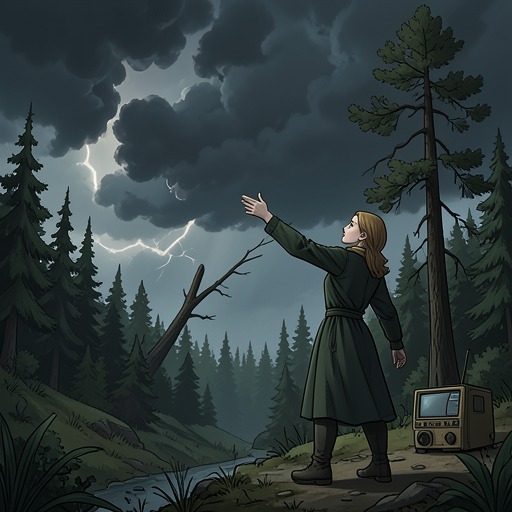
The Earthquake BirdThe taboo against the unlucky northwest is a directional belief that turns geography into a language of danger in The Earthquake Bird. Sado Island can be deemed unlucky from more than one orientation, but for Lucy Fly the northwest has a particular pull: she does not simply fear misfortune there; she recognizes herself in its supposed affinity with malevolence. The belief shapes how she imagines travel, place, and her own vulnerability, without the novel establishing it as an objective cause of events.
The Island and Its Bad Directions
Sado Island is described as lying in the unlucky northeast or the unlucky northwest, depending on the observer’s position. The historical explanation Lucy recalls is centered on Kyoto: when it was the capital, places northeast of the city were thought capable of bringing bad luck, and Sado fell within that dangerous region. The island’s misfortune is thus not a fixed property in the landscape so much as a judgment produced by where the observer stands and which direction is being measured.
The belief has left a visible mark on the island. Sado is fortified against bad spirits by numerous temples, making protection against misfortune part of its cultural landscape. Mrs. Katoh, who left her husband and son on the island to seek good luck in Tokyo, gives the directional idea a human history: the journey away from Sado is also a search for a different fortune. Lucy speculates that Mrs. Katoh’s relentless giggle might itself serve as a defense against badness, though she cannot know whether it began with her arrival in Tokyo or with her discovery of Mrs. Yamamoto’s house, its wisteria, and the music inside.
Lucy’s Identification with Misfortune
For Lucy, the relevant orientation is the one seen from Tokyo. Sado lies to the northwest, a direction she regards as particularly unlucky for herself. Rather than treating the warning as a reason to stay away, she finds that its danger draws her toward the island. Her response differs from Mrs. Katoh’s: where Mrs. Katoh left in search of good luck, Lucy is attracted to a place associated with the bad luck she believes belongs to her.
Lucy connects this feeling to Kinkakuji and its tragic monk, Mizoguchi. A fortune-teller warns him not to travel northwest because it will bring bad luck, but he goes in that direction. Lucy identifies with the figure’s relation to the warning, describing herself as unable to stop thinking that she is somehow connected to a place prone to malevolence. The literary parallel does not prove that the taboo predicts what will happen to her; it gives shape to her sense that misfortune is not merely something to avoid but something to which she may already belong.
Travel into the Northwest
Lucy’s trip to Sado begins at Tokyo Station, where Lily Bridges waits with her to take the shinkansen to Niigata and then a ferry to the island. Lucy has told Teiji about the plan but does not expect him to come. In her imagining, he has spent his life learning Tokyo through solitary nights and photography, following its streets, bridges, and rivers outward without reaching an end. Leaving the city for its physical edge would, she thinks, contradict the way he understands it. Her expectation that he will stay behind is also bound up with her belief that she is too strange to be wanted.
The northwest acquires a bodily immediacy when Lucy swims at night in the Sea of Japan. She guesses that she is swimming northwest from the island and imagines the water carrying her toward Vladivostok or Nakhodka, then farther north toward the freezing Sea of Okhotsk. She turns south instead, thinking of South Korea, Shanghai, and the warmer East China Sea. The imagined route makes the taboo an inner compass: the northwest offers a destination associated with danger, while the cold water supplies an immediate physical limit. Lucy feels both close to death and intensely alive, but later cannot recover that exhilaration through memory. The episode links directional fantasy to the novel’s larger uncertainty about whether remembered experience can be made present again.
Recurrence and Narrative Significance
The northwest returns not only as a route on a map but as a pattern through which Lucy reads places and relationships. During her all-night walk around Tokyo, she remembers the handkerchief and ice cream exchanged between Lily and Teiji and their leaving her on the cliffs. As she reaches the northwestern part of the city, including Takadanobaba and Shin-Okubo, she recognizes the direction’s significance within her own map of loss. Earlier, she had described walking from one Yamanote Line station to another as a way of moving through the city; on this night, the circular route brings familiar places and painful memories into the same circuit.
The taboo remains a belief Lucy interprets rather than a rule whose supernatural force is confirmed. Its importance lies in how it organizes anticipation: Sado is at once a real destination, a culturally marked island, and a place onto which Lucy projects her sense of affinity with misfortune. By setting Mrs. Katoh’s departure in search of luck against Lucy’s attraction to the unlucky direction, the novel makes geography express contrasting responses to vulnerability—escape from bad fortune on one hand, and an almost deliberate movement toward it on the other.