Tokyo
The Earthquake BirdTokyo is the city where Lucy Fly’s life with Teiji begins and where, after Lily’s disappearance and Teiji’s departure, familiar streets become a map of what she has lost. Its everyday geography—railway stations, office districts, parks, markets, and apartment windows—holds both the routines of her life and the memories that keep interrupting them.
Geography and Everyday Setting
Tokyo is presented through Lucy’s movement across it rather than through a single panoramic view. The city contains anonymous blocks of offices and homes alongside distinct local landmarks: railway arches, street markets, parks, shrines, graveyards, nightclubs, and love hotels. For Lucy, these features make a varied foreground against a recurring urban corridor of rectangular buildings and tracks.
Earthquakes are also part of the city’s ordinary conditions. On the morning of Lucy’s arrest, a tremor wakes her as coat hangers strike the wardrobe, kitchen plates rattle, and the floor creaks. She emphasizes that Tokyo has a quake about once a month, sometimes more often, and resists treating this one as an omen or as a sign connected to the police who later come for her. Yet since Lily’s death and Teiji’s disappearance, she has become fearful: she puts on a cycling helmet, retrieves a flashlight, and checks for her whistle and earthquake water before crouching in the wardrobe.
The city is also where Lucy’s work gives her a daily structure. When police arrive at her office, she is translating a technical document about a new bicycle pump. The work is tedious but familiar, and its concentration has helped take her mind off recent events. Tokyo is thus not only the charged landscape of remembered meetings and loss; it is also the place of routine she expects to return to, including the Shibuya office she later imagines revisiting.
Routes and First Encounter
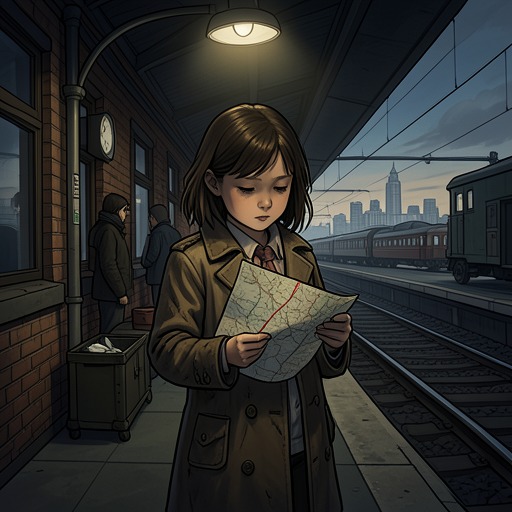
Before meeting Teiji, Lucy wanders Tokyo alone, often taking the Yamanote Line to a station and following the tracks to the next one or farther. She does not describe herself as lonely, but the encounter in Shinjuku changes the meaning of that solitude: when she sees Teiji absorbed in his surroundings, she cannot bear simply to walk on and be alone again.
The meeting takes place in the rain near the Keio Plaza Hotel, among the high buildings of Nishi-Shinjuku. Lucy dislikes the towers from street level, finding them dull and imposing, and refuses an umbrella because she considers umbrellas cumbersome and dangerous to passersby. Teiji, by contrast, is bent over a puddle with his camera, apparently studying what its surface reflects. Lucy approaches to see what has caught his attention; her shoes enter the water, and Teiji’s photograph includes her feet. The city’s wet pavement and reflected hotel form the setting for their first contact, while his act of looking through the camera makes observation part of their initial connection.
After they meet, Tokyo becomes a landscape the two explore together. They walk its streets and spend time at Teiji’s uncle’s noodle shop, where Lucy reads Japanese literature and practices kanji in a notebook while Teiji serves customers or takes out rubbish. They also spend weekends in bed, but their favorite outings are warm, rainy nights. Teiji teaches her Japanese words for different kinds of rainfall. In Lucy’s recollection, their time together is persistently colored by the rainy season, so the city’s weather becomes part of the remembered texture of their intimacy.
The Yamanote Line as Personal Map
The Yamanote Line gives Lucy a practical route through Tokyo and, later, a way to organize memory. Its twenty-eight stations form a ring that she understands as a necklace of distinct places. During her later walk, each station brings a different part of her life into view. At Shinbashi she remembers waiting for Natsuko before they went to Odaiba, where they rode a capsule on the Ferris wheel and looked toward Rainbow Bridge, Tokyo Tower, the industrial plants, and the gray sea. At Yurakucho, the soot-dark railway arches recall dinners with Bob, who asked her advice about his life and told her of his hope to become a rock star.
Other stations call up less personal but equally specific scenes. Tokyo Station passes quickly in a confusion of converging lines before Lucy identifies the route toward Kanda. Akihabara recalls looking at cameras with Teiji, though he never bought one; Ameyoko recalls shopping with Natsuko for inexpensive food. At Ueno, Lucy remembers encountering a crowd so dense during cherry-blossom viewing that she could hardly see the treetops. Near Yanaka, the cemetery recalls a visit before she went to Mrs. Yamamoto’s house. The railway route therefore links ordinary errands and social encounters with places shadowed by death and loss.
The Circumnavigation
On the fourth day after she has stopped speaking to Lily and Teiji, Lily’s repeated calls continue through the morning. Lucy cannot bring herself to disconnect the phone, but eventually leaves the apartment because its ringing has become unbearable. Starting from Gotanda, she walks counterclockwise toward Osaki and continues from station to station. Movement helps her thoughts move faster, making them less clear and less able to wound her as sharply; the walk is at once a response to the phone and an attempt to outpace what it recalls.
As the route lengthens, the city’s landmarks accumulate into a record of Lucy’s attachments. She passes Akihabara, Ameyoko, Ueno, Yanaka, Komagome, and Ikebukuro, and continues toward the territory associated with Teiji. At Shinjuku, she returns in memory to the place where they first met and thinks of Sachi, whose photographs she had once found among Teiji’s belongings. She wonders whether Teiji moved from Sachi to her and then to Lily as if they were successive stations on a line. This is Lucy’s conjecture, not an established account of Teiji’s relationships; the walk gives the suspicion a geographic shape without resolving it.
Near Yoyogi Park, Lucy hears again the song she, Lily, and Teiji sang together. She cries as she passes, then reaches her office in Shibuya, a place she can still imagine feeling at home without either of them. By morning she has walked the distance of a marathon and completed the circuit of Tokyo, ending where she began in Gotanda. Back in her flat, she ignores the still-ringing phone and sits in a hot bath with water up to her neck. The return closes the physical loop but does not settle the losses: Tokyo has brought her back to her starting point while making visible how many histories that point contains.