Tokyo as a Circle
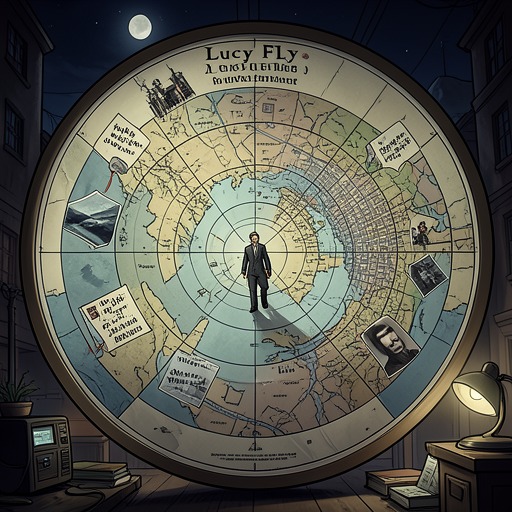
The Earthquake BirdTokyo as a Circle turns the Yamanote Line into more than an urban landmark: it is a map of Lucy Fly’s attachments, losses, and repeated returns. The loop joins the city she knows intimately to the feeling that her life is going nowhere. Its stations hold distinct memories, but the route brings her back to where she started, making circular movement at once a way to remember and an image of confinement.
The City as a Route
Tokyo first becomes legible to Lucy Fly through wandering rather than a planned itinerary. She rides the Yamanote Line to a station, then walks beside the tracks to the next one or farther. The method takes her to Shinjuku on the rainy night she meets Teiji: after the string quartet at Mrs. Yamamoto’s has disbanded, Sunday evenings leave her without her accustomed activity, and she finds herself at the Keio Plaza Hotel, where Teiji photographs a puddle. Lucy Fly does not think of herself as lonely, but seeing him makes it impossible to keep walking alone. The route thus begins to connect the city’s physical paths with an unexpected attachment.
Teiji’s own conception of Tokyo extends this pattern. Having arrived from outside the city at fourteen to meet Soutaro, he comes to understand Tokyo as an apparently limitless form: its streets, bridges, and rivers lead outward in a spiral without a visible end. For him, traveling beyond the city by train would expose a boundary where this continuous world stops. Lucy Fly’s later walk gives that open-ended urban image a counterform. The loop has no outer limit to discover; it returns her to familiar ground.
Stations as Personal Memory
Lucy Fly describes the twenty-eight stations around the Yamanote Line as beads in a necklace, each one a distinct gem. The metaphor holds two ideas together: the stations belong to one continuous circuit, yet every part of the circuit carries its own associations. When she walks through Shinbashi, she recalls going with Natsuko to Odaiba, where they rode in a small rotating capsule on a Ferris wheel and looked out toward Rainbow Bridge, Tokyo Tower, industrial plants, and the gray sea. At Yurakucho, the sooty railway arches recall dinners with Bob, who asked for advice about his life and talked of becoming a rock star at forty-one.
Other stations retrieve less intimate but equally particular episodes. Tokyo Station’s many converging lines briefly seem indistinguishable to Lucy Fly; when the tracks separate, she follows her feeling and finds the Yamanote route again at Kanda. Akihabara recalls looking at cameras with Teiji, though he never bought one. At Ameyoko she remembers shopping for inexpensive food with Natsuko, and at Ueno, the crowded cherry-blossom viewing of her first year in Japan. Yanaka brings back the cemetery where she sat before going to Mrs. Yamamoto’s house. Seen at night from the railway, its tombstones become silhouettes on a hill. The circuit is therefore not an abstract diagram laid over Tokyo: it is a sequence of places that makes Lucy Fly’s past present as she moves through it.
Walking the Loop After Betrayal
The most sustained realization of the circular motif comes after Lucy Fly has decided not to speak to Lily or Teiji again. Lily’s repeated calls keep sounding in her apartment, and Lucy Fly leaves without choosing a destination. From Gotanda she walks counterclockwise toward Osaki, then continues from station to station. She remembers the handkerchief and ice cream Lily and Teiji exchanged and their abandonment of her on the cliffs. Movement does not erase these memories; she keeps walking because, while she is in motion, her thoughts move faster and become less clear, less able to inflict fresh wounds.
As the night advances, the city’s range of remembered places widens. She passes the dark shrine at Komagome, Ikebukuro, and the territory associated with Teiji; Takadanobaba and Shin-Okubo lie in Tokyo’s northwest. Familiarity makes each arrival resemble a homecoming, even though Lucy Fly is not returning to a single home or person. The route brings her back to Shinjuku, close to where she first saw Teiji, and prompts her to think of Sachi. She wonders whether Teiji moved from Sachi to her and then to Lily as if the three women were stations on the same track. The metaphor turns the railway’s succession of stops into a troubling possibility: that intimacy, too, might repeat without offering a secure destination.
Return and Significance
Near Yoyogi Park, Lucy Fly hears Ue o Muite Arukou again, the song she sang with Lily and Teiji. She cries without lifting her head to stop the tears. She then passes her office in Shibuya, a place she can still imagine feeling at home without either of them, and continues as morning comes. From Ebisu she reaches Meguro and, finally, Gotanda. She has walked the distance of a marathon and circled Tokyo. The scale of the effort contrasts with the exactness of the return: after crossing the city on foot, she is back at her starting station, with her loss unresolved.
The loop also gives form to Lucy Fly’s later account of her situation. When someone advises her to return to Britain, she says she has nowhere to be and is going around in circles in Tokyo; the people there feel like ghosts, and Britain is not home. The line makes literal movement and emotional stasis difficult to separate. Tokyo’s circuit has offered Lucy Fly a way to inhabit her memories, recognize the city as the place where her life has accumulated, and keep moving through a night she cannot endure indoors. Yet it cannot by itself turn return into escape. The circle is at once a map of belonging and the shape of her impasse.