Yorkshire
The Earthquake BirdYorkshire is Lucy Fly’s home region, but in her account it is less a settled source of belonging than the place from which distance becomes a purpose. Its small-town constraints, an eroding coast, and the regional identity she resists all shape her decision to leave; later, Lily Bridges’s connection to the same part of England makes that attempted separation unexpectedly intimate.
Home Region and Local Identity
Lucy describes Yorkshire as her part of the world while insisting that she cannot stand East Yorkshire people. The contradiction is pointed: she claims the county as home and rejects the people associated with it. When Bob notes that Yorkshire is her own region, Lucy treats that fact as precisely why her dislike makes sense. Local belonging, in her telling, is not uncomplicated affection but something she can define herself against.
Her response to the coast gives that resistance a physical image. Asked whether she likes the area, Lucy identifies erosion as its appeal: the land is falling into the sea, she says, losing a foot or two each year. She imagines the pieces drowning or swimming south to become part of East Anglia. The coast is not presented as a picturesque refuge. It is a boundary continually breaking down, and Lucy finds satisfaction in its disappearance. The image suits a character who wants distance from the place that formed her, even as she remains attentive to its particular landscape.
Childhood, Maps, and the Decision to Leave
Lucy’s early life in Yorkshire was marked by a narrow social world. At secondary school, Lizzie was her first and only friend, while Lucy considered herself strong and lonely without her. Lizzie repeatedly imagined or suffered illnesses, and Lucy shared in that suffering even while knowing that Lizzie could not have contracted every condition she named. Their friendship offered intimacy, but not the total separation from others that Lucy wanted.
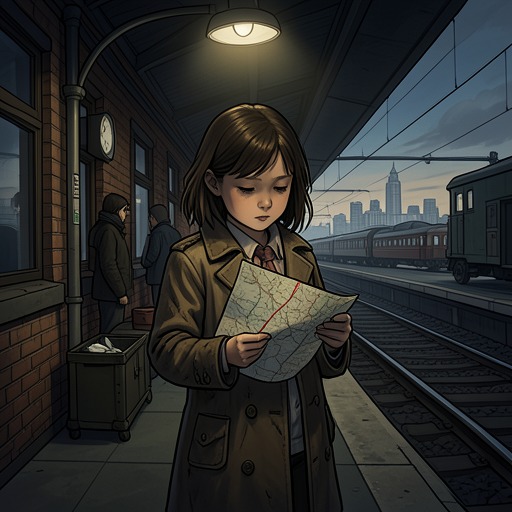
Maps offered another kind of escape. Lucy kept her family’s small collection of maps and atlases under her bed and studied countries by flashlight, concentrating on their geography and languages. At the British Museum, seeing the Rosetta Stone led her to think of language as a way beyond the limits of the world she knew. She wanted to learn a language no one around her could read or speak. The impulse linked curiosity to separation: another language might carry her beyond the familiar without requiring her to belong to it.
Lucy left Yorkshire for London to study Japanese. London appealed as the capital and as the opposite of the small town at England’s edge where she had endured her earlier life. She considered Chinese but was deterred by the number of characters she believed it required; Japan, meanwhile, lay farther from England and seemed nearly as distant as one could travel without turning back toward home. Australia did not count in the same way because English was spoken there. Her choice of Japan thus extended a wish to get as far away as possible, while her relief at leaving was shared by her family: there were no tears on either side. Most of her brothers had already left, and their absence had brought Lucy and Miriam Fly uncomfortably close. Yorkshire is the starting point for this chosen distance, not a place to which the narrative describes her returning.
Lily and the Return of Regional Ties
Yorkshire becomes socially present again when Lucy is asked to meet Lily, an English teacher from the same part of the county. Before they meet, Lucy imagines Lily as tall, pale, elegant, and beautiful, and envies her in advance. The real Lily is short and angular, with dyed auburn hair falling over one eye; Lucy finds her attractive but also comical, and smiles rather than maintaining her imagined rivalry.
That first impression does not erase Lucy’s prejudice. She tells Bob she will help Lily find an apartment but does not want to be burdened with her, invoking her dislike of East Yorkshire people. Later, when Lily explains that they come from the same place, Lucy tells Teiji that she and Lily are from the same part of the same county. Her jaw is tense as she says it. The shared regional origin is therefore both a point of recognition and a source of irritation: Lucy has crossed an ocean, yet encounters a person whose background overlaps with her own. The connection complicates her effort to make Japan a complete break from home.
Distance, Wandering, and the Meaning of Place
In Tokyo, Lucy’s movement is often solitary. After Mrs. Yamamoto’s death, she wanders the city and follows the Yamanote Line from one station to another; that practice takes her to Shinjuku, where she meets Teiji. She says she did not think of herself as lonely, but seeing him makes it unbearable to walk away and be alone again. Her life in Japan is thus shaped not only by distance from Yorkshire but by new attachments formed through movement and chance encounters.
After Lily and Teiji have deserted her on the cliffs, Lucy walks through the night from Gotanda and follows the railway around Tokyo. The route passes places associated with the life she has built there: the market where she shopped with Natsuko, the cemetery near Mrs. Yamamoto’s house, and the neighborhood where she first saw Teiji. By morning she has covered the distance of a marathon and circled the city, returning to where she began. The episode reverses the outward movement that took her from Yorkshire toward Japan. Leaving home promised a line leading away; the Tokyo walk instead makes movement circular, carrying Lucy through memories and back to her starting point. Yorkshire’s significance lies in that contrast: it is the distant origin of her escape, but the wish to escape does not prevent familiar ties, losses, and patterns from following her.