Hurdy-gurdy
The Edge of the WorldThe Hurdy-gurdy is a strange wooden instrument Ollie gives to Shay Maloney without initially naming it. Its significance unfolds through use rather than explanation: it draws the two closer through music, asks Shay to learn an unfamiliar instrument by touch and trial, and eventually becomes a concrete link to his Polish heritage. Its meaning changes when Ollie reveals that he found a photograph of Artur Nowack playing one in an old London newspaper.
Gift and withheld identity
Shay first examines the wooden instrument while holding it up to the light and asks what it is. Ollie, sitting on the floor below the stage, refuses to tell him or let him look it up. Instead, he asks Shay to keep it nearby for a while and find out whether it speaks to him. The gift thus begins as an invitation to encounter the object before receiving an explanation of it: its name and history are deliberately held back, while the possibility of a personal response is left open.
Shay finds Ollie’s behavior peculiar, but the gesture draws him closer. He kisses Ollie on the lips while lying on the stage, unconcerned about being seen. The instrument is present within a relationship already growing more intimate: they have shared a bed for four nights, their longest stretch so far, and Shay has kissed Ollie before. When Shay takes the instrument back to the band, Mara is the only person whose expression suggests recognition. Shay asks her not to identify it, treating the withheld name as part of something else between him and Ollie rather than a puzzle to be solved by someone else.
Form and first attempts
The instrument’s appearance helps explain why Shay cannot immediately approach it as a familiar instrument. It is about the size of a ukulele and has strings, but also a wind-up handle, accordion-like keys, decks, and tuning pegs. Its combination of recognizable parts and unfamiliar arrangement gives Shay no obvious starting point. He later brings it back from the bag where he has left it with his harmonica and penny whistle, placing the Hurdy-gurdy among instruments he already knows without making it simply another of those instruments.
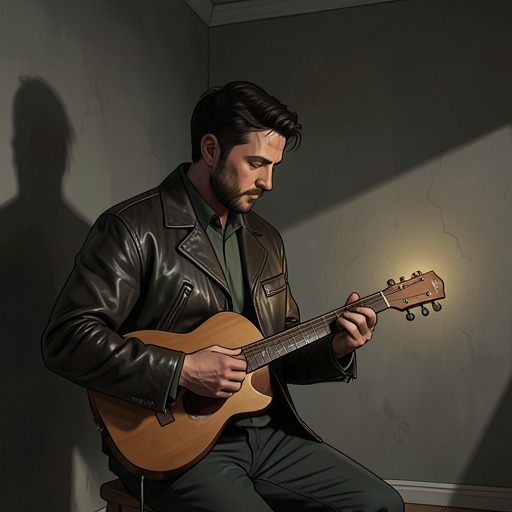
Shay asks Ollie to play guitar in exchange for trying the gift, but Ollie says he is poor at guitar and takes the Hurdy-gurdy instead. Though he has not wanted to tell Shay about it, Ollie handles the instrument with an ease that surprises Shay. He turns the handle at its base, producing a sustained bass note, then presses several keys to make a simple melody. The rotating handle and keys work together: their combination gives the music a more complex sound than Shay expects from the individual parts. Shay asks Ollie to continue, shifting from uncertainty about how to begin to concentrated attention on what the instrument can do.
Learning by ear
Ollie demonstrates the Hurdy-gurdy rather than explaining its name or construction. When Shay wonders whether the tune is a traditional song connected to his unknown origins, Ollie identifies it as Lucy in the Sky with Diamonds and says it is also almost the only thing he can play on guitar. The tune offers Shay a recognizable melody to follow, but the instrument remains unfamiliar in his hands.
Shay turns the handle and listens for a sound he recognizes as Ollie’s; when Ollie speaks again, Shay barely registers the words. After Ollie leaves the room, Shay retraces the movement of Ollie’s fingers, pressing the keys and working out the Beatles interpretation. He finds the rest of the melody but loses the bass line, then returns to the beginning, understanding that learning the instrument will take time. The scene makes practice an act of careful attention: the melody can be recovered, but its distinctive accompaniment depends on coordinating with the handle as well as the keys.
Polish history and later use
The Hurdy-gurdy’s identity is finally disclosed when Shay asks Ollie what the Polish instrument is called. Ollie names it and explains that he found a photograph in an old London newspaper of Artur Nowack playing one. He offers to show Shay the photograph, and Shay welcomes the prospect. The object’s delayed identification now brings together its musical strangeness and a specific historical trace: a newspaper image of Artur playing the same kind of instrument. Ollie’s initial refusal to supply the answer had allowed Shay to encounter it first as a sound and a challenge; the photograph adds an origin to that experience.
Six months later, Shay is sitting in the garden with the Polish Hurdy-gurdy. He has mastered it quickly now that he knows what it is and where it comes from, although he seems to be writing or staring into space more than playing it. He considers using Rudzio Maloney as a performer’s name, distinguishing the appeal of a Polish name as a stage moniker from a desire to use it more generally. The instrument consequently remains present at the intersection of music and heritage: it is something Shay has learned to play, and a material reminder of a history that Ollie has helped him uncover.