Lucy in the Sky with Diamonds
The Edge of the WorldLucy in the Sky with Diamonds enters the story not as a named song but as a melody Shay must learn to recognize by listening, watching, and trying it for himself. Ollie’s simple performance on an unnamed instrument reveals the tune’s identity; Shay then reconstructs it on the keys, finding most of the melody but losing the bass line. The episode makes musical inheritance tangible as a practice: a sound is received, recognized, and worked through, rather than explained in advance.
The Historical Sound Behind the Name
The song’s meaning is prepared by Ollie’s account of Anna, a Lithuanian musician whose history gives Shay a new frame for hearing traditional music. Though she was a peasant rather than a noblewoman, Anna moved among Lithuanian nobility when young and, at eighteen, became principal lutist for the royal court. She played many instruments, as Shay does. Ollie can only speculate about how she acquired that breadth of skill: an uncle’s craft may have placed instruments within reach during her childhood.
Anna’s history then becomes a story of departures and gaps. She left the court, perhaps to marry, and disappears from the records for about ten years. Later accounts place her travelling through the countryside, playing many instruments in religious sects. She eventually broke from religion as well, wandered alone from village to village, and wrote poetry that Ollie has not found. The surviving details do not settle her life into a complete biography; they leave music as the thread connecting its scattered records.
Ollie plays Shay an unnamed recording attributed to Lithuanian students in the 1970s, who recorded music from parchments in the National Museum. Its deep string bass grows beneath layered female chanting. Shay had expected something simpler and rougher, but hears a delicate sound instead. Ollie connects that quality to Lithuania’s Christianisation in the 1300s and the influence of Gregorian chant on traditional music. He also notes the opera associated with the royal court, which Anna may have been escaping. The sound thus carries several histories at once: courtly music, religious influence, and a musician’s possible flight from both.
From Listening to Composition
The earlier recording becomes a point of reference when Ollie asks Shay whether a new song is new. Shay says that they have just made it up, though it did not feel new to him. Ollie recognizes a resemblance to the Lithuanian folk music he had played for Shay. Shay then understands where the tune came from: the connection had been bothering him for days. The scene links listening to creation without claiming that Shay deliberately copied a historical piece. The music returns in altered form, familiar in feeling before its source is consciously identified.
That exchange gives Lucy in the Sky with Diamonds a place in a wider pattern of musical transmission. The Lithuanian recording offers Shay an unfamiliar sound; the newly made song shows that a sound can persist as influence even when its listener cannot immediately name it. Recognition arrives after composition, not before it. The tune associated with Ollie’s instrument later makes this process more intimate and concrete: this time Shay can hear a melody, learn its shape, and discover its title through Ollie’s playing.
The Instrument and the Tune
Ollie’s instrument remains unnamed. Shay brings it back with his harmonica and penny whistle, asks what it is called, and is told that Ollie will not say, though he would like to hear Shay play it. Instead, Ollie demonstrates. He turns the handle at the base, producing a plaintive sound that settles into a sustained bass note, then presses keys to add a simple melody. The handle supplies the bass while the keys carry the tune, making the combined sound more complex than Shay expects.
Ollie admits that he knows only one tune on the instrument and will have to repeat it in a loop. Shay asks him to continue anyway. The music fills the living room, delicate yet firm in its effect on Shay, who leans closer until their heads bump. The repetition is part of the scene’s meaning: a limited repertoire does not make the performance emotionally slight. One melody, patiently played again, holds Shay’s attention and brings the two closer through shared listening.
When Shay asks whether the tune is a traditional song from his unknown place of origin, Ollie identifies it as Lucy in the Sky with Diamonds. He adds that it is also about all he can play on the guitar. The answer overturns Shay’s guess: the unfamiliar instrument had made the melody seem potentially ancestral, but its source is a song Ollie already knows in another musical setting. The unnamed instrument’s sound has obscured the tune’s identity, while Ollie’s disclosure connects the different performances through the player rather than through a claimed family tradition.
Recognition Through Practice
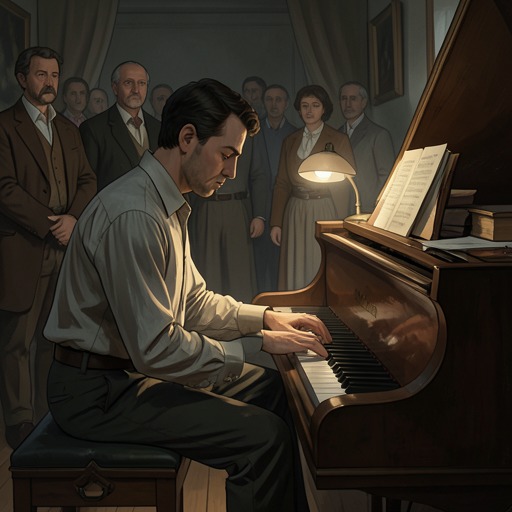
After Ollie names the song, Shay turns the handle himself. He recognizes the sound as Ollie’s, but does not catch the other words Ollie says. Ollie laughs, kisses the top of Shay’s head, and leaves the room; Shay stays with the instrument. Closing his eyes, he retraces where Ollie’s fingers had been and presses the keys. His attempt produces what the narration calls a strange Beatles interpretation: he finds the rest of the melody, but loses the bass line.
Shay starts again, knowing that learning the tune will take time. That unfinished effort is the expression’s final form in the scene. Lucy in the Sky with Diamonds is neither presented as a polished performance nor reduced to a title disclosed in conversation: it becomes something Shay begins to reproduce through touch and repetition. Ollie’s demonstration gives him a pattern, but not instant mastery. The tune’s movement from Ollie’s hands to Shay’s is therefore both musical and relational, a small act of attention in which recognition opens into practice.