Music as Identity and Communication
The Edge of the WorldMusic as Identity and Communication is a recurring idea in Shay Maloney’s life: it gives shape to feelings he cannot readily put into words, binds him to Smuggler’s Beat, and connects his own playing with the musical lives uncovered in his family history. The novel treats music not as a fixed inheritance or a finished repertoire, but as something learned, performed, adapted, and shared. Its meanings emerge in particular places and encounters, from Shay’s solitary preparation before a show to an improvised song that joins his present band to sounds from Lithuania.
Music as a Personal Practice
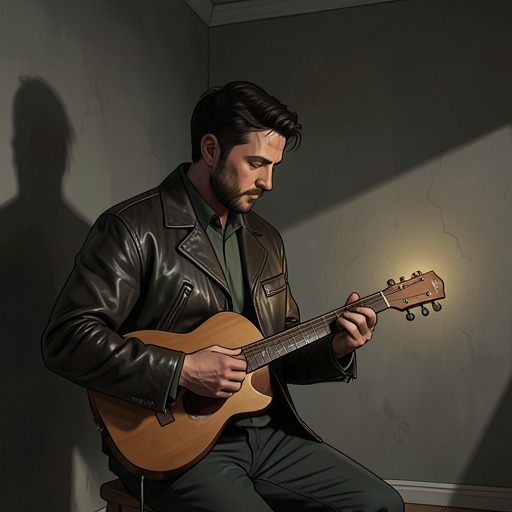
Before Smuggler’s Beat’s first Dublin show, Shay follows a private routine despite the long journey and the cramped, makeshift dressing room. He goes alone to explore the stage, then lies on it with his eyes closed and imagines the sold-out crowd’s response. The ritual makes performance a space where anticipation and self-doubt meet: the band has a loyal following, but its shanty-punk sound is an acquired taste, and a new city brings the possibility of failure as well as opportunity. Music matters to Shay not only as a public performance but as a way to prepare himself for that uncertainty.
The habit returns when the band reaches Cardiff for its largest venue yet. Shay is uneasy about whether Smuggler’s Beat can create the intimacy and energy he associates with smaller shows. After testing his blood, he returns to the deserted stage and lies down again; the familiar gesture steadies him even as his thoughts turn to Ollie and to the scale of the coming performance. The repeated staging of this ritual makes the stage both a workplace and a place of private reflection. Shay’s identity as a musician is grounded in the act of returning to music, even when the setting changes and confidence falters.
That identity is also collective. Shay recalls that Smuggler’s Beat’s first London show drew twenty-six people, with half the audience leaving before the set ended; three years later, the band is playing to a sold-out crowd of six thousand. The contrast helps explain why the later gig carries such weight for him. He describes the band as a pirate band from Derby, an unlikely act of belonging in a music industry that had not seemed to promise this scale of success. Music is therefore both the work by which the group makes its living and the shared history through which its members recognize how far they have travelled.
Inherited Sound and Musical History
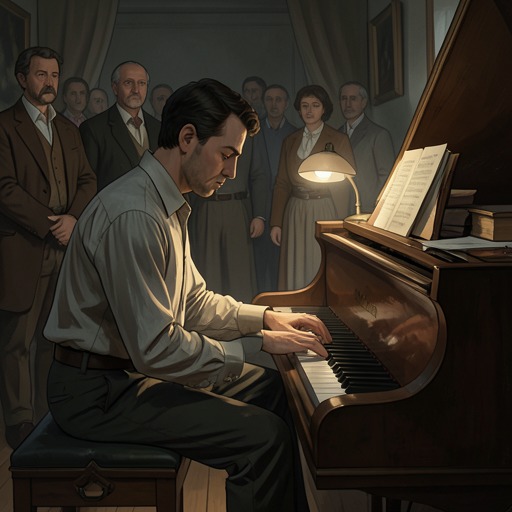
Ollie’s research introduces Shay to Anna, a musician whose history complicates the idea that family inheritance is simply biological. Anna had been an accomplished player of many instruments. At eighteen, she became principal lutist at the royal court, an unusual position for a peasant girl. Ollie has not established how she learned so many instruments; one possibility he considers is that she spent time with an uncle who made instruments for the nobility. The uncertainty matters: the account offers possible routes of learning rather than a complete explanation of Anna’s musical skill.
Her life does not remain within the court. After a gap of about ten years in the records, Ollie finds accounts of Anna travelling through the countryside and playing folk music in religious communities. She later left religion as well, travelled alone, played in villages, and wrote poetry that Ollie has not found. These changes place music within a life shaped by movement and independence, rather than tying it to one institution or setting. The scraps of documentation leave parts of Anna’s story unresolved, while still establishing a pattern of musical practice across markedly different contexts.
Ollie plays Shay a recording made by Lithuanian students in the 1970s from parchments held in the National Museum. It has no known title. Its deep strings and layered female voices surprise Shay, who had expected something rougher and simpler. Ollie explains that Lithuanian traditional music had been influenced by Gregorian chant after Christianisation in the thirteenth century, and that opera at the royal court may have been among the sounds Anna left behind. The recording is not presented as a recovered performance by Anna; it is a possible point of comparison that lets Shay hear how musical traditions can gather influences over time.
Ollie values Shay’s wonder at these discoveries because it shows him that Shay’s past includes people who lived for music and love. The encounter gives family history a practical, audible form: instead of remaining information in a book, it becomes something Shay can listen to and later bring into his own playing. That connection does not require the novel to claim that Shay’s music is a direct copy of Anna’s. It is a relation made through attention, listening, and creative response.
Improvisation and Communication
Smuggler’s Beat’s practice of never repeating the same show makes improvisation part of the band’s identity. At the second Belfast performance, Shay reaches the encore after playing his penny whistle and feels unable to settle for a familiar number. He refuses the cajon Larry offers and lifts a harmonica instead, not knowing what he will play until he begins. A melancholic melody takes shape as he performs it. In this scene, music communicates before Shay has lyrics: the instrument gives form to a feeling for which he has no spoken explanation.
The same movement from listening to making appears later in Southampton. Ollie watches the band from the back of the venue as Shay plays a tune on his penny whistle. Larry, Ben, and Mara gradually join him, and the piece develops into something with the character of a Smuggler’s Beat song, though its melodic line is carried by the whistle. Shay later recognizes the source of the sound in the Lithuanian folk music Ollie had played for him; the melody had been on his mind for days. The tradition has not simply been reproduced. It has been absorbed, altered, and made communal through the band’s response.
Ollie’s photographs offer another kind of listening. He follows Shay through the camera as the melody gathers other players, then studies the images afterward. Even a photograph that shows only Shay’s fingertips on the penny whistle feels recognizably his to Ollie. The still image cannot preserve the sound, but it makes visible a quality of Shay’s playing that Ollie experiences as distinctive. The camera thus records more than a concert: it gives Ollie a way to attend to Shay’s musical presence when direct speech does not express the depth of his attention.
That attention also leads Ollie to notice a tension between the band’s established material and the breadth of Shay’s musical self. Shay can play the crowd-pleasers and album tracks, but Ollie senses that they do not contain all of him. The Lithuanian-inflected improvisation offers a different mirror, one that brings the discoveries about Anna into contact with Shay’s present creative life. Music’s communicative force here depends on more than performance for an audience: it allows Ollie to recognize a part of Shay that the familiar songs may leave unheard.
Songs, Objects, and the Journey Home
The instruments gathered around Shay make this continuity tangible. After reuniting with Ollie, Shay retrieves a harmonica, a penny whistle, and an instrument Ollie has given him but whose name he still does not know. Ollie asks to hear him play it without identifying it. When Shay tests the handle, he recognizes Ollie’s musical voice in the sound. Ollie tells him that what he has played is Lucy in the Sky with Diamonds, a song he can also play on guitar. Shay follows the melody on the new instrument, finding more of it on the keys while losing the bass line. The exchange turns a gifted object into a small act of communication: the sound carries a familiar song and, for Shay, the presence of the person who chose the instrument.
The novel later gives music a broader shape through the construction of a set. Shay returns to the beginning and rebuilds the performance track by track, starting with the period when the band consisted of a flute and a drum kit. He adds layers until the final, forceful number combines every instrument the group has available. The sequence is described as colour and chaos, but it also traces the band’s development from its spare beginnings to its present sound. Shay writes that concluding song while looking toward Ollie, bringing their personal connection into the music without making it the only meaning of the performance.
Across these episodes, music joins private feeling, group identity, and historical curiosity without collapsing them into one thing. A rehearsed pre-show ritual and a spontaneous encore, Anna’s uncertainly documented musical life and Shay’s newly made melodies, a crowded concert and a photograph of moving fingers all show different ways sound can carry meaning. For Shay, music is not merely something inherited or performed; it is a continuing practice through which he discovers what belongs to him, communicates what speech cannot, and makes a shared history audible.