Music as emotional expression and inheritance
The Edge of the WorldMusic in Shay Maloney’s story is both a language for feelings that have not yet become words and a practice through which he can meet other people. It gives shape to grief connected with his family history, joins individual improvisation to collective performance, and offers an evocative link to Anna, a musician in his ancestral past. The connection is meaningful but not presented as proof that musical ability or a particular tradition passed directly through the family: what the story shows most clearly is music being heard, learned, remembered, and made anew.
Music Before Words
Shay describes his difficulty making sense of the family question until he has written a song about it. He apologizes to Ollie Pietruska for not knowing how to talk about what he feels, and calls that difficulty a reason he can seem strange. Ollie reassures him, but the exchange also establishes a recurring distinction: Shay’s emotions may be present before he can name them, while music gives him a way to approach them without first resolving them into explanation.
That process becomes audible at the sold-out second Belfast show. As Shay finishes on the penny whistle, a mournful melody persists in his mind, and the excitement of the concert gives way to a flat feeling. When the audience calls for an encore, he refuses the cajon Larry offers. Smuggler’s Beat does not repeat its shows, and Shay feels compelled to play something new, although he does not know what it will be until he lifts the harmonica.
The tune gathers a meaning as he plays. Shay uses the harmonica when he has a feeling but no words to sing; here, its single notes carry a grief he had not thought belonged to him. The melody seems to articulate both the emptiness he has not recognized and his guilt about wanting the missing parts of his heart. Music does not immediately explain the source or settle the feeling. Instead, it makes that previously unacknowledged absence perceptible, allowing the performance to begin where speech cannot.
Improvisation as Shared Practice
Shay’s solo does not remain solitary. When he falters, Ben reads the change in him and joins on violin, reshaping the tune with an Irish lilt that returns the crowd to the performance. Ben’s responsiveness matters both musically and relationally: he can sense what Shay needs onstage and, in this instance, acts as a lifeline without requiring Shay to state what is happening.
The other musicians build on that intervention. Larry finds a beat, Jumbo adds a bass line, and Mara joins on melodeon. The music develops through listening and adjustment rather than a plan Shay has set in advance. Its movement from a private, painful melody toward a full-band improvisation does not erase the grief that began it; the group makes room for the feeling while giving it a form that can also reach the audience. The crowd’s roar marks the performance’s public ending, while the scene preserves the more intimate process by which the band helped Shay carry it there.
This episode presents improvisation as a central practice of Smuggler’s Beat, not simply as a display of individual skill. Shay initiates an uncertain musical gesture; his bandmates wait close enough to follow, then answer it when needed. The resulting performance depends on an exchange between expression and attention. The band’s musical coordination is also a form of care: Ben notices Shay’s faltering, and the others join without demanding that he explain his grief first.
Anna’s Musical Past
Ollie’s research gives Shay a historical point of contact for thinking about music and family. He tells Shay that Anna was an accomplished musician who played many instruments, as Shay does. At eighteen, she became principal lutist for the Lithuanian royal court, an unusual position for a peasant girl. Ollie has not discovered how she learned so many instruments as a child. He suggests that an uncle, who may have made instruments for the nobility, could have exposed her to music and instruments, but presents this as a possibility, not an established explanation.
Anna’s surviving record is discontinuous. She left the royal court, possibly to marry, and the account then has a gap of about ten years. Later records place her travelling through the countryside and playing folk music in religious sects on many instruments. Ollie says that she eventually broke away from religion, travelled alone, played in villages she encountered, and wrote poetry that he has not found. Shay notices a pipe in the photographs; Ollie characterizes Anna as a rebel and free thinker. Her musical life therefore appears in fragments—court service, a documentary silence, religious settings, independent travel, and lost writing—rather than as a complete biography.
Ollie offers Shay an unnamed recording of music that might resemble what Anna played. He explains that Lithuanian students recorded it in the 1970s from parchments in the National Museum. The sound, which Shay finds delicate and haunting, differs from his expectation of something rougher or simpler: a deep stringed bass is joined by layered female chanting. Ollie connects the style cautiously to Lithuania’s Christianization in the 1300s and the influence of Gregorian chant on traditional music. He also notes that opera was common at the royal court, though it may have been what Anna left behind. These details do not establish the exact sound of Anna’s own performances; the recording is an informed, uncertain approximation that lets Shay listen toward a past the records cannot fully restore.
Influence, Memory, and Making
The possible connection to Anna becomes more than historical exposition when Shay later plays a new song. Ollie recognizes a resemblance to the Lithuanian folk music he had played for him. Shay understands the connection too: the sound has been bothering him for days, although he had not identified its source. The scene suggests musical influence working indirectly. Shay has heard the recording, and its qualities have stayed with him long enough to enter a new performance, but the song is still something he and his band have just made rather than a recovered piece attributed to Anna.
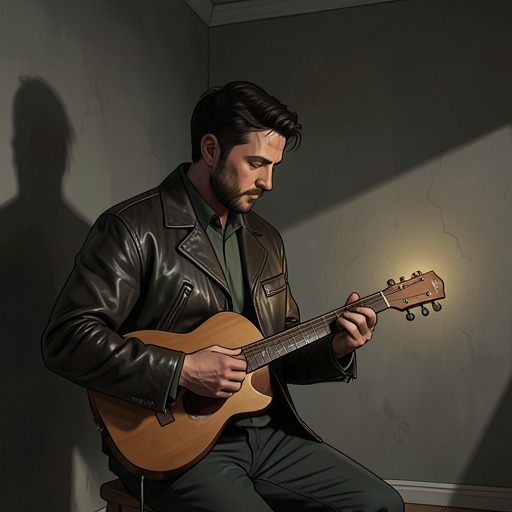
Another moment presents musical memory in a less deliberate form. After hours alone, Shay picks up a mandolin and strums without a clear intention. Ollie recognizes the chords as Country Girl by Primal Scream. Shay repeats them before realizing what he has been playing, then admits he had not noticed. The episode distinguishes conscious expression from music that emerges through habit or attention elsewhere: a familiar song can surface before Shay has identified it as memory.
Instruments and Intimacy
Music also shapes the quieter exchanges between Shay and Ollie. During a conversation about how much they know about one another, Shay says that he knows Ollie’s way of kissing but little else, while Ollie knows so much about Shay’s life. Before saying this, Shay has hummed a tune Ollie recognizes. Music thus accompanies a request for mutual knowledge: it is part of the language between them, but it cannot replace the personal disclosures Shay is asking Ollie to make.
After a later intimate encounter, Shay retrieves his bag, which contains his harmonica, penny whistle, and an instrument Ollie gave him. He brings the unnamed instrument back and asks what it is called. Ollie does not tell him, but says he would like to hear Shay play it. The exchange leaves the object’s name unresolved and turns attention instead to what Shay might make with it. When Shay turns its handle, he recognizes a sound as Ollie’s; Ollie identifies the tune as Lucy in the Sky with Diamonds, one of the few songs he can play on guitar. After Ollie leaves the room, Shay traces the keys beneath his fingers and works out more of the melody, though he loses the bass line. The instrument carries Ollie’s musical gesture into Shay’s hands, where recognition becomes an attempt to play. Across these episodes, inheritance remains less a matter of a proven, uninterrupted family tradition than of music passing between people, gathering associations, and acquiring new life in performance.