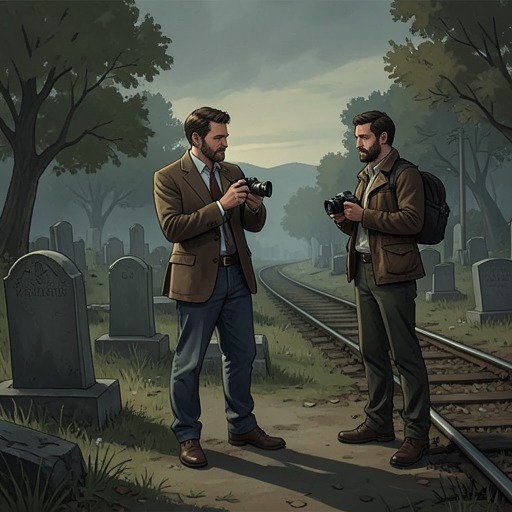
Ollie Pietruska
The Edge of the WorldOllie Pietruska enters the story as an outsider with a notebook, a camera, and an investigation that will alter his relationship with its subject. Hired to research Shay Maloney for a genealogy documentary, he joins Smuggler’s Beat on tour and discovers that the project is not simply a matter of filming the band: Shay does not initially understand that the research concerns his own biological history. Ollie’s conduct moves between the obligations of a documentary worker and the increasingly intimate responsibilities he accepts toward Shay.
Identity and Assignment
Ollie is a freelancer working on a documentary for Sky. At first he is identified through the project and its paperwork: Corina Hussain asks whether he is there to film the genealogy documentary with Shay, and he clarifies that he is freelance rather than an employee of Sky. He travels to Galway by train after abandoning his hire car, but the practical change does little to reassure him about spending a month on the Smuggler’s Beat tour bus. He has at least one professional consolation: he has already seen the band perform and considers them genuinely talented.
His preparation is substantial but uneven. Ollie has spent a month researching Shay’s family, and he knows what Shay’s grandfather, great-aunt, and a distant cousin look like. Yet he has never found a photograph of Shay himself. When the band takes the stage at a packed venue, the musician he has pursued through genealogical records becomes a living presence: Shay appears in tight jeans, worn boots, a leather fedora, and with a vintage guitar. Ollie’s startled admiration marks a shift from an abstract research subject to a person who affects him immediately.
The Documentary and Its Boundaries
The assignment is governed by a nondisclosure agreement between Shay and Sky. Corina explains that it prevents the researcher from reporting what he sees on tour, and that filming will happen as the band travels rather than in a single, controlled interview. The documentary therefore carries an explicit tension: it depends on access to Shay’s life, while the agreement sets a limit on what that access permits Ollie to disclose.
That tension becomes personal when Ollie explains the project. He lays a thick folder on the table and shows Shay a name he does not recognize. Ollie clarifies that he is not researching Shay’s adoptive family; he is researching Shay himself. The revelation leaves Shay shocked and confused, and Ollie feels guilty that he has given him almost no time to absorb it before Shay is called away. The scene establishes the documentary’s central imbalance: Ollie has spent weeks gathering information, while Shay has only moments to understand what the investigation means for him.
Ollie also distinguishes filming from recording everything that happens around it. Before a filmed conversation, he tells Shay that the preceding discussion will be edited out and explains when the camera will begin in earnest. Later, when Shay wants to hear a painful family story at a grave, Ollie offers to switch off the camera and go somewhere else, emphasizing that they can leave the setting or stop filming. These choices do not erase the unequal knowledge built into the project, but they show Ollie recognizing that access is not the same as permission to record every vulnerable moment.
Trust, Disclosure, and Intimacy
Ollie’s personal history surfaces in a quiet exchange with Shay. His hands are still trembling when he reaches for one of Shay’s hands and threads their fingers together. He then says, “I’ve never told anyone that.” When Shay asks why he shared it, Ollie answers that Shay had asked. The disclosure is therefore not presented as a prepared account for the documentary; it emerges in a private moment of physical closeness and tentative trust.
Ollie later tells Shay that he was a passenger in an Uber returning to London from Oxford after a meeting. The car overturned on the M1 and caught fire; the driver died, and Ollie suffered burns to his left side. He remembers little of the accident or what followed, but describes his body as retaining the memory. The account connects his visible tremor and his difficulty with travel to a specific past event without suggesting that telling the story resolves its effects. By entrusting Shay with what he has never told anyone, Ollie allows the person he is researching to become someone he relies on emotionally.
Their closeness is also evident in small, deliberate gestures. After kissing Shay, Ollie redirects Shay’s hands, and Shay rests his head on Ollie’s chest. It is in that quiet aftermath that Ollie begins speaking about the crash. Elsewhere, he reaches for Shay’s hand rather than filling a difficult silence with questions. His relationship with Shay thus develops not only through revelations about ancestry but through moments in which touch, restraint, and disclosure make room for trust.
Care During the Tour
Ollie’s attention to Shay’s diabetes becomes practical during the demands of touring. When Shay is struggling to focus, Ollie takes out the glucose monitor and asks whether they should test first or whether Shay needs medication or food immediately. The question is careful rather than authoritative: Ollie offers to help determine what is needed without pretending to know Shay’s body better than Shay does.
During a later episode, Shay accepts Ollie’s help with a glucose check. Ollie moves with the confidence of someone who has done it many times, although he has only tested Shay on a handful of occasions over the preceding weeks. The reading is extremely high, and Ollie admits that he has never seen it like that and does not know what to do. His care is therefore not framed as medical expertise; it is the act of staying present and responding to Shay while acknowledging the limits of his knowledge.
Afterward, Ollie continues to monitor how Shay is doing. When Shay’s levels begin to dip, Ollie tells him to eat and gives him a banana. The moment belongs to a wider pattern of care that also includes the tour’s ordinary logistical pressures: Shay has to keep his testing kit close, calculate insulin around food and soundcheck, and manage his condition while performing. Ollie’s assistance matters precisely because it is responsive to those routines rather than a replacement for Shay’s own knowledge and management.
Narrative Role and Significance
Ollie’s role changes as the documentary proceeds. He arrives with a professional purpose and a month’s worth of research, but the folder that explains the project also creates a rupture: the person whose story he has pursued must first be given the chance to understand that pursuit. His camera can record, but Ollie repeatedly faces decisions about when not to film, what to leave out, and whether to offer Shay a different place or a private moment instead.
The same movement from observation to participation shapes his connection with Shay. Ollie is at once the researcher who knows family details Shay has not yet encountered, the person who discloses his own traumatic history, and a companion who helps with the immediate work of managing a health crisis. These roles do not settle into a simple distinction between professional and personal. Instead, the story places their overlap under scrutiny: documentary access creates the conditions for revelation, while reciprocal care and attention begin to make the relationship more than an investigation.