Ollie decides to seek trauma therapy
The Edge of the WorldOllie’s decision to seek trauma therapy turns his recognition that he cannot manage alone into a concrete first step toward change. It follows his choice to separate from Shay’s tour temporarily, and it reshapes that departure: rather than simply waiting until he feels ready to resume his life, Ollie asks his family for help and begins addressing the crash that has continued to govern his responses to travel and fire.
The decision to change course
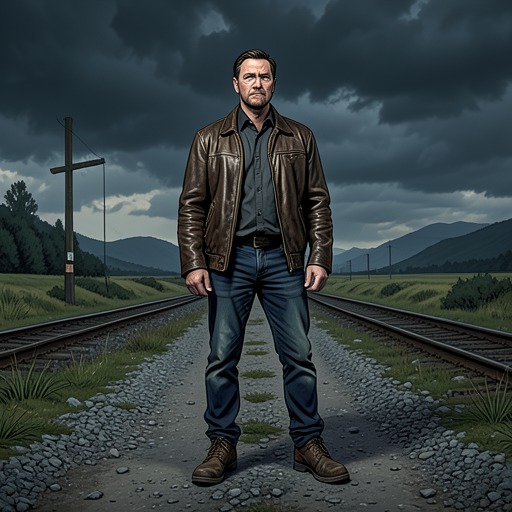
On a train with Shay, Ollie tells him that he will not return with the tour the next day. The separation is not evidence that his feelings for Shay have diminished. Ollie has been absorbed by the emotional intensity of their recent days together, but recognizes that he needs to work on himself and does not yet know how. The decision to step away from the tour creates room for that unresolved need to come into focus.
At home, Ollie watches footage in which Shay’s expressions change as Ollie has recounted his past. He reads curiosity becoming grief, and notices a frame of the two of them looking at each other. The footage gives shape to a realization: he is no longer the same person, and Shay has become someone he wants in his life, but Ollie fears he cannot offer him enough while he remains as he is. He had already left Shay with a plan to address his problems after catching up with work; now he decides he cannot keep postponing that work. The choice to seek help grows from the conflict between wanting a future with Shay and recognizing that desire alone will not resolve his own distress.
Asking his family for help
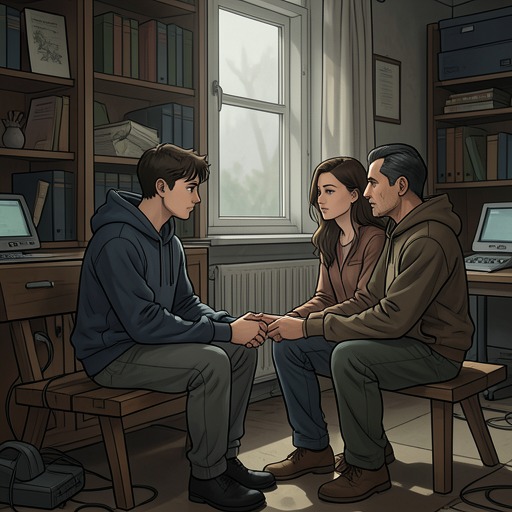
Rather than continue trying to solve the problem in isolation, Ollie messages the family group he rarely uses, asking his mother for help. At his childhood home, his parents, Jannah and Wit, sit close by without touching him. They have learned not to touch him since the accident, yet their presence offers support without requiring contact. In this scene, being helped begins with Ollie being able to remain present with them and speak plainly about the state he is in.
He tells them that he has met someone, and Jannah asks whether they can meet him. Ollie says he wants that, but not yet: first he needs to address what he feels unable to place on the person he has met. His admission is not a claim that the relationship itself is the problem; rather, he does not want to make Shay carry the consequences of distress Ollie has not begun to work through. When Wit asks what he is requesting, Ollie says he does not know exactly what he needs, but knows he cannot do it alone. That distinction marks a change in his approach: he cannot yet specify a solution, but he can ask for assistance in finding one.
Finding a form of treatment
Ollie declines Wit’s suggestion that he go to the place at Gubałówka to find himself. He says he does not want to go to Poland and that he is already there, with himself; what he needs is help. His refusal narrows the request from a symbolic journey toward a practical form of care. Jannah returns with a thick brown envelope of trauma counsellors. She and Wit have searched for suitable people, knowing that Ollie would need more than just anyone, and have kept the information ready in case he became willing to accept their help.
The envelope makes their support tangible, but Ollie still has to take it and allow his parents to see his uncertainty. His hands shake as he accepts it. He asks whether the counsellors are in London, repeating that he does not want to go to Poland; Jannah confirms that most are in London and offers to let him look through the options. The exchange establishes both a practical condition of his decision—treatment should be accessible in London—and a relational one: his parents had prepared for this possibility, but the decision to proceed remains his.
Beginning therapy and understanding the fear
After several days of therapist appointments and reflection, Ollie is ready to return to work. Shay remains on his mind: Ollie listens to the recording of the last London gig at his mother’s kitchen table, with images of Shay spread across the available surfaces. The scene places his continuing attachment alongside, rather than in place of, the work he has begun. In sleep, Shay’s flute accompanies him without becoming a source of torment, a small contrast to the way the crash’s effects have shaped his waking life.
In a message to Shay, Ollie reports that he has started therapy that week. He describes the arrangement as an hour a week, either in London or online when he is away. He also recounts a moment on a train to Leeds: a car has crashed near the tracks, and the train is held at a level crossing while the scene is cleared. He watches the fire for a long time instead of hiding, and regards that response as progress. The episode does not mean the fear has vanished; it shows him encountering a reminder of the crash without responding as he believes he would have a week earlier.
Therapy helps Ollie understand that his fear of cars, roads, and fire has served to protect him from reliving what happened. Recognizing that function makes the fear more intelligible, but it does not make change effortless. He finds it easier to accept that the crash happened than to unlearn years of unhealthy behaviours and thought patterns. His decision therefore does not close the work of recovery. It begins a sustained process, supported by his parents and pursued alongside his commitment to return to work and his hope of making a life with Shay.