Ollie leaves the band to seek trauma therapy
The Edge of the WorldOllie’s decision to leave the tour is not a rejection of Shay but a recognition that he cannot sustain their growing intimacy while avoiding the consequences of his past. He steps away from the shared life of the road, asks his parents for help, and begins trauma therapy; the departure becomes the first concrete action in an effort to live differently rather than simply keep himself safe from reminders of the crash.
The decision to leave
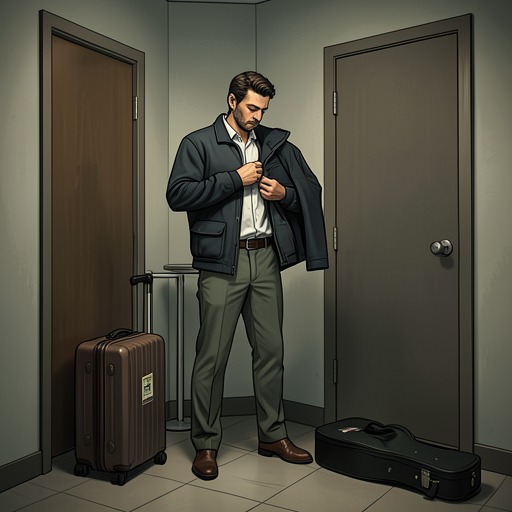
At the station, Ollie watches Shay move along the platform with an open fascination, while his own attention remains divided. Their recent days together have formed an emotional bubble that exhausts him, but he is not ready to let it go. He feels on the edge of the rest of his life and knows he must work harder on himself, though he cannot yet see how. When a train arrives and blows Shay’s hair from his face, Ollie envies the freedom he sees in him. On the carriage, he takes Shay’s hands and tells him that he will not return with him to the tour the next day.
The choice separates Ollie from the tour and from the person he wants to be near. It does not resolve what he feels for Shay. Rather, Ollie understands that wanting the relationship is not enough: he believes he must address his own difficulties before asking Shay to carry them. That distinction shapes the departure as an act of care as well as withdrawal, even though it leaves Ollie facing the work of change alone at first.
A promise, then a request for help
After the goodbyes, Ollie returns to the empty tour bus. The band is at rehearsal, and the bus feels like the right place to be despite his knowledge that it is no longer where he belongs. Sitting on Shay’s bed, he tears a page from a notebook, borrows a pencil from Shay’s stash, and writes the words he has already said aloud: “I am coming back”. He tucks the note beneath Shay’s pillow and leaves. The message gives his departure a limit: he is stepping away, not closing the possibility of returning.
Back at his flat, Ollie has work to catch up on. Driving the van, running the roadie crew, and spending his free time with Shay or thinking about him have left him far behind. He initially intends to follow a plan after catching up, but watching tour footage at home changes the urgency of that intention. He studies Shay’s expressions as he recounts his past, moving from curiosity to grief, and notices a frame in which they are looking at one another. The footage makes Ollie confront his own guardedness and his sense that he is not yet enough for Shay. He decides he is done waiting and reaches for his phone.
Ollie rarely participates in his family’s WhatsApp group, but this time he asks his mother for help. The directness of the request marks a change from privately recognizing that he needs to work on himself to allowing another person to assist him. It also interrupts the practical delay he had set for himself: work still matters, but it is no longer a reason to postpone seeking help.
His parents’ support and the choice of therapy
Ollie sits with his parents, Jannah and Wit, in the colourful living room of his childhood home. They sit on either side of him without touching; since the accident, they have learned to respect that boundary while remaining close enough for him to sense their presence. Ollie says that he has met someone. When Jannah asks whether they can meet him, Ollie says not yet. He wants that eventually, but first needs to address what he fears would be unfair to place on the other person.
He struggles to explain what he needs, telling his parents that he is badly affected and cannot handle it on his own. Wit asks whether he wants them to take him to the place at Gubałówka. Ollie refuses the idea of going up a mountain to find himself, insisting that he is already present and simply does not know what he needs. The exchange makes the immediate need plain: not a symbolic journey or a solitary solution, but practical help from people he trusts.
Jannah returns with a thick brown envelope of trauma counsellors. She and Wit have searched for suitable practitioners, knowing that Ollie could not work with just anybody and hoping he would one day accept their help. Ollie takes the envelope with shaking hands and allows his parents to see his reaction. He asks whether the counsellors are in London because he does not want to go to Poland. Jannah confirms that most are local. Accepting the list is a small but consequential reversal: his parents’ long-prepared support becomes usable only when he lets them witness his vulnerability and receive their help.
Beginning therapy and facing reminders
After days of appointments and reflection, Ollie is ready to return to work. Shay remains vivid in his attention: Ollie hears Shay’s flute in his sleep, but the sound no longer haunts him; it keeps him company. At Jannah’s kitchen table, he listens to a recording of the last London performance with Shay’s face spread across the available surfaces. These details show that leaving the tour has not made his attachment disappear. Instead, Ollie is trying to make room for work on himself without pretending that Shay no longer matters.
In a letter to Shay, Ollie describes being stopped on the train to Leeds after a car crashes near the tracks. The fire has gone out, but he has watched it burn. A week earlier, he says, he would have hidden under the table; now he recognizes this as progress. The incident brings together the reminders he has been trying to avoid—cars, roads, and fire—without turning the moment into a claim that his fear has vanished.
Ollie explains that he has started therapy that week, for an hour each week, either in London or online when he is away. He writes that he had held on to his fear as a way of protecting himself from reliving what happened, and that assuming he was simply afraid had been easier than accepting the experience behind it. Understanding this does not make recovery effortless: he distinguishes accepting what happened from unlearning years of unhealthy behaviour and thought patterns. Still, he believes he can do that work. His departure from the tour thus leads not to an instant cure or a completed return, but to a specific commitment—regular therapy, honest communication with Shay, and the difficult practice of facing what his avoidance had kept at a distance.