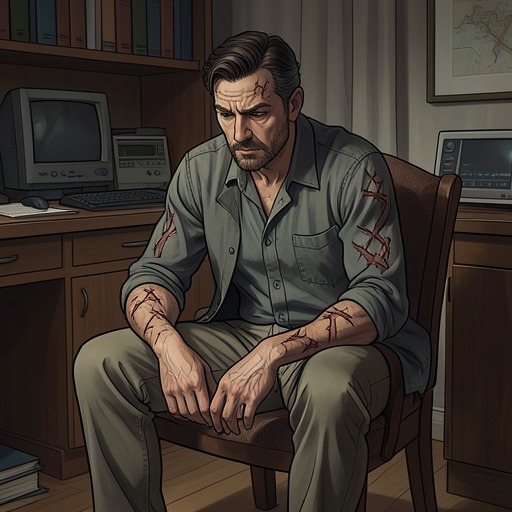
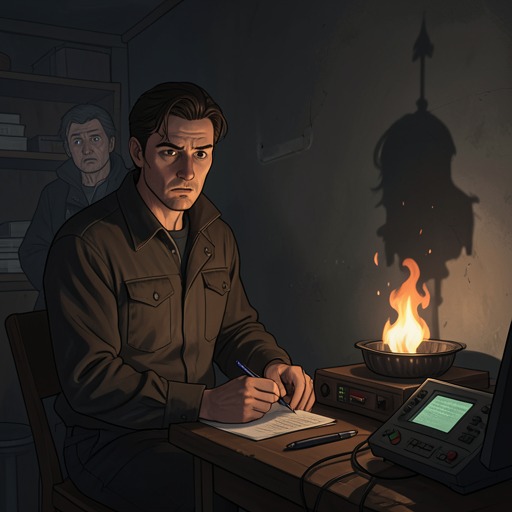
Ollie's car crash and burns
The Edge of the WorldOllie's car crash and burns matter not only as a past injury but as an experience whose effects arrive late, recur in sleep, and remain difficult to name. When Ollie finally describes what happened to Shay, he explains that he watched his arm burn without feeling pain; weeks passed before it began to hurt. The event’s significance lies in this split between what he witnessed and what his body registered, and in the long effort to understand why the experience continued to return.
The injury and its delayed pain
Ollie’s account gives few details of the crash itself, but makes the burn’s immediate aftermath stark: he watched his arm burn and felt nothing. The pain began weeks later. For a long time, that absence of sensation led him to think the experience had been a bad dream, although he eventually states plainly that it had hurt. The injury is therefore recalled not as a straightforward sequence of impact, pain, and recovery, but as an event whose bodily meaning was postponed.
Shay offers possible explanations for the delay, suggesting that adrenaline from the crash and other injuries could have suppressed pain at the time, and that painkillers in hospital might also have played a part. These are Shay’s hypotheses, not an established medical account of what happened. Ollie’s own emphasis is on the disorienting gap between the burn and the pain: it hurt, but not when he expected it to. He also says he felt bad about that delay. The distinction matters to the exchange: the absence of immediate pain did not mean the injury was unreal or insignificant to him.
Disclosure and resistance
The crash and burns surface in a conversation that begins with Ollie’s refusal to explain why he no longer plays guitar. Shay points out that he has seen Ollie at his worst many times and still does not know why the music stopped. Ollie initially deflects the question by saying he was never very good anyway. Shay insists that the issue is not the guitar itself. The conversation thus moves from an apparent question about music to the injury and its emotional aftermath, without making the guitar a sufficient explanation for either.
Ollie reacts to Shay’s insistence with dread that feels both new and familiar. He searches for anger to defend himself and keep Shay at a distance, then challenges the value of explaining what happened: disclosure, he argues, would not change who either of them was. His resistance is not evidence that the event does not matter. Rather, the exchange shows how speaking about it feels exposing, even with someone who has already seen him in vulnerable circumstances. Shay’s pressure makes the silence visible; Ollie’s defensive anger makes clear that telling the story is itself a struggle.
Pain returning as dreams and replays
Ollie says that the delayed pain haunted him, and that the experience began happening in his sleep. Sometimes these were bad dreams; at other times, he describes them as replays. He questions whether an experience that really happened can properly be called a dream. Shay supplies the word flashback and says it would probably be classed as PTSD. That is Shay’s interpretation, not a diagnosis confirmed by the conversation.
Ollie responds that he was tested for PTSD and did not have it. The exchange preserves a distinction between the name Shay proposes and the result Ollie reports: the injury returned in sleep, but an earlier assessment did not identify PTSD. The narrative does not resolve that difference by assigning a definitive diagnosis. Instead, it shows Ollie trying to make sense of recurring experiences that do not fit neatly into his earlier understanding of the event. His insistence that the crash was real, alongside his account of mistaking it for a dream, captures how delayed pain and repeated recollection have unsettled the boundaries between the original injury and its later return.
A later encounter and the start of therapy
In a later note addressed to Shay, Ollie describes being on a train to Leeds when a car crashes near the tracks. The train is held at a level crossing while the scene is cleared; by the time he writes, the fire is out. He has stared at the burning car for a long time. The sight links a present-day fire to the fears associated with his own crash, but this time he marks a change in his response: a week earlier, he believes he would have hidden under the table. He treats his ability to remain there and look as progress, while also recognizing that the fear has not simply vanished.
Ollie writes that he has started therapy that week. He describes it as an hour a week, either in London or online when he is away, and initially minimizes it before calling it everything. Through therapy, he has learned to understand his fear of cars, roads, and fires as a way of protecting himself from reliving what happened. It had been easier to think of himself as afraid of those things than to accept the event and its continuing effects. He says he did not believe that explanation at first, but now does, and feels better for knowing it.
His note distinguishes accepting that the crash happened from changing what followed. Acceptance, he says, is easy; unlearning years of unhealthy behavior and thought patterns is harder. He nevertheless believes he can do it. The later account does not erase the burn’s delayed pain or the replays Ollie described to Shay. Instead, the burning car near the railway tracks gives him a concrete measure of change: he can face a reminder that would recently have made him hide, and can begin to describe both the protection his avoidance offered and the cost of continuing it.