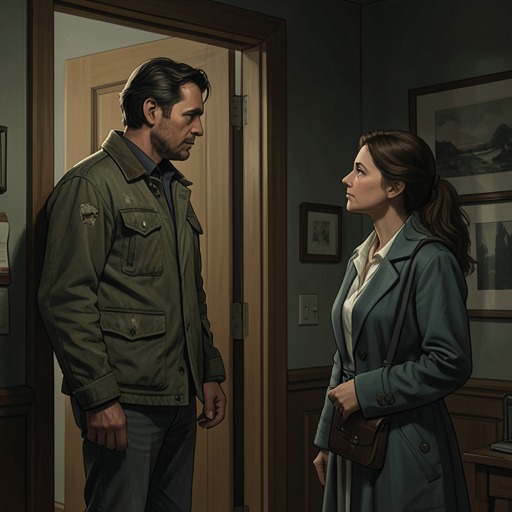
Ollie's flat in North London
The Edge of the WorldOllie's flat in North London is both a concrete home and a turning-point setting for his relationship with Shay. After Ollie drives them into north London, the flat becomes the place where their conflict can no longer be kept at a distance: Shay arrives exhausted and hurt, while Ollie’s familiar habits of evasion give way, for a moment, to an attempt at closeness. Later scenes in the home return to its rooms as a setting for touch, vulnerability, and desire.
Setting and Ownership
Ollie’s home occupies the end of a corridor on the twelfth floor of a nondescript block of flats. The arrival is practical rather than grand: he swings the van into a vacant parking space, retrieves a spare permit from his wallet, and places it on the dashboard before getting out. When Shay asks whether he owns the flat, Ollie confirms that he does. His description of it as not much but his makes ownership sound less like a display of status than an assertion of personal belonging.
The building’s ordinary thresholds give the arrival its shape. Ollie takes Shay by the arm and guides him through the revolving doors, then leads him to the lift. At the flat, he drops his bags to wrestle with the front door and ushers Shay inside. These actions make the home a destination reached through successive barriers, but Ollie is the one who knows the route and opens the way. The flat is modestly situated in an unremarkable building; its significance comes from being Ollie’s own place and from what the two men are able to face there.
Arrival and Care
The drive into north London follows a period in which Ollie recognizes that Shay’s uncertainty may have been shaped by Ollie’s unpredictable behavior. He considers apologizing again but concludes that words will not repair the damage; only what he does can make a difference, if repair is possible at all. On the journey, he keeps a close eye on Shay. Shay dozes, then seems to revive as they approach the block. His question about whether this is where Ollie lives turns arrival into a moment of discovery: the home is not merely a stop but a part of Ollie’s life that Shay is seeing directly.
Inside, Ollie turns on the lights and is relieved that the housekeeper has kept the flat presentable while he was away. He knows Shay likes things clean and tidy, and notices the contrast between that familiar preference and Shay’s present appearance: tousled hair, rumpled clothes, drooping eyes, and translucent skin. After a brief standoff, Ollie takes Shay’s bags and asks whether he wants to sit down. The attention to the bags and to Shay’s condition makes care visible through small practical gestures, even while Shay resists being approached. The flat thus holds both the strain between them and Ollie’s effort to respond to it without relying on another apology.
Conflict and Intimacy
The home does not immediately dissolve their conflict. Shay tells Ollie to stop when he tries to speak, then explains that he cannot manage the evasions Ollie produces whenever Shay asks the wrong question. Shay is hurt, but also worries that confronting Ollie may make Ollie’s life harder. Ollie answers with a kiss. The gesture silences Shay, but the narration distinguishes it from an attempt simply to shut him up: Shay’s words have begun to penetrate Ollie’s defenses, and Ollie’s sense of the relationship shifts.
Ollie then focuses on physical sensation, resting his head on Shay’s shoulder and counting Shay’s breaths. The attention to touch and breathing makes the scene turn away from argument without pretending the underlying hurt has disappeared. Ollie thinks, “I can do this.” In the flat, closeness is not presented as proof that everything has been fixed; it is a tentative action taken where Ollie can no longer substitute repeated apologies for change.
Scars, Return, and Significance
In another intimate scene at the flat, Shay reaches toward Ollie after a conversation about family and Ollie’s habit of keeping to himself. Ollie is still shirtless and damp from the shower. Shay lays a hand over his heart, feeling the web of scars running down from Ollie’s shoulder, then touches his unscarred hip and draws him closer. His question about whether the scars still hurt makes the body, rather than an explanation alone, the focus of attention.
The flat also frames a later return to physical intimacy. Ollie says that his pain is not so bad when Shay is around; Shay’s smile is sad. Ollie draws Shay’s hands away from his knees, laces their fingers together, and kisses him. The spark between them becomes a fire Ollie is not afraid of. When Shay abruptly pulls back and disappears, Ollie panics, but Shay returns almost immediately, bringing what is needed for the two of them to resume their encounter. The movement from alarm to renewed closeness gives the domestic space an emotional rhythm: vulnerability can provoke fear, but separation in the moment need not become abandonment.
Across these scenes, Ollie’s flat is distinguished less by architectural description than by the actions it accommodates. It is a home Ollie owns, maintained in his absence, and entered by Shay through a guarded but deliberate welcome. Its recurring details—an ordinary parking space, a permit, bags set down, a clean interior, and the scars beneath a shirt—anchor the relationship’s changes in lived space. The flat becomes a place where conflict remains present while care and intimacy become possible.