Shay Maloney
The Edge of the WorldShay Maloney’s story turns on the difference between discovering where he comes from and deciding who he is. A 23-year-old musician in Smuggler’s Beat, he begins with an assumed Irish heritage and a family history he does not know. Ollie’s genealogical research uncovers his Polish biological ancestry, but the revelation does not replace the family that raised him. By the epilogue, Shay can acknowledge both histories without treating either as the whole of his identity.
Identity and Introduction
Shay is introduced as the band’s frontman, on tour with Smuggler’s Beat, a self-described pirate band from Derby. The group’s rise from pub performances to major touring has outpaced his sense of what is happening: he reacts to the scale of it with disbelief, then turns to the practical matter of needing new boots. The exchange also establishes a persistent pressure around his public identity. Corina calls him a brat, a word that irritates him because he has outgrown the child-prodigy label he carried through school but has not escaped its sting.
His ancestry is initially framed through other people’s assumptions. Larry calls the Irish Shay’s people and describes the tour’s Dublin-to-Derby route as a way to bookend it with the leader’s heritage. Shay knows that this account is false: his name is a lie, and he has no Gaelic blood. The gap between the story attached to him and the history he actually knows makes the later research personal before he has learned any of its details.
The Genealogy Project and Its Stakes
Ollie’s research begins under a misunderstanding. Shay initially believes that the project concerns his adoptive family; Ollie eventually lays out the papers and clarifies that he is researching Shay himself. The distinction changes the project from a documentary about a family Shay already knows into an inquiry into his own origins. Ollie sees that the disclosure has shocked and confused him, and Shay has little time to respond before being called away.
Shay does not treat the discovery as uncomplicated entertainment. He has already argued with Corina because the studio wanted him in part because he was adopted, as though that made his history more compelling. Although he has signed the contract, he asks to delay the work until he can speak to his father; beginning without telling him would feel wrong. His request asserts a limit on how quickly other people may turn his adoption into material. Ollie offers to ask the producers to shift the subject to the adoptive family, but acknowledges that contracts and fees constrain his own choices as well.
As the research continues, Ollie introduces Shay to Rudolph Kaspersen, his great-great-great-grandfather. The project also reaches further back through the family’s musical history, particularly in the account of Anna. She was a gifted musician who played many instruments and, at eighteen, became principal lutist for the royal court despite being a peasant girl. Later records place her outside the court, playing folk music in religious communities; after leaving religion, she travelled alone, played in villages, and wrote poetry. The decade-long gap in the records leaves part of her life unresolved, rather than supplying a complete lineage for Shay to inherit.
Music as a Link to the Past
The account of Anna gives Shay a point of connection that is not merely a name on a family tree. Ollie tells him that she played many instruments, as he does, and shares a recording made by Lithuanian students in the 1970s from old parchments held at the National Museum. Shay expects something rougher and simpler; instead, he hears a delicate arrangement with deep strings and layered female voices. Ollie explains that Lithuanian traditional music was influenced by Christian chant and that opera was present around the royal court, while allowing that Anna may have rejected that courtly world.
The music later returns as a source for Shay’s own work. When Ollie hears a new song, Shay says it has just been made up, though it does not feel entirely new to him. Ollie recognizes a resemblance to the Lithuanian folk music he had shared, and Shay understands that this is the source of the melody that had been troubling him for days. The connection does not prove that Shay’s musical instincts are inherited directly from Anna; rather, it shows how research, listening, and performance let him make something present from material he had not known was part of his history.
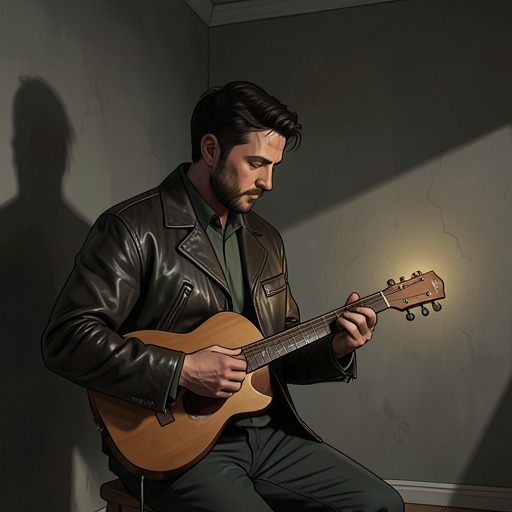
Music also remains a language between Shay and Ollie beyond the documentary. Ollie gives him an instrument whose name he withholds, and Shay later brings it back with his harmonica and penny whistle. When Ollie plays a version of The Beatles’ Lucy in the Sky with Diamonds on it, Shay recognizes the sound and experiments with the handle and keys, tracing Ollie’s playing and finding the rest of the melody. The scene places learning and shared attention alongside genealogy: the connection is made through what Ollie demonstrates and what Shay works out for himself.
Relationships and Care
The project brings Shay and Ollie into a relationship shaped by unequal knowledge. Ollie has access to the research and must decide how to disclose it; Shay is the person whose life the papers describe, but he cannot make their revelations arrive at a pace of his choosing. Ollie’s clarification about the project and his apology after seeing Shay’s distress register this imbalance. Shay, in turn, insists on telling his father before the inquiry proceeds, keeping the obligations of his existing family in view even as he begins to investigate his biological one.
Their connection also develops through practical care. During a moment when Shay feels unwell, Ollie supports him and asks whether he wants his blood sugar checked; Shay agrees. The exchange makes care part of their intimacy without turning it into a grand declaration. Later, after a private encounter, Shay kisses Ollie’s cheek and returns with his instruments. Six months after the tour, the documentary’s final image shows them seated together on a bench, heads bowed and hands clasped. Their closeness is presented through repeated acts of attention and presence, rather than through a claim that all of Shay’s uncertainties have been resolved.
Biological Family and Unanswered History
The research eventually gives Shay a concrete account of what happened after his biological mother, Francesca, died. Ollie has found school reports about her, including that she was an accomplished hockey player, but Shay postpones looking at them and asks instead where he was when the fire happened. An archived report contains no mention of a baby. Because Shay was adopted at two and had spent only six months in foster care, the report cannot explain the intervening period. His question exposes a gap in the archive, not a settled answer.
Ollie identifies Artur and Zofia Nowack as Shay’s grandparents and says they cared for him after Francesca’s death and fought to keep him. Social services did not allow them to retain him, probably for some reason connected to Rudek, though Ollie does not present that explanation as certain. Shay was taken from his grandparents and placed in foster care; as far as Ollie can tell, he never saw them again. When Shay asks whether they wanted him, Ollie answers that they did. This is a consequential discovery: the separation was not evidence that his biological grandparents had rejected him, even though the records cannot fill in every part of his early childhood.
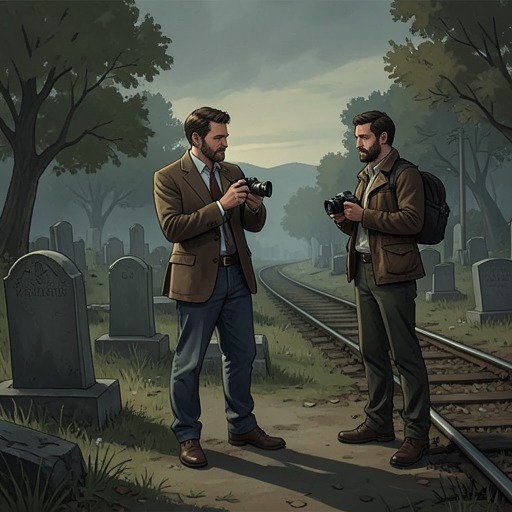
The family graves also give the revelation a place. Shay learns that his grandparents are buried near Ollie’s family home in Warsaw. Faced with the accumulated evidence, he asks whether he is Polish, and Ollie confirms that he is. The answer names a heritage and a home connected to his ancestors, but it does not erase the losses or uncertainties that brought him to the question.
Change and Continuing Identity
Six months later, Shay considers using Rudzio as a performer’s name. He likes the sound of Rudzio Maloney, but rejects Rudzio Nowack as a name that is not his to use. The distinction is deliberate: he can draw on a Polish name without claiming an identity that belongs to another branch of his history. He has also fast learned the Polish hurdy-gurdy, now understanding what the instrument is and where it comes from. The instrument’s meaning has shifted from an unnamed gift to a particular connection with his heritage, made real through practice.
Shay has spent time coming to terms with his family history but has not travelled far from the people who raised him. He remains a Maloney, and he chooses not to seek surviving members of his biological family for now. That qualification leaves the future open without making further reunion necessary for the present resolution. As Ollie finishes editing the genealogy documentary they filmed on tour, Shay prepares for another tour. His story closes not with a single recovered identity, but with a negotiated one: biological origins matter, adoptive family remains central, and music gives him a way to carry both without pretending that the record is complete.