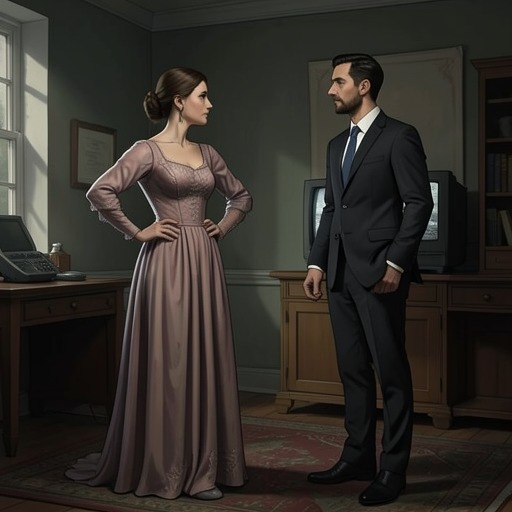
Shay and Francesca King
The Edge of the WorldShay and Francesca King are biological son and mother, but their relationship reaches Shay only after her death and through an investigation into his origins. The discovery gives his family history an immediate, personal loss: Francesca is not a distant ancestor in an archive, but a mother whose life ended while he was still an infant, leaving both an intimate connection and unanswered questions about what happened to him next.
Discovery Through Research
The relationship emerges through Ollie’s research project about Shay. When Ollie shows him a folder and explains that he is researching Shay rather than his adoptive family, the project’s purpose becomes personal in a way Shay had not understood. Shay objects that the studio wanted him because he was adopted and says he has already signed the contract, but asks to delay the investigation until he can speak to his father. The request marks a limit he wants respected: the search may concern his identity, but it also reaches into the family that raised him.
Ollie’s disclosure initially leaves Shay shocked and confused. The information about Francesca arrives later, as part of the family history Ollie has assembled, rather than through a relationship Shay remembers or a direct account from her. This distinction shapes what the discovery can offer. Shay can learn facts about his mother, but the records cannot supply a shared history between them.
Francesca’s Death and the Evidence
Ollie gives Shay a police report dated six months before Ava Martin’s death. It describes a house fire on a Leeds housing estate in which a twenty-six-year-old woman, Francesca King, died. Shay recognizes the surname from the family line Ollie has traced and understands that the report concerns his mother. Ollie confirms the news and apologizes.
The report establishes the circumstances and timing of Francesca’s death, but does not answer the questions Shay most needs to ask. A newspaper image accompanying the story is so blurred that he can hardly make her out; he is glad of that distance, though the account does not explain why. His response contrasts with his earlier interest in photographs of remote relatives. Their fates could be approached chiefly as history; Francesca’s death cannot be held at the same remove, because she was his mother by blood.
Ollie can offer a few details about her life. Francesca had no siblings, and her parents, Shay’s maternal grandparents, were already dead. She had been an accomplished hockey player, and Ollie had found school reports and related material about her. Shay declines to see those records just then. The decision leaves the available portrait incomplete: her athletic achievement is known, but the evidence presented does not make her into a fully recoverable person for him.
Infancy and the Missing Years
The report does not mention a baby. Ollie says that Shay would have been only a few months old when Francesca died and that he had checked the archived account that morning; as far as he can tell, Shay was not present at the fire. This is a careful limit on what the record proves, not an explanation of where Shay was. Shay asks whether he was there and then identifies the gap that remains: he was adopted at two, after spending only six months in foster care, so the account still does not establish what happened between Francesca’s death and that period of care.
Ollie’s further findings connect Francesca’s death to a part of Shay’s infancy he had not known. After she died, her parents cared for him and fought to keep him. Social services did not allow them to continue, and he was taken from them into foster care; according to Ollie, Shay never saw them again. Thus Francesca’s place in his story is linked not only to the loss of his mother but also to the separation from grandparents who wanted him. The known chronology offers a connection, while the circumstances behind the decisions and the missing interval remain uncertain.
A Family Line, Not a Recovered Past
The name King helps Shay connect Francesca to the wider genealogy Ollie has uncovered. Joyce King, a woman in the family history associated with shipbuilding during the Second World War, had once been a Kaspersen; she married and had children and grandchildren. Shay follows the names back through the family and recognizes that the record is not simply a sequence of historical figures. Francesca belongs to that lineage, but her nearness changes its meaning: ancestral information now touches the short life of his mother and the unknown conditions of his own infancy.
The evidence does not produce a reunion or a complete account of Francesca’s relationship with Shay. It instead makes the limits of the search part of the relationship’s significance. Her death prevents any later exchange between them, and the surviving documents offer only fragments: a police report, a blurred image, school material, and the facts Ollie can piece together. Shay’s questions about his whereabouts and the missing years remain open rather than being answered by the discovery of his mother’s name.
Identity and the Choice of Family
By the time Shay reflects on how to use his Polish heritage, he has spent a long time coming to terms with his family history but remains close to the people who raised him. He considers Rudzio Maloney as a performer’s name, not Rudzio Nowack, saying that the latter is not his name to use and that he cannot be entirely one thing and none of another. His choice does not erase his biological origins, including Francesca’s place in them; neither does the discovery displace his Maloney identity.
Shay has chosen, for now, not to seek out surviving members of his biological family. That decision places a boundary around the search without undoing what it has revealed about Francesca. Their relationship remains one of blood, loss, and partial knowledge, while the care he received from the Maloneys belongs to his lived family history. The account holds these affiliations together rather than treating one as a substitute for the other: Francesca is his mother, but learning who she was does not make the life he has lived with his adoptive family less his own.