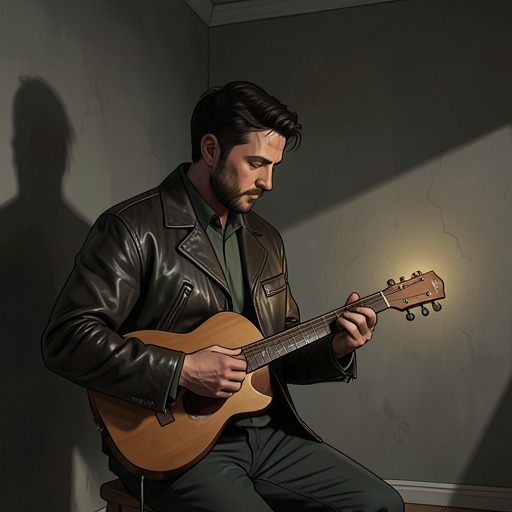
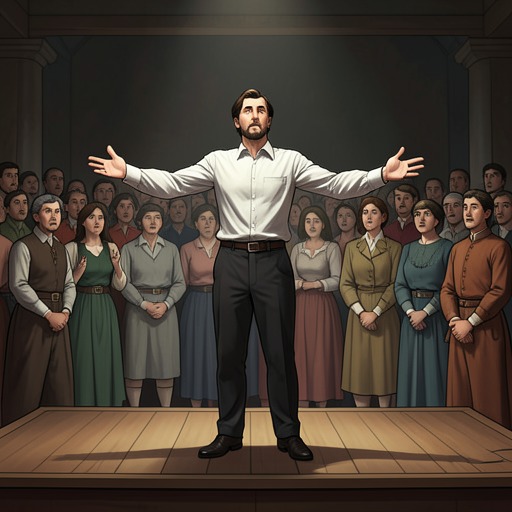
Shay improvises a new song at the Belfast show
The Edge of the WorldShay Maloney’s improvised song at the second Belfast show begins as an answer to a feeling he cannot yet name and becomes a collective performance. Rather than repeat a familiar set, he refuses the offered cajon and lifts a harmonica to his lips. The melody that follows gives voice to grief, emptiness, and a desire for missing parts of himself; the band gradually enters around it, carrying an exposed private feeling into the crowd without resolving where it came from.
Background and Performance Context
The improvisation grows out of a tour in which performance is both a practiced routine and a source of uncertainty. At the Dublin stop, the band has arrived after seven hours on the road, but Shay still makes time for his solitary circuit of the unfamiliar stage. He lies down on it and imagines the lights going down and the audience deciding whether to love or hate the band. Smuggler’s Beat has loyal followers, yet its shanty-punk sound is an acquired taste, and Shay privately worries about failing in a city where they have not played before.
That mixture of ritual and risk matters in Belfast. Shay is not simply departing from a fixed arrangement: Smuggler’s Beat’s practice is never to play the same show twice, and improvisation already lies at the heart of the band. But the choice to make something entirely new in the encore is more immediate than a routine variation. After the second Belfast performance, he has to follow a melody that has returned to him, even though he does not know what the music will become until he starts playing.
The Improvised Song
Ollie does not attend either Belfast show, despite having an all-access pass to the tour. At the sold-out second performance, the audience is packed into a traditional venue, drinking ale and stomping its feet. As Shay closes the set on penny whistle, however, the pleasure of the gig gives way to a flat sensation. A mournful melody runs through his head and will not let go. When the crowd calls for an encore, Larry offers him the cajon; Shay declines, sensing that he must play something new rather than return to the expected shape of the show.
His bandmates recognize that he is about to take an unorthodox turn. They step back without leaving him alone, keeping close enough to join if he signals. Shay raises the harmonica, and the melody comes back with a more tangible purpose. He often uses the instrument when he has a feeling but no words to sing. Here, the single notes carry what his voice cannot: an arching, painful grief that he had not believed belonged to him, the emptiness he had not previously recognized, and the guilt he feels about wanting the missing segments of his heart.
The performance is not a finished song Shay presents to the band in advance. It takes shape in front of the audience, through listening and response. When Shay falters, Ben steps forward with his violin and picks up the tune, adding an Irish lilt that shifts the atmosphere back toward the crowd’s celebration. Larry finds a beat; Jumbo threads a forceful bass line into the melody’s roots; and Mara joins on melodeon. Each entry changes the music without erasing its mournful beginning. What starts with Shay alone becomes a band arrangement built in real time.
The Band and the Audience
The others’ participation shows how the band’s improvisational practice can hold contrasting moods at once. Ben reads Shay closely enough to support him, but also understands how to reconnect the music with the audience. Larry, Jumbo, and Mara complete the developing arrangement through rhythm, bass, and melodeon rather than interrupting Shay’s initial feeling. The shift does not make the grief disappear: it gives the melody a shared form that the band can play through together.
The crowd roars when they finish. That response marks the performance as a success in the room, but it does not settle Shay’s state. He leaves the stage as off-kilter as he arrived. The applause and the unsettlement remain side by side: the song has reached the audience, while the feeling that produced it remains unresolved for its composer.
Significance and Later Echo
The Belfast improvisation gives musical form to an absence before Shay can explain it in ordinary language. Its emotional disclosure is specific but incomplete: he experiences grief and a sense of missing parts of himself, yet the scene does not identify their cause or provide an answer. The gap between what the music expresses and what Shay understands preserves the performance’s uncertainty. The song is new not only because the band has not played it before, but because the feeling becomes perceptible to him as it is being played.
A later Southampton scene offers a qualified echo. Ollie watches Shay play penny whistle and hears a haunting tune; déjà vu leaves him unsure whether he has heard that song before or has simply been so captivated by Shay that memory and dream blur. The scene does not establish that this is the Belfast harmonica melody. Instead, the uncertainty recalls the earlier episode’s power to make music carry feeling beyond what can be confidently named. In Belfast, that power is communal onstage but unresolved for Shay after the performance ends.