Shay's family genealogy files
The Edge of the WorldShay's family genealogy files are the paper trail at the center of Ollie's investigation into Shay's biological ancestry. They turn a documentary assignment into an intimate revelation: the records give Shay details about relatives and histories unknown to him, but they do not settle every question about his past or dictate which family he belongs to. Their importance lies both in what they preserve and in the gaps that remain around them.
A research file becomes personal
At first, Shay misunderstands the project as research into his adoptive family. Ollie corrects him by laying a thick folder on the table and showing him its first page: he is researching Shay himself. That distinction changes the meaning of the papers. They are not simply background material for a film about a musician; they concern Shay's birth identity and biological family, subjects he has not been invited to approach with equal knowledge. Ollie has already examined the file, while Shay is encountering its implications as they are disclosed.
The investigation is being made for a documentary during the Smuggler’s Beat tour. Shay signs a nondisclosure agreement with Sky, and Corina tells him that the researcher will join the tour and film as it proceeds. When filming begins, Ollie tells Shay that their initial conversation will be recorded, but that he will edit out what they have just discussed; he proposes to signal when the formal segment starts. The folder therefore enters a process of disclosure shaped by both research and camera work. Its contents are private family evidence, but they are also being selected and presented for a documentary.
Documents, photographs, and recovered names
The folder contains records from several generations of Shay's biological family. Among them are Rudolph Kaspersen's birth and death certificates, records of his marriage and children, and a grainy photograph of a hardware shop that remained in the Kaspersen family for a hundred years after the Battle of Dybbøl. These items give the investigation different kinds of evidence: certificates establish official life events, family records link generations, and the shop photograph locates a family history in a continuing place and occupation.
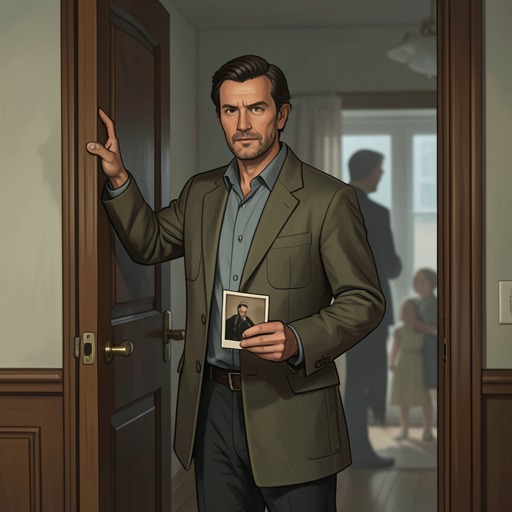
A photograph of Shay's great-uncle makes the connection startlingly physical. The young man has short hair and a thick beard, but Ollie recognizes Shay in his willowy build, long legs, and elegant hands clasped around a battered cart rattle. The resemblance prompts Ollie to hold likeness and identity together without treating them as identical: Shay may resemble this relative, yet the name attached to his own birth is different from the one he has been known by. The file has not simply supplied an ancestry chart; it has made a hidden name and a bodily resemblance newly visible to the person they concern.
As the pages are explored, the family tree expands beyond the records Ollie has already discussed. In one filmed exchange, he identifies Anna as a woman briefly married to Shay's sixth great-grandfather, three generations before Rudolph on Shay's father's side of the tree. Elsewhere, he identifies Joyce King, née Kaspersen, as Shay's great-great-grandmother. These discoveries make the genealogy a sequence of particular people and relationships rather than an abstract claim of descent. Shay's surprise at learning about relatives Ollie has not yet told him also shows that possessing the folder and knowing its contents are not the same thing.
Unequal knowledge and the work of disclosure
The folder gives Ollie a kind of authority over Shay's past: he has read ahead, traced connections, and can decide when to turn a page or introduce a name. Shay eventually names the imbalance directly. Ollie knows so much about him—more, Shay says, than he knows about himself—while Shay knows very little about Ollie's own life. The complaint links the genealogy project to their personal relationship: information that looks like research from Ollie's side can feel like an intimate asymmetry to Shay.
That imbalance does not make the files irrelevant to their growing trust. Rather, it makes the manner of disclosure consequential. Ollie films Shay's reactions, but also distinguishes the informal conversation from the segment intended for the documentary and says he will remove the earlier material. Later in the investigation, the camera is absent when Shay is told that his biological grandparents cared for him after Francesca died, fought to keep him, and lost him to foster care; Ollie confirms that they wanted him very much. Shay and Ollie sit together with their knees pressed together and hands clasped as Shay asks him to finish the story. The contrast shows that the documentary record is not the whole encounter: some of the most affecting knowledge is shared without the camera in view.
What the records establish—and what they cannot
The genealogy helps recover relationships, but it does not close every gap in Shay's early life. When he asks whether he was present at the fire in which Francesca died, Ollie describes checking an archived report. Shay would have been only a few months old, but the report made no mention of a baby. That absence does not prove where Shay was; Ollie presents it as the limit of what he can tell from the material he has found. The distinction between a documented connection and an unanswered question matters throughout an investigation that reaches into a life Shay cannot remember.
Nor does recovered biological kinship erase the care and identity formed elsewhere. Shay has spent a long time coming to terms with his family history, but has not travelled far from the people who raised him. He remains a Maloney and chooses, for now, not to seek out surviving members of his biological family. The files supply names and links that were withheld from his knowledge; they do not require him to replace his existing family with the family tree they reconstruct. By the documentary's final edit, the closing image is not a chart or certificate but Ollie and Shay seated together on a bench, heads bowed and hands clasped. The archive has made a history legible, while the ending locates belonging in the living relationship that accompanies its telling.