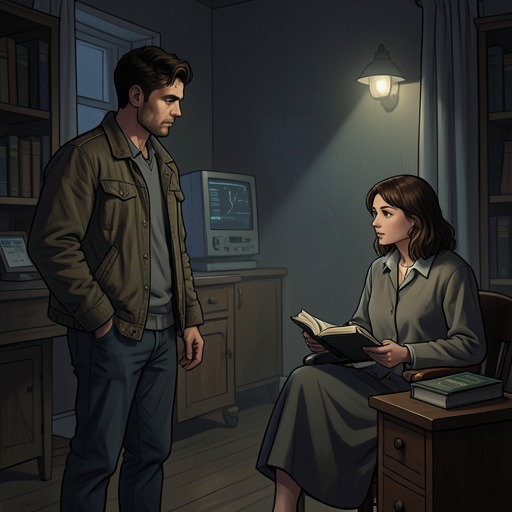
The best stories don’t go in order
The Edge of the World“The best stories don’t go in order” is Ollie’s defense of a deliberately non-linear approach to telling Shay about his history. In response to Shay’s demand to begin at the beginning and learn who he is and where his name comes from, Ollie makes delayed disclosure part of the method: history, he suggests, can become clearer when its pieces are uncovered gradually rather than delivered as a straight account.
The Exchange
Shay asks whether Ollie will tell him who he is and where his name comes from, then presses for the story to start at the beginning. Ollie answers, “Nah, son. The best stories don’t go in order.” His breezy phrasing meets a serious request with a principle about how to tell the story, leaving Shay’s questions unanswered for the moment.
That postponement is explicit. Ollie says that, had he known Shay was coming into the conversation without this knowledge, he might have withheld even Shay’s name until the very end. The remark makes the order of disclosure consequential: Ollie is not simply recounting information as it occurs to him but choosing when Shay receives the facts.
Piecing Together a History
Ollie describes the process as “uncovering someone’s history, puzzle piece by puzzle piece.” He says that withholding obvious answers at the beginning can make the final picture clearer. The metaphor casts the past as something assembled from separate clues: individual pieces may be legible on their own, but their fuller significance depends on how they fit together.
The expression therefore captures both Ollie’s storytelling preference and the tension it creates with Shay’s need for direct answers. Ollie sees patience and delayed revelation as ways to sharpen understanding; Shay’s question about his identity shows why that delay matters. The promised clarity belongs to the eventual picture, while the conversation leaves Shay waiting for it.