“In memory is the most beautiful refuge”
The Eight Mountains: A NovelThe expression “In memory is the most beautiful refuge” becomes a memorial inscription and a statement of purpose at the mountain house Pietro and Bruno build together. Carved into the rock wall in honor of Giovanni Guasti, it gives physical form to a change in Pietro’s understanding of his father: the man he knew in the city and the mountain-lover whose life he can recover through places, records, and remembered stories. The phrase makes memory not simply a return to loss, but a shelter that can be built and shared.
The Inscription at the House
The words appear in black paint on an inscription Pietro has cut into the rock wall with a mallet and chisel. The memorial names Giovanni Guasti and gives his dates, 1942–2004, before declaring: “IN MEMORY IS THE MOST BEAUTIFUL REFUGE.” Its location matters. The words are not placed in an abstract tribute, but at the house that Pietro and Bruno have built in the mountains, amid the landscape associated with Giovanni. Memory is set into the very material of the place they have made.
Pietro’s mother sees the inscription during her visit to the completed house. She has climbed from Grana mountain village at her own steady pace; inside, Bruno has lit the stove, and the three sit with tea by the window. Before leaving, she goes onto the terrace and looks carefully at the lake, scree, peaks of Grenon, and the house, as if committing the scene to memory. She also stands for a long time before the inscription. The phrase thus belongs to a moment of family witnessing: Pietro has made the memorial, his mother sees it, and Bruno is present as the other builder.
The inscription is followed by a song that Pietro’s mother calls them to sing, a song for a lover of the mountains who has died, asking God to let him continue walking in the afterlife. The memorial’s words and the song offer different forms of remembrance: one fixes Giovanni’s name and dates in rock; the other gives voice to the hope that his mountain life continues beyond death. Together they make the house a place where grief is acknowledged rather than hidden.
Memory, the Mountains, and the Father
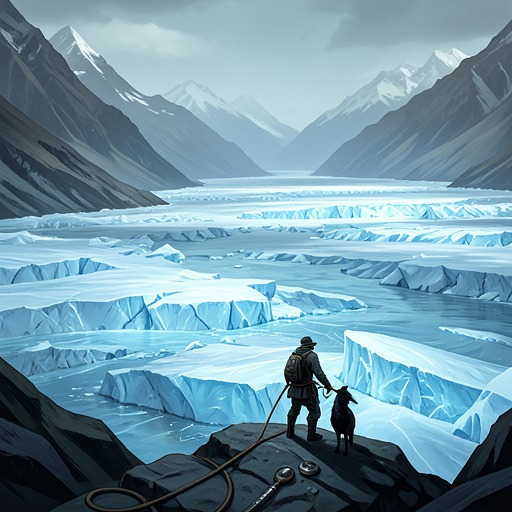
The phrase acquires its force from Pietro’s delayed recognition of who Giovanni was. After hearing his mother’s account, Pietro thinks again about the glaciers and about the way his father spoke of them. Giovanni had said that “the summer erases memories, just like it melts the snow; but the glacier is the snow of winters long past; it is a memory of winter that does not wish to be forgotten.” The glacier provides an image for what the inscription names: the persistence of the past beneath the changes of the present.
Pietro comes to understand that he has known two versions of his father. One was the stranger with whom he lived in the city for twenty years, followed by a further decade of estrangement. The other was Giovanni in the mountains, walking behind him on the paths and drawn to glaciers. Pietro says that this second father left him a ruin to rebuild, and resolves to complete that work as a way of remembering him. The house and inscription give this decision a durable form: memory becomes bound to a shared labor and a particular mountain place, not only to private recollection.
Maps and Records as Other Refuges
The rock inscription belongs to a wider pattern in which the past survives through objects that can be revisited. In the old kitchen, Pietro discovers that his father’s map is still thumbtacked to the wall. What had once been a map of valley trails has become, through twenty years of markings, something resembling a novel or biography. Its black, red, and green routes record the mountains Giovanni visited and the people who accompanied him. By recalling the three of them getting stuck together on a glacier, Pietro deciphers the colors: black for his father, red for himself, and green for Bruno. The map discloses not only Giovanni’s journeys but also relationships Pietro had not fully understood, including his father’s many walks with Bruno.
A second record waits above the house. On a barren mountain summit, Pietro finds a notebook in a metal box, its ruled pages damaged by water and protected only imperfectly by a plastic bag. Among its entries he recognizes Giovanni’s handwriting from 1997: “Climbed up from Grana in 3 hours and 58 minutes. Still in great shape! Giovanni Guasti.” Pietro imagines his father alone on the climb, watching the time and hurrying to reach the summit in under four hours. He considers taking the page, then rejects the idea as sacrilegious, like removing a stone from the summit. The record is precious precisely because it remains where Giovanni left it; recognition does not require possession.
A Shared Home and an Inherited Remembrance
At the house, Pietro makes the meaning of the inscription practical as well as commemorative. In front of his mother, he says that the house should not be his alone, but theirs—his and Bruno’s—because they built it together. He believes this is what Giovanni wanted, but emphasizes that he wants the arrangement himself. Bruno asks whether Pietro is sure, and Pietro confirms it. The expression’s refuge is therefore not only the shelter of memory or the wooden room left open to travelers in difficulty; it also names a home shared between the living.
The phrase gathers these distinct forms of preservation without making them identical. The map turns years of mountain travel into a personal record; the summit notebook preserves a brief trace of Giovanni’s physical achievement; the inscription deliberately honors him where Pietro and Bruno have built. Each keeps the absent father present in a different way. By setting the memorial into the house’s rock wall and giving Bruno a claim to the house, Pietro turns remembrance into both an inheritance and a continuing relationship.