Annapurna
The Eight Mountains: A NovelAnnapurna is the goal of Pietro’s Nepal expedition, but in his account it is also the far-off presence that transforms the journey into a study of mountain life. As the Himalayas rise beyond the settled valley, he is drawn not only to their newly formed-looking peaks but to the villages, fields, and working traditions on the route toward them. The contrast with the abandoned buildings he has seen in his own mountains makes the approach a journey through both landscape and memory.
Setting and approach
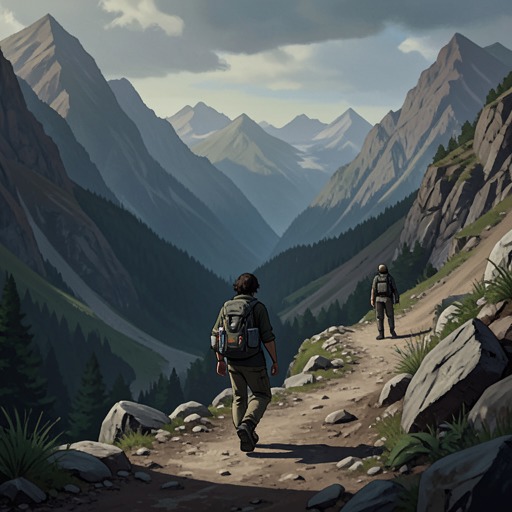
Pietro travels toward Annapurna with four Italian mountaineers, sharing a tent with them for several weeks and carrying a film camera for a well-paid documentary assignment. He is initially intrigued by the prospect of observing how the group will fare under extreme conditions. Yet before reaching base camp, the surrounding country captures his attention so fully that he decides to remain after the expedition and make his own journey through the lower elevations.
The approach begins a day’s drive from Kathmandu, fewer than two hundred kilometers from the city’s crowds. A narrow, irregular, wooded valley follows a river that can be heard below but not seen. Villages stand higher up where the slopes soften in sunlight, connected by steep mule tracks and narrow rope bridges spanning streams that cut across the valley sides. In October, during harvest, terraced fields and rice paddies make the mountainside resemble a staircase of semicircular plots, bordered by low dry-stone walls and divided into countless smallholdings.
Villages and working life
The valley is presented through the work that sustains it. Women kneel in the fields, men beat grain in village yards to separate husk from chaff, and older women sift rice drying on cloths. Children help plow with a pair of thin oxen, urging them on with shouts and blows from a stick. Pietro’s observation of the children brings back the image of Bruno’s yellow cane from their first meeting, linking this distant agricultural scene to his own mountain past.
The tools and buildings reinforce Pietro’s sense of continuity with an older mountain civilization. Wooden plows, stones used to sharpen scythes, and wicker baskets carried by porters remain in use, although farmers wear trainers and radios and televisions can be heard. Houses have stone walls cemented with mud; roofs are made from bamboo split lengthwise and laid in concave and convex halves to shed monsoon rain. Unlike the derelict buildings Pietro associates with his own mountains, he sees no abandoned structure along this route. The villages are not remnants of a vanished way of life but part of a still-functioning one.
The Himalayan landscape
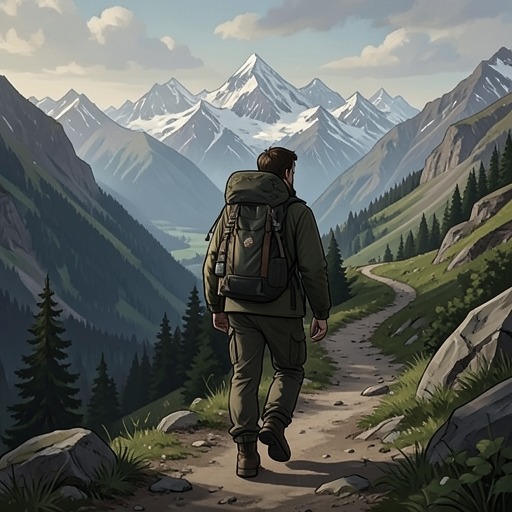
On the second day of walking, at the end of the valley, the Himalayan summits come into view. Pietro sees them as newborn mountains, sharply cut and seemingly untouched by the erosion of time. Their snow shines above the valley at heights of six or seven thousand meters. Waterfalls plunge from overhangs, landslides of reddish earth break from ledges and tumble into foaming rivers, while glaciers overlook the movement below. The mountains are not merely scenery for the expedition: their ice and meltwater shape the valley’s visible and audible world.
Water recurs throughout the approach—in rivers, fountains, irrigation canals, and the basins where women wash clothes. Pietro imagines seeing the valley in spring, when flooded rice fields would turn it into a multitude of mirrors. The name Annapurna, associated in his account with a goddess of harvest and fertility, fits this landscape of water and cultivation. The route therefore joins the high glacial source to the agricultural life below, connecting the expedition’s destination with the valley’s daily work.
Narrative significance
The mountaineers are impatient to leave the villages behind and reach the glittering ice with their ice axes and crampons. Pietro moves at a different pace. Walking among the porters, he asks about crops, stove fuel, and the small roadside shrines, attending to the inhabited landscape rather than treating it as a prelude to climbing. The difference in attention marks the journey as more than an approach to a summit: Annapurna draws him into a world whose mountain life remains present where he has known decline and abandonment.
The unfamiliar vegetation sharpens that encounter. The woods contain rhododendron trees five or six meters high, their scaled black bark and oily leaves unlike the fir and larch of Pietro’s familiar mountains. Their brief flowering recalls his mother’s favorite plant, while the bamboo groves at three thousand meters surprise him; young men carry cut bamboo toward villages where it will become roofing. The route toward Annapurna thus repeatedly connects what Pietro sees to what he already knows, without making the two places interchangeable. Its decisive significance in the account lies in this contrast: the Himalayas appear ancient in scale yet newly made to his eyes, while the living valley below offers a mountain society he had thought lost at home.