Barma mountain house
The Eight Mountains: A NovelBarma mountain house is the structure Giovanni Guasti chose to build in the mountains but never completed, a four-by-seven-meter ruin he left to Pietro. Rebuilt by Pietro and Bruno, it becomes more than an inherited property: its stones hold the history of Giovanni’s mountain journeys, while the work of raising it gives his son and Bruno a common task and a way to make the place theirs together.
The Inheritance and Its Hidden History
After Giovanni’s funeral, Pietro discovers among his father’s papers a list of practical instructions and a note leaving his share of the Milan apartment to his wife and the property in Grana to Pietro. The document offers no farewell or explanation. Pietro’s mother knows little about the purchase: Giovanni had acquired a small mountain plot the previous year without asking her to visit or discussing the decision. The accompanying contract and land-registry document identify an agricultural building measuring four by seven meters, but the map is too small and unfamiliar to show Pietro where it lies or what surrounds it.
Bruno knows. When he leads Pietro up to the site, snow disguises the slope as a wooded terrace facing a lake. Three remains of drystone walls emerge from the snow: two short sides and a longer one, with the rock face serving as the fourth wall and supplying the white stone used in construction. The roof has collapsed completely. A small Swiss pine has taken root among the rubble and grown to the height of the walls. The inheritance is at once a location and a fragment: rock, snow, shaped stones, and a living tree growing inside the outline of a former building.
Bruno reveals that he and Giovanni had found the ruin nearly three years earlier, after searching together for possible sites. Giovanni had recognized this one immediately as the place he wanted. Finding the owners and persuading them to sell had taken time; people in the mountain community were willing to keep a ruin for a lifetime but reluctant to sell it to someone who might put it to use. Giovanni’s intended use was to build a house. He chose the site, designed the house as he wanted it, and asked Bruno to promise that he would build it. His death left Bruno holding that promise and Pietro holding the property, with neither yet knowing the full meaning of the arrangement.
A House Assembled from Clues
The inheritance becomes legible through other things Giovanni left behind. In the old kitchen, Pietro sees his father’s mountain map still thumbtacked to the wall. It has ceased to be merely a map of valley trails: after twenty years, its dense network of routes reaches almost every summit, alpine pasture, and refuge, recorded in black, red, and green ink. Pietro deciphers the colors through remembered journeys. Black marks Giovanni’s routes; red accompanies him with Pietro; green identifies Bruno. The lines show that father and son had climbed together, but also that Giovanni continued to walk with Bruno, sometimes along routes that make Pietro feel a pang of jealousy. The map suggests that the house, too, belongs to a history of companionship not fully shared with Pietro during his father’s life.
Pietro also finds evidence that Giovanni had completed some mountain journeys alone. At a summit above the house, a weather-damaged notebook in a plastic bag records the names and dates of climbers. In an entry from 1997, Pietro recognizes Giovanni’s handwriting and the brisk note that he had climbed from Grana in three hours and fifty-eight minutes and was still in good shape. The summit record makes the father’s mountain life tangible in a public register; the map preserves its wider pattern of routes. Together, these traces help Pietro understand the man who had remained difficult to know in the city.
The house’s purpose is therefore not explained by a single message. Giovanni leaves no direct account of what he wanted from Pietro. Instead, the property, map, summit entry, and Bruno’s recollection form a set of clues. Pietro understands the mountain-going father as distinct from the stranger with whom he had lived in Milan, and decides to complete the work as a way of remembering that father. The ruin becomes a material answer to an incomplete inheritance: not a recovered explanation, but a task through which memory can continue.
Rebuilding the Ruin
Bruno offers to work on the house for the summer and says Giovanni had made him promise to build it. He does not expect payment, but explains that another pair of hands would help him finish in three or four months. Pietro has little money left after settling his own financial troubles and doubts that he can contribute usefully. Yet, sitting on a wall among snow at two thousand meters, he accepts the work as another of Giovanni’s riddles and asks when they can begin. Bruno says they will start as soon as the snow melts.
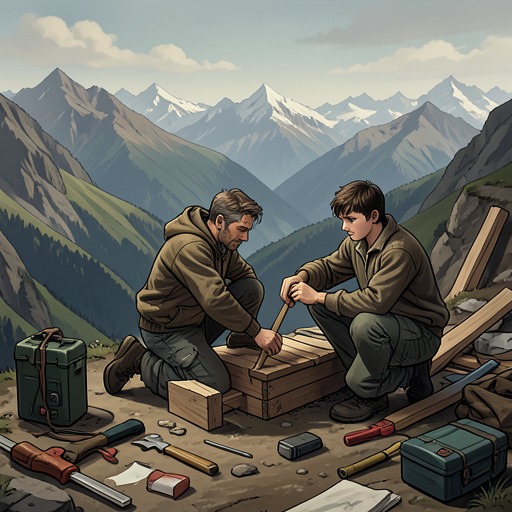
The snow disappears quickly that year. In early June, as thaw swells the river and water runs down the valley in temporary streams and waterfalls, the two men carry tools up to the property: a spade, pickaxe, large hatchet, chainsaw, and half a tank of petrol. The contrast between father’s old climbing rules and Pietro’s conduct is plain. He repeatedly stops to regain his breath, sitting down while his heart slows. At the site, the softened ground reveals the ruin’s condition. The walls are sound only to about a meter; above that, the long wall leans outward, and the short walls are unstable, with their upper stones barely in place. Bruno judges that they must be taken down nearly to the base rather than straightened.
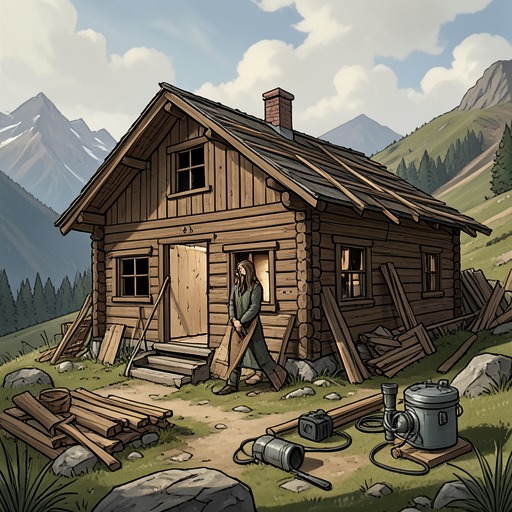
Before rebuilding, they clear the interior. The collapsed roof has left shingles, sodden pieces of the old floor, and long beams jammed into walls or stuck in the ground. Bruno examines the beams for pieces that can be reused. They extract the sound ones and roll them outside along two inclined planks; the spoiled wood is split and saved as firewood. The house is thus made not by erasing every remnant, but by sorting what can serve again from what has failed. Its construction proceeds through shared physical work, judgment, and patience, turning an inherited outline into an actual dwelling.
A Shared Home and Memorial
By September, the house is standing, with a stone room that can be locked to protect equipment and a wooden room left open, as is customary in mountain refuges, for anyone who may need shelter. Grass around it has been cut like a garden, firewood stacked under a lean-to, and the small pine replanted to face the lake. The building combines private use with a practical openness to passing strangers: it is a home, but one whose wooden room remains available to those in difficulty.
Pietro brings his mother up to see it on a short September day. She walks steadily for two hours and is delighted by what Pietro and Bruno have built. Inside, Bruno has lit the stove; she likes the window and later goes onto the terrace to take in the lake, scree, Grenon peaks, and the shape of the house. She studies the inscription Pietro has carved into the rock wall with a mallet and chisel, then painted black: “IN MEMORY IS THE MOST BEAUTIFUL REFUGE.” The words give the house a memorial purpose without making it only a monument. Its memory is lodged in the place and its use—in the view, the shelter, the construction, and the people who return to it.
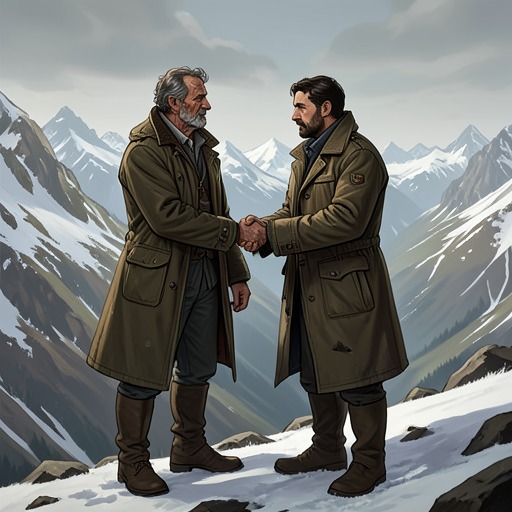
Pietro then tells Bruno, in front of his mother as a witness, that the house should belong not to him alone but to both of them. He believes this is what Giovanni intended, but stresses that he wants it that way because they built it together. The decision changes the inheritance from individual property into a shared home. In the book’s account of Barma mountain house, the decisive act is not simply finishing Giovanni’s design: it is recognizing Bruno as a co-owner in the memory and labor that made the house possible.