Bruno Establishes a High-Altitude Dairy Farm and Cheese Business
The Eight Mountains: A NovelBruno’s high-altitude dairy farm and cheese business grows from a deliberate choice to make mountain life his vocation, not merely a seasonal task. He rebuilds his uncle’s neglected farmstead, buys a herd, and makes cheese by hand; the work restores activity to an abandoned landscape, but it also tests the possibility of sustaining a life there through farming alone.
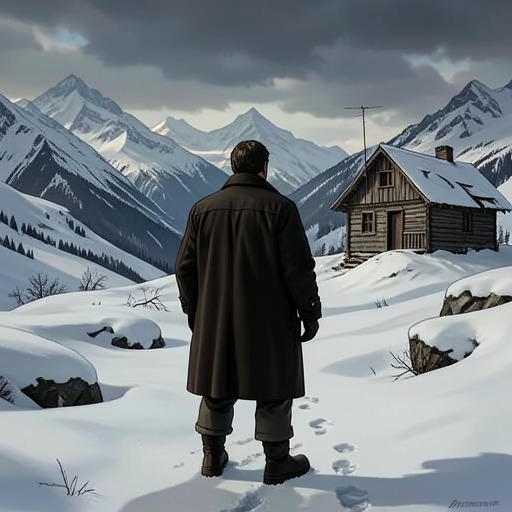
An abandoned landscape and a contested inheritance
Bruno’s project takes shape against the decline of the Grana mountain village. As boys, Bruno and Pietro explored abandoned stables, haylofts, granaries, and other unused buildings, keeping close to the cows Bruno was grazing. In 1984, only fourteen people lived in the village, although its population had once reached one hundred. The buildings retained traces of former domestic life, but their condition suggested that neglect had become part of the landscape rather than a temporary interruption.
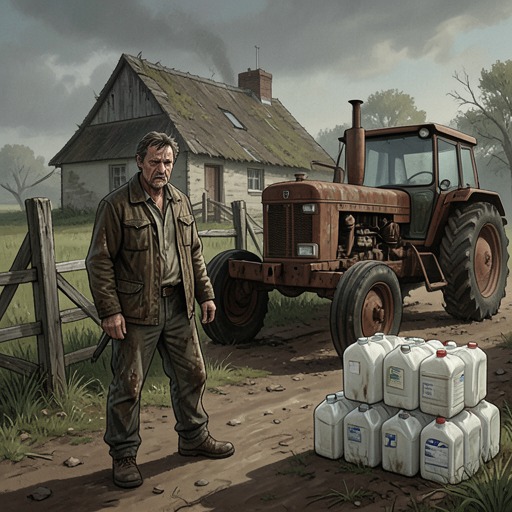
That neglect was not only physical. At Bruno’s uncle’s farm, the surroundings included improvised and discarded objects; Pietro recognized a wider contempt for maintaining places already assumed to be doomed. In conversation with Pietro’s father, Luigi Guglielmina described the economics of small Alpine farmsteads: low returns and regulations made the work difficult to justify financially, and he continued largely out of passion. He anticipated that the land would return to forest after his death. His outlook frames Bruno’s later undertaking as a challenge to an expectation of abandonment, but also as a venture burdened by the same economic pressures.
Bruno’s intended farmstead had itself accumulated a history of retreat. He told Pietro that his uncle had stopped repairing things, while his father resented the place and its decline. A nearby ruin Pietro examined had a damaged roof and a single room left in disrepair; he noticed a stove there that he hoped to salvage before the building collapsed further. During the work at Barma house, the salvaged stove was installed against a rock wall as part of the effort to make the interior usable. Repairing old structures was therefore both practical work and a refusal to treat the mountain’s deteriorating buildings as beyond recovery.
From trial run to a concrete plan
While working with Pietro at Barma house, Bruno began preparing to buy his uncle’s farmstead. He had saved for some time, and his cousins were willing to sell because they wanted to leave the place and its painful associations behind. Bruno spent his savings on a down payment and hoped to borrow the balance from a bank. The months at Barma had functioned as a trial: they gave him experience of the labor and living conditions involved, and he believed he could manage them.
His plan was to spend the following summer rebuilding the huts, acquire cattle, and establish the farm over the next few years. He did not describe the work as an incidental opportunity. When Pietro asked what he was born to do, Bruno answered that he was born to be a man of the mountains. He had used the phrase before in speaking of earlier mountain inhabitants, whose presence he associated with woods, wild meadows, and derelict houses he had explored. For him, purchasing the farmstead joined a personal ideal to specific tasks: rebuilding, keeping animals, and making a living at altitude.
The project’s commercial scale developed as Lara returned to see Bruno and learn about his work and plans. He expected to begin his agricultural business in spring, was considering buying thirty cows, and wanted to use their milk for cheese instead of selling it to dairies. That plan would require another worker. Lara liked the place, had grown up around cattle, and offered to take the job. Bruno welcomed her experience but had not expected a woman to join him in the mountains; Pietro assessed that she would be capable, and Bruno accepted that judgment.
Bringing the herd uphill
During a winter with little snow, Bruno decided to take the cattle up to the high pasture on the first Saturday in June. He had bought twenty-eight dairy cows, all pregnant, and they arrived by truck in the square in the Grana mountain village. Bruno, his mother, Lara, and Pietro positioned themselves to keep the unsettled animals together as they came down the ramp. Two black dogs with a local herding lineage helped control the herd on the climb, rounding up cows that fell behind as the group followed the mule track past ruined huts, weed-covered stone walls, and the remains of felled larches.
The ascent made the plan visible as a collective undertaking. Bruno led the animals; his mother and Lara followed, while Pietro brought up the rear. The cows’ return to the high pastures did not erase the ruins around them, but it put a working herd back into a landscape where farming had receded. Pietro understood the movement as a renewal of activity in the valley, a contrast to the dereliction that had shaped his and Bruno’s childhood explorations.
The buildings were reconstructed as a house, a stable, and a storeroom, with stone walls and roofs. Though restored to an earlier form, they now served a modern agricultural enterprise. Bruno occupied the farmstead as its owner and host, but the practical conditions remained austere: the first shared toast took place standing at the stable threshold because there was not yet furniture to sit on. The contrast between restored structures and the still-developing operation marks the work as an ongoing process rather than a finished pastoral retreat.
A workday measured in milk and care
Bruno insisted on milking by hand, considering it the right method for cows that could become nervous at small disturbances. He spent about five minutes obtaining each cow’s milk. At that rate he could milk twelve cows in an hour, and the whole herd required roughly two and a half hours. The task brought him out of bed before daylight, every day of the week; there were no weekends on the farm. Although the routine took away the possibility of sleeping late, he would not hand the milking over to anyone else. He treated the work as a repeated act of attention to the animals, not simply a step in production.
Lara brought Bruno coffee and biscuits at seven and took the herd out to pasture twice a day. Bruno combined the morning’s roughly 150 liters of milk with an equal quantity from the previous evening, after removing the cream that had risen overnight. He heated the mixture, added rennet, and strained and pressed it into wooden molds. Five or six cheeses resulted, amounting to no more than thirty kilos of toma from 300 liters of milk. The figures make the small scale of the operation plain: a substantial daily volume and a long sequence of work produced a limited quantity of finished cheese.
Cheese-making remained uncertain even when Bruno followed the process he had been taught. He could not know in advance whether the curd would form properly or whether the cheese would be good. That uncertainty gave the work a dimension he could not control through effort alone. He could care for the cows and observe each stage of production, but the outcome was never guaranteed. He also made butter from the cream and washed the boiler, churns, pails, work surfaces, and stable, carrying the cleaning through as part of the same daily cycle.
After the morning work, Bruno ate and rested for an hour, then turned to tasks such as building a calf enclosure or digging drainage where rain had waterlogged the pasture. The cows returned to the stable for a second milking in the afternoon, and Lara took them out again in the evening. As the day’s work eased, Bruno and Pietro sometimes sat outside with wine while Bruno described the farm. The pauses belonged to the same working life: they came after the animals had been tended and the tasks completed, rather than outside the demands of the enterprise.
Vocation and the limits of viability
Bruno’s commitment gives the farmstead a future that neither his uncle’s withdrawal nor his father’s resentment had seemed to allow. His ideal of mountain life is grounded in skilled labor and responsibility for a place: huts must be rebuilt, cows tended, milk processed, and pasture maintained. The farm is not simply a return to an untouched rural past. Its restored buildings house a modern business, and its routine depends on family labor, purchased cattle, and the sale of cheese.
Yet the venture does not prove economically viable. Lara later recalled that, two or three years earlier, when the farm’s failure had become clear, alternatives were still possible: they could have sold the cows, rented the farmstead, and found work elsewhere. She was prepared to accept ordinary employment until circumstances improved. Bruno, however, did not accept the possibility of another life. She concluded that he placed the mountain above her, their daughter Anita, and what she believed they had been building together; from the moment she understood that, she began imagining a future with Anita but without him.
The farm therefore carries a double significance. It is Bruno’s practical answer to a landscape of abandonment and the fullest expression of the identity he chose for himself. At the same time, the enterprise’s failure reveals the cost of making that identity absolute: the mountain gives Bruno purpose, but his refusal to consider alternatives leaves little room for a shared future when the business cannot sustain itself.