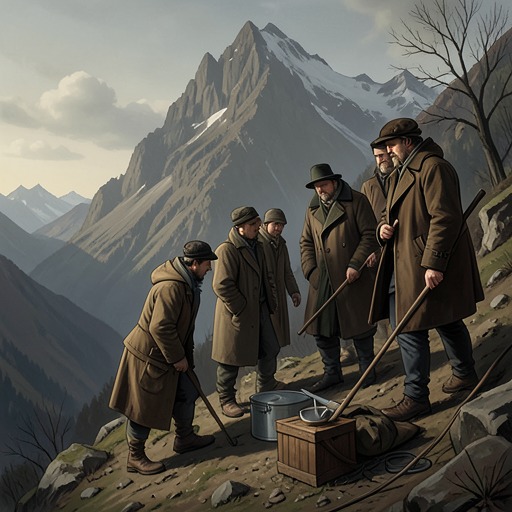
Bruno and Lara Separate
The Eight Mountains: A NovelBruno and Lara Separate marks the collapse of a shared mountain-farming future into two incompatible understandings of what could still be saved. As the farm’s debts mounted, Lara was prepared to abandon the business and take ordinary jobs until circumstances improved; Bruno could not accept a life apart from the mountain. Their relationship ended amid financial failure, but the separation also exposed how differently each had understood the life they were building.
The Farm and Its Precarious Promise
Bruno’s commitment to mountain life had taken material form in a plan to buy his uncle’s farmstead. He had saved for the purchase, used all his savings for a down payment, and hoped to borrow the balance from a bank. The months he spent rebuilding at Barma had functioned as a trial: he believed he could manage the work and intended to rebuild the huts, acquire cattle, and establish the farm over the following years. The plan was not simply an abstract attachment to the mountains; it depended on a particular property, livestock, and the possibility of making a livelihood there.
That possibility was already under pressure. Bruno’s uncle calculated aloud that the economics of small Alpine farms no longer made sense under prevailing prices and cattle-breeding regulations, and said that he continued only because of his passion for the work. He predicted that within ten years after his death the land would return to forest. Around the farmstead, neglect was visible in half-rotted wood, discarded buckets, and other damaged or abandoned objects. The wider village offered a related history of retreat: in 1984 Grana had only fourteen residents, compared with as many as a hundred in the past, and empty buildings stood in various stages of decay. These conditions do not by themselves explain Bruno and Lara’s breakup, but they establish the economic and social landscape in which Bruno’s ambitious farm project had to survive.
Strain and the Unequal Burden
The narrator’s mother followed the couple’s worsening circumstances through her close involvement with Bruno’s family. Earlier, she had taken Bruno’s schooling on as a personal responsibility, winning his aunt’s cooperation and arranging for him to attend school in winter and do homework at the narrator’s home in summer. She recognized that his mother was unlikely to help, and persisted through repeated visits until the aunt agreed. In the narrator’s memory, Bruno came to study three times a week, dressed and scrubbed for the occasion; he read novels by Stevenson, Verne, Twain, and Jack London, but struggled with grammar and Italian spelling. He did not complain, and worked hard in part because he understood how much the effort mattered to the narrator’s mother.
That earlier pattern of care broadened into practical support for Bruno and Lara’s daughter. The narrator’s mother became attached to Anita and, during summers, often kept her at Grana to relieve the parents of some childcare while they worked. From Nepal, the narrator received her accounts of Anita growing up wild and fearless, and of the strain between the adults: Lara was exasperated by debts, while Bruno had withdrawn into silence and work. The mother feared what this combination might lead to. Her concern was informed by a longer practice of maintaining relationships and offering help, rather than by any claim to control the couple’s choices.
The Decision to Leave
When Lara later explained the breakup, she described a point when she believed the farm could no longer be made viable but alternatives remained. Two or three years earlier, she thought, they could have sold the cattle, rented out the farmstead, and both sought paid work. She believed Bruno could have found a position at a building site, a dairy-processing plant, or on the ski slopes; she herself was prepared to work as a shop assistant or waitress. In her account, an ordinary life was not an ideal outcome but a workable interval, a way to keep going until the crisis passed.
Bruno, as Lara understood him, would not consider that course. He saw no alternative life beyond the one centered on the mountain. Lara concluded that neither she nor Anita, nor the future she thought they were making together, mattered as much to him as the mountain. The decisive change was therefore not only the business’s failure: it was her realization that they disagreed about what should be sacrificed to preserve their life as a family. From the next day, she began imagining a future far away from the farm, with Anita and without Bruno.
Bankruptcy and Separation
In the autumn of 2013, Bruno declared himself bankrupt, shut down the agricultural business, and handed the farm’s keys to the bailiff. Lara went to live with her parents with Anita. The narrator’s mother gave a different sequence of events: she believed Lara had decided to leave first and Bruno had then given up, resigning himself to failure. The two accounts place the emphasis differently—one on Bruno’s refusal to consider other ways of living, the other on the collapse that followed Lara’s departure—but both describe the same final division. The narrator recognizes that the order does not alter the outcome.
The news reached the narrator in Nepal through his mother, who was alarmed not only by the end of the partnership but by Bruno’s isolation afterward. She wrote that he had lost everything and was alone, and asked whether the narrator could do anything. Until then, the narrator and Bruno might go years without contacting one another, as though their friendship required no routine maintenance. At his mother’s urging, however, the narrator called Bruno from a telephone booth in Kathmandu. The call was a departure from his usual silence and a direct response to the fear that Bruno, after losing the farm and his partnership, might withdraw further from everyone around him.
Meaning of the Separation
The breakup brings the conflict between economic reality and attachment to place into the intimate sphere of a household. Lara’s proposed alternatives would have meant giving up the farm as a business while preserving room for a shared future; Bruno’s refusal made the mountain-bound project inseparable from his idea of a life worth living. The farm’s failure and the relationship’s end thus become connected without being identical: financial collapse provides the immediate crisis, while their different limits for compromise determine what the crisis does to them.
The episode also reverses the earlier image of the couple building a future together. Bruno had once planned to buy, rebuild, and stock a farmstead; now he handed its keys to a bailiff. Lara’s departure with Anita turned the family’s imagined common life into separate futures. The narrator’s mother, who had helped sustain connections across the family and cared for Anita, became the messenger between the estranged friends. Her intervention prompted the narrator to act where friendship alone had long permitted silence, making the separation a turning point not only in Bruno and Lara’s life but also in the narrator’s renewed effort to reach Bruno.