Bruno's Relationship with His Father, Luigi Guglielmina
The Eight Mountains: A NovelBruno’s relationship with his father is shaped by a recurring contradiction: they share a life of physical work, yet the story offers little evidence of emotional closeness between them. His father’s long absences leave Bruno growing up within a household and village organized largely by other people, while their later work together brings them into sustained proximity without making their bond legible to an outsider. Much later, Bruno tells Pietro that the relationship ended in a confrontation and permanent separation. His account of that rupture leads directly to his fear that no one has taught him how to be a father.
Childhood and Absence
Bruno describes himself as the youngest inhabitant of Grana mountain village and the last boy left there, with no expectation that other children would follow. His father is away for most of the year, returning infrequently and generally in winter before leaving again in spring to seek construction work in France, Switzerland, or elsewhere. The account gives no detailed explanation of the father’s departures or of what either parent feels about them; their practical consequence is clearer than their cause. Bruno’s childhood is spent in a shrinking community, with his mother’s small rural household and the surrounding pastures as its immediate world.
The childhood account also places Bruno and his mother in a house belonging to an uncle, whose family has ties to the pastures and dairy cattle. Luigi Guglielmina is associated with that farmstead and with the economic pressures on mountain work. These family and work arrangements provide context for Bruno’s early life, but they do not establish an intimate father-son relationship: the narrative does not show his father regularly present in the home or taking part in Bruno’s upbringing during these years.
Work Without Intimacy
As Bruno grows older, the pattern changes from absence to shared labor. He works with his father as a builder on projects high in the mountains, including refuges and alpine pastures; during the working week they sleep there, and Bruno is seen back in the valley mainly on Fridays or Saturdays. Their work places them side by side, but it does not, by itself, demonstrate closeness or repair the earlier distance.
A brief encounter in a café bar makes that distance especially visible. Bruno stands among the workers and drinkers with his father, who treats him as he treats the other men. Pietro, watching them, can detect no obvious difference in tone or gesture that would identify them as father and son. He envies this apparent ease, while also recognizing that the relationship gives no outward sign of special tenderness, embarrassment, confidence, or irritation. The scene remains filtered through Pietro’s observation: it reveals how little can be read from their public manner, not what either man privately feels.
Estrangement and Disclosure
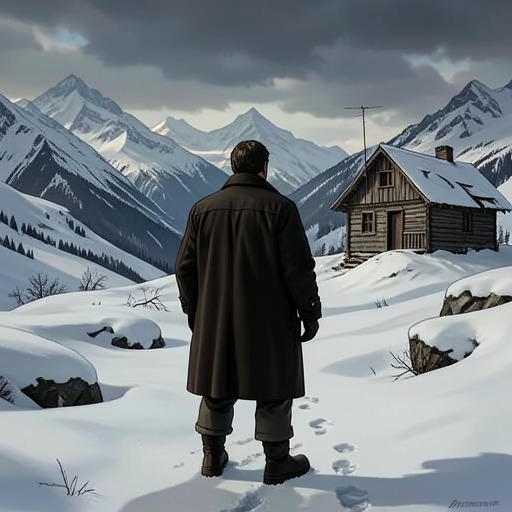
The definitive account of the rupture comes much later, when Bruno speaks with Pietro beside the landscape he has known throughout his life. He says that his father did not teach him how to be a father; instead, Bruno eventually fought him and drove him away. Bruno explains that they had been working on a building site and that he was stronger than his father. He believes he must have hurt him badly, and says that he has not seen him since. The disclosure establishes both the finality of their separation and the fact that Bruno has carried the break without having previously told Pietro about it.
Bruno’s recollection does not offer a fuller history of the conflict, and the narrative does not supply a reconciliation or a later meeting. His brief expression of pity for his absent father complicates the account without undoing it: estrangement has persisted, but Bruno’s words are not simply a declaration of indifference. The relationship ends, as far as the story reveals, in separation and unresolved feeling.
Fatherhood and Inheritance
The disclosure matters because Bruno connects his past with the responsibility he now has toward Anita. He can name practical skills learned in childhood—milking cows, making cheese, cutting down trees, building a house, and surviving through hunting—but cannot identify anyone who taught him how to be a father. His own father therefore represents not only a lost relationship but also the absence of a model for the emotional work Bruno now faces.
Bruno says that he is glad Anita is a girl because he can simply love her. The remark expresses tenderness, but it also exposes how little confidence he has in his capacity to pass on fatherhood as something learned. The contrast is pointed: Bruno can describe a wide range of useful skills acquired from experience, while paternal care seems to him to have no instruction he can inherit. His troubled history with his father thus reaches into the next generation, shaping both his anxiety and the uncomplicated love he hopes to give his daughter.