Bruno's Self-Imposed Isolation at Barma
The Eight Mountains: A NovelBruno's Self-Imposed Isolation at Barma is the prolonged retreat Bruno makes to the mountain house after the collapse of his agricultural business and the end of his relationship with Lara. Barma offers him shelter and a life organized around mountain work, but his withdrawal also places his losses beyond conversation and his friend's help beyond easy reach. When the winter of 2014 brings exceptional snowfall, Bruno disappears from the buried house, and the retreat ends not in a known return but in uncertainty.
Background: Work, Family, and the Mountain
Bruno's retreat follows years in which his attachment to mountain life had shaped both his ambitions and his choices. As a boy in Grana, he grew up among abandoned buildings and a declining village; in 1984 only fourteen people lived there, though the population had once reached one hundred. His uncle Luigi described the economics of small Alpine farms as increasingly untenable, continuing his work out of passion rather than financial sense. He predicted that within ten years after his death the area would revert to forest. That prediction gives Bruno's later decision to build a farm on the mountain a difficult context: the life he sought to sustain was already under economic and demographic pressure.
The narrator's mother had earlier taken Bruno's education into her own hands. Recognizing that she could not accomplish this alone, she cultivated an alliance with Bruno's aunt and persuaded the family to send him to school in winter and to the narrator's home for lessons in summer. Bruno attended three times a week, read novels, and struggled with grammar, but did not complain. This history shows the care others had invested in making alternatives available to him. It also throws his later insistence on the mountain into relief: he had been helped toward a wider world, yet as an adult found no acceptable alternative to the life he had built there.
The Farm's Collapse and Retreat to Barma
Bruno's isolation begins against the practical and emotional losses surrounding the farm. His business and Lara's relationship with him deteriorated while both continued to work hard. The narrator's mother, who was close to their daughter Anita, watched the crisis worsen and often cared for the child at Grana during the summer to ease the burden on her parents. In the autumn of 2013 Bruno declared himself bankrupt, shut down the agricultural business, and handed the farm keys to the bailiff. Lara went to live with her parents with Anita. The account preserves uncertainty over the sequence: according to the narrator's mother, Lara had decided to leave, after which Bruno gave up; either way, the partnership and the farm ended together.
From Kathmandu, the narrator received his mother's account of the breakup and her alarm that Bruno had lost everything and was alone. He called, despite the long-standing pattern that the two friends might go years without contacting one another. Bruno asked if he could use the house at Barma because he did not know where else to go. He said he did not want to see anyone and would spend time in the mountains. The narrator agreed that he could stay. Barma was therefore not simply Bruno's inheritance or property: it was a place made available to him by his friend at a moment when his former home and work had fallen away.
Life Inside the Withdrawal
A month after the call, the narrator found Bruno established at Barma and stocked for an extended stay. Their provisions included sacks of cornmeal, cheese from the last batch, tins, potatoes, and wine. They used candles because the small mill wheel had stopped during a drought. Bruno's remark that things had gone badly was followed by a shrug; he avoided speaking about the failed farm and relationship as though both belonged to a remote past. The supplies and the retreat into mountain routines give his silence a material shape: he had prepared to remain, rather than treating Barma as a brief stop on the way back to ordinary life.
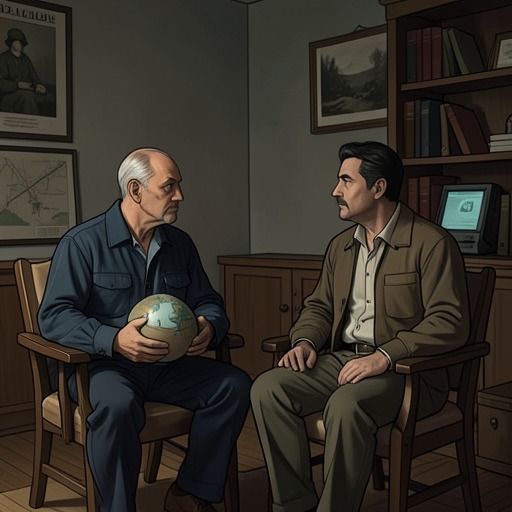
The days were filled with work, but labor did not open an easy path into conversation. Bruno and the narrator cut dead trees, removed branches, and hauled the trunks down steep slopes with ropes and improvised wooden slides. In the evenings, they sat for hours by the stove, reading by candlelight, rationing wine, and eating potatoes cooked in different ways. Bruno might stare at the fire or answer a question so vaguely that conversation ended before it could develop. The narrator had returned from Nepal hoping to help his friend, yet found himself waiting for a need Bruno did not express. Their companionship persisted in shared work and silence, while the emotional purpose of the visit remained unmet.
The Mountain as Refuge and Boundary
Bruno's retreat gives the mountains two meanings at once. They provide a place where he can avoid other people and endure the immediate aftermath of bankruptcy and separation; they also become a boundary around the life he considers possible. When the narrator asks whether Anita should live with him at Barma, Bruno argues that she is better off with her mother than living his kind of life. The narrator suggests that Bruno himself might go down and change his way of life. Bruno's response rests on his certainty about who he is: a cowherd, a bricklayer, a man of the mountains, and his father's son. In the narrator's understanding, that last identification carries a consequence: Bruno risks repeating his father's disappearance from the life of his child.
Lara later explains that the breakup had not been inevitable when the farm first became unviable. She had been willing to sell the cows, rent out the farmstead, and seek ordinary employment until circumstances improved. She believed Bruno could find work in construction, a dairy processing unit, or on ski slopes, while she could work in a shop or as a waitress. In her account, he would not consider alternative lives. She came to feel that neither she nor Anita, nor what she thought they were building together, mattered as much to him as his mountain. Her account gives the retreat a relational cost: the mountain is not merely the setting of Bruno's livelihood, but the commitment against which Lara measured their shared future.
Disappearance and Unresolved Ending
In March, while the narrator was in Nepal, Lara wrote asking him to call. Bruno could not be found. His cousins had gone up to Barma, where snow had covered the house and no one had cleared a path for some time. A rescue team reached the roof by helicopter and dug through it, but Bruno was not inside. There were no tracks in the surrounding area after the recent snowfalls, and a pair of skis was also missing from the storeroom. Searchers began looking with dogs, but the deep snow and spring avalanche danger limited the search; the narrator called daily for a week without news.
The evidence establishes neither Bruno's route away from Barma nor what happened to him. The narrator and Lara expected that he might be found after the thaw, perhaps in a gorge, but this remained a hope rather than a confirmed outcome. His disappearance makes the self-imposed retreat more than a period of silence: the friend who had refused the prospect of another life vanishes from the place he chose, leaving both his fate and the meaning of his final withdrawal unsettled.