Giovanni Guasti
The Eight Mountains: A NovelGiovanni Guasti is Pietro’s father, a chemist whose life in the mountains is revealed gradually through family recollections and the objects he leaves behind. An avalanche on Sassolungo killed his close climbing companion Piero and reshaped Giovanni’s family life; years later, maps, a summit record, and a house he designed help Pietro recognize a more vulnerable and affectionate father than the one he thought he knew.
Identity and Background
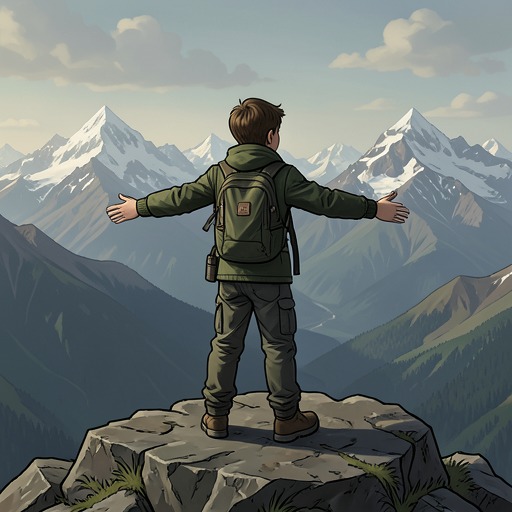
Giovanni studied chemistry and was drawn to the mountains as both a setting for adventure and a world with its own conditions to learn. In 1967, after graduating, he completed military service in the Alpine artillery. His work took him with a company moving cannons and mortars along mule tracks associated with the Great War. He spent much of the year traveling between valleys rather than in barracks, and returned with an appetite for the demanding life of long marches and winter encampments. He talked to Piero about snow: its different forms, changing character, and distinct language. For Giovanni, winter transformed the mountain into another world worth exploring.
His temperament combined enthusiasm with a practical curiosity. When he and Bruno planned a house, Giovanni wanted to understand why particular materials and methods were appropriate, not simply to be told what to use. He bought a book about building and brought a notebook to a meeting with Bruno’s former employer, recording the older builder’s advice. Bruno suspected that Giovanni later checked the advice against his book, consistent with a habit of not trusting information without verification. These details show the same attentiveness in domestic construction that he brought to routes and mountains.
Climbing with Piero and the Avalanche
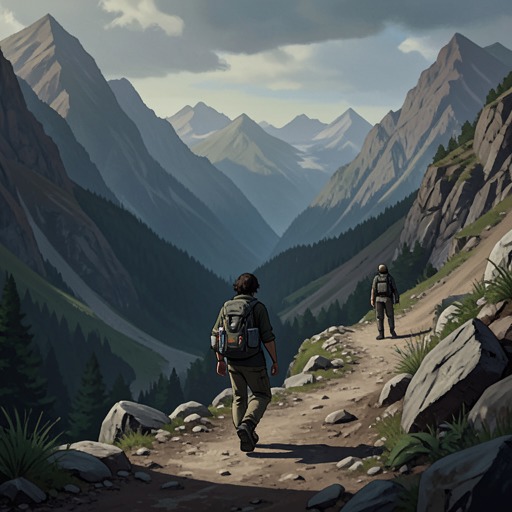
Before their lives diverged, Giovanni and Piero went into the mountains together on many Saturdays from June to September. They traveled by bus toward Trento or Belluno and hitchhiked back up, sleeping in meadows or haylofts because they had little money. Giovanni studied maps and planned routes; Piero was more cautious, but once committed, difficult to dissuade. Their differing temperaments made them companions: Giovanni could lose heart when plans went wrong, while Piero persisted.
After Giovanni’s military discharge, the two began a winter season together around Christmas 1968. They borrowed skis and sealskins and returned to familiar places, now staying in refuges. They lacked money for an Alpine guide and had limited equipment and technique. In March, on a fork of Sassolungo, they crossed a slope in afternoon sun after recent snowfall, at a time when the warmth made the crossing unsafe. Giovanni was ahead and had removed a ski when the slope began to move. He managed to catch hold of a rock, while Piero, on a steeper and smoother part of the slope, was carried down by damp spring snow. Giovanni searched the avalanche ground, then went to the refuge to call emergency services. Rescuers found Piero dead the next morning.
The accident became a defining rupture. Giovanni was regarded as responsible because he was the more experienced climber and should have recognized the danger, avoided the slope, or retreated. Piero’s father could not forgive what he saw as Giovanni’s failures. His anger endured, and at the memorial Mass for his son he sat on the other side of the church from Giovanni. The distance between them eventually became a silence Giovanni stopped trying to cross.
Family, Fatherhood, and Loss
Piero’s sister, who had long known Giovanni as her brother’s friend, drew closer to him after the accident. They had already shared singing, drinking, walking, and grape harvesting; afterward they met to talk, as she believed he should not be left alone to bear the blame. They fell in love and married about a year later. Their families refused the wedding invitations, and the couple left for Milan to begin again. Pietro, given a family name, became part of that new life.
Giovanni’s relationship with Pietro carried hopes that the son did not always welcome. During an August stay at a refuge on Castor, Giovanni wrote in the guest book that he was there with his fourteen-year-old son and imagined that these would be among his last occasions leading the rope, before Pietro took over. He anticipated their becoming climbing companions, and perhaps drinking companions, sharing maps and routes. Pietro found the entry sentimental and resented the gap between Giovanni’s ideal of mountain life and the family’s actual choices, including leaving a friend born and raised in the mountains to live in the city. The episode captures a central mismatch: Giovanni could imagine intimacy through a future shared in the mountains, while Pietro questioned the assumptions behind that vision.
Pietro later learned, through his mother’s letters, that Giovanni had a more fragile side. He worried when Pietro was ill on a glacier and instinctively reached for his trouser belt when the boy leaned over a rock. These moments complicated Pietro’s earlier image of his father as a difficult stranger. He began to think that a bridge between them might still be possible. In March 2004, before that possibility could be pursued, Giovanni died of a heart attack at a motorway lay-by. He had stopped safely and turned on the hazard lights, but was found still seated with his seat belt fastened and his hands on the wheel.
Maps, Records, and the House
After the funeral, Pietro discovered that Giovanni had prepared practical instructions for the inheritance, including financial details. On the same paper, he specified that his half of the Milan apartment should go to his wife and that he wanted Pietro to have the property in Grana. The document offered no farewell or explanation. Pietro’s mother knew little about the mountain land, which Giovanni had acquired the previous year without seeking her permission or inviting her to see it. The property was one sign of how separately the couple had been living, but for Pietro it also opened an unexpected connection to his father’s private plans.
In the old kitchen, Pietro found the Father's mountain map still fixed to the wall. Over twenty years Giovanni had covered it with routes reaching summits, alpine pastures, and refuges, so densely that it had become difficult for anyone else to read. Pietro worked out the map’s colors from the routes they had taken: black marked Giovanni, red accompanied him with Pietro, and green identified Bruno. Where the red and green lines ended but the black route continued, Giovanni had completed the climb alone. The many routes marked in black and green also showed that he had gone into the mountains with Bruno over the years. The map was not merely a guide to trails; its colored lines recorded relationships and stretches of a life Pietro had not witnessed.
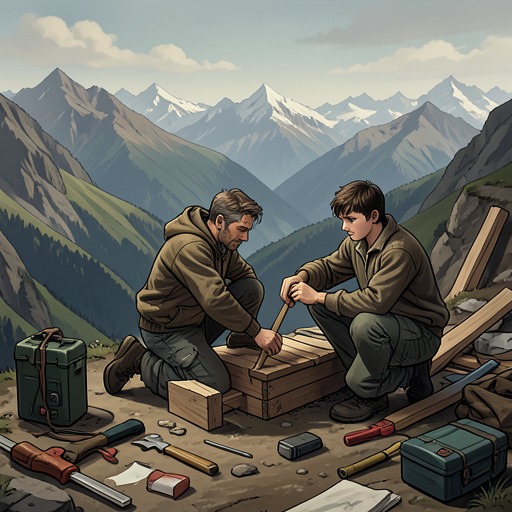
Bruno told Pietro that Giovanni had designed the house and made him promise to build it. Giovanni had asked him while sitting in the place where Pietro later sat. The plan, then, linked the two men through a task arranged before Giovanni’s death. Bruno recalled Giovanni’s questions about such matters as plank width, spacing, and wood, as well as his notebook and building book. Pietro ultimately joined Bruno in constructing the house, transforming an inheritance into shared work rather than treating it as a possession he would keep alone.
Memory and Significance
Giovanni’s mountain life survives in records that differ in form and reach. The map accumulates routes over two decades; the refuge guest book preserves an intimate hope about his son; the Grenon summit logbook records a solitary ascent in 1997. Pietro finds Giovanni’s entry there: he had climbed from Grana in three hours and fifty-eight minutes and noted that he was still in great shape. The entry gives Pietro a concrete image of his father moving alone toward a summit, timing his ascent and pleased with his strength. Rather than remove the page, Pietro returns the notebook to its box, leaving the record where other climbers can find it.
His mother’s account also helps Pietro understand what Giovanni meant when he spoke of glaciers. Giovanni avoided revisiting unhappy times, yet glaciers could bring something back to him. He understood them as snow from winters long past, a memory that summer’s melting could not erase. The image gives physical form to the way the past persists: not as an unchanged story, but as something retained and encountered again. Pietro comes to distinguish the father he had known in the city from the man he had glimpsed in the mountains, and chooses to remember the latter by completing the house Giovanni left to be built.
When Pietro’s mother visits the finished house with Bruno, she sees the inscription Pietro has cut into the rock wall: Giovanni’s name and dates, 1942–2004, followed by the words “IN MEMORY IS THE MOST BEAUTIFUL REFUGE.” The family sings a song for a dead lover of the mountains. Pietro then tells Bruno, in his mother’s presence, that the house should belong to both of them. Giovanni’s importance to the ending lies not in a final explanation—none is left—but in the material traces and unfinished obligations through which his son makes a different understanding of him possible.