Grana Flood
The Eight Mountains: A NovelThe Grana Flood of 2000 is recalled through Pietro’s return to Grana and his conversation with Bruno, who tells him that the village had to be evacuated by helicopter. The flood becomes legible not through a narrated moment of rising water, but through its aftermath: a widened river, debris carried down from the mountain, and a landslide that left an old route unstable and unusable. Pietro’s delayed awareness of the disaster makes the altered landscape a measure of both physical damage and his distance from the place.
Setting and Earlier Landscape
The flood struck a village already marked by population loss and the abandonment of buildings. When Pietro and Bruno were boys, only fourteen people lived in Grana, compared with as many as one hundred in the past. They explored disused stables, haylofts, granaries, a shop, and an old bread oven; some abandoned kitchens still held tables, crockery, and cooking utensils. These traces suggested that people had continued to occupy the buildings for a time after they fell out of use before leaving them altogether.
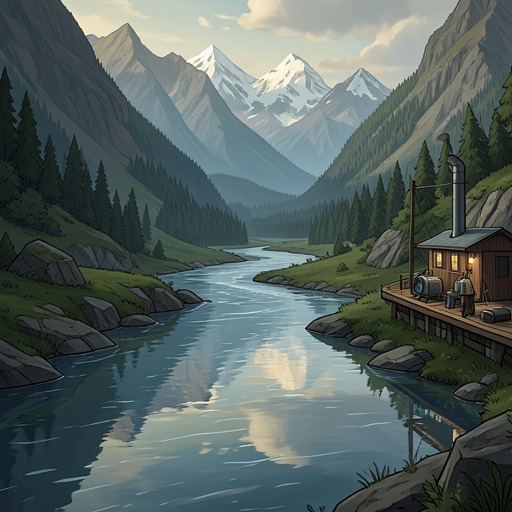
The surrounding mountain landscape also carried evidence of long, deliberate work. In higher settlements, Pietro’s father pointed out flattened ground, collected stones, irrigation ditches, and riverbanks shaped into terraces for fields and gardens. He admired the earlier inhabitants’ ability to cultivate difficult terrain and live through winters with little outside support. Against that history of maintenance, the flood’s damage appears not as an isolated change to scenery but as a force acting upon a landscape already affected by the retreat of its human population.
The Flood and Its Visible Aftermath
On a later visit, Bruno identifies the broad, changed riverbed as a consequence of the 2000 flood. Pietro has no memory of having known about it when it happened; he had been so far away in body and spirit that the disaster in Grana had escaped his notice. Bruno recalls that the volume of water was so great that the villagers had to be taken out by helicopter.
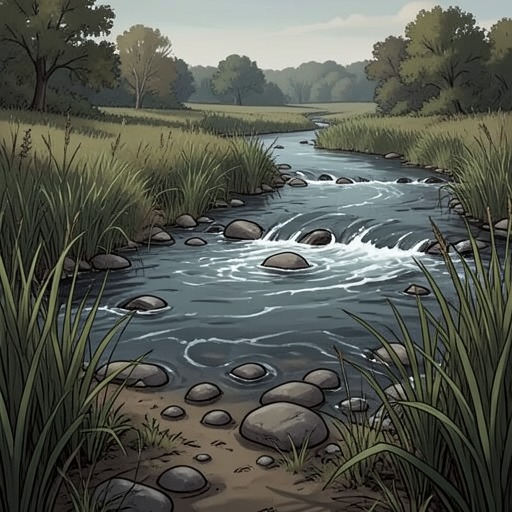
The river now seems at least twice as wide as Pietro remembers it, as though its bed had been freshly ploughed. A digger is working below the village, among tree trunks, beams, pieces of cement, and other wreckage washed down from the mountain. At the bends, erosion has exposed the roots of trees whose soil has been carried away. The river’s altered course and the debris it holds make the flood’s reach visible well beyond the episode of evacuation: the mountain had sent material down into the valley, and the river continued to display the damage years later.
The Landslide and the Lost Path
Beyond the cabins, the flood’s aftermath is more severe. Above the pastures where cows once climbed in the height of the season, rain brought down a substantial section of the mountain, carrying trees and rocks with it. Four years later, the resulting mass of unstable material still shifted underfoot. Bruno crossed it in silence, picking his way over mud, rocks, and fallen trunks; Pietro had to hurry to keep up with him.
The path did not survive the slide. Bruno explains that few people had used it even before the damage and that he was probably now the only one who still came that way. The change therefore involves more than a broken route: it compounds the loss of a seldom-used connection with the valley’s gradual abandonment. Bruno’s continued passage preserves a personal familiarity with the terrain, even as the physical trace that once guided others has disappeared.
Memory and the Changed Valley
The flood is narrated retrospectively, through Pietro’s encounter with evidence he had not witnessed. His first response to the transformed river is sorrow for it, while Bruno supplies the missing history. That contrast gives the episode its emotional structure: Bruno remained close enough to experience the evacuation and know the damage, whereas Pietro had been absent enough not even to know the flood had occurred.
The aftermath also links sudden disaster to slower changes in the mountain landscape. Abandoned buildings, former fields, eroding banks, and a lost path register different forms of transformation, but each makes the present harder to separate from the history of human use and departure. The flood does not explain Grana’s decline; rather, its physical traces become part of a valley where old works and routes are increasingly left without the people who made and maintained them.