Grenon summit logbook
The Eight Mountains: A NovelThe Grenon summit logbook turns a solitary climb into an encounter across time: among its worn pages, Pietro finds his father, Giovanni Guasti, recorded not as the distant city-dweller he had known for years, but as a vigorous and solitary climber who kept returning to the mountains. The notebook’s brief entries preserve details that family recollection alone could not supply, and its weathered pages become a material link between a father’s unshared mountain life and his son’s emerging understanding of him.
Form and Setting
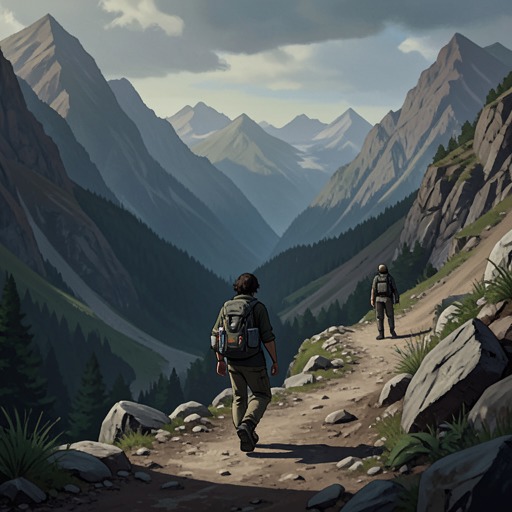
At the summit, Pietro finds a metal box wedged into a mound of stones. Inside it, a notebook rests in a plastic bag that has not fully protected it from the weather. Its ruled pages feel like paper that has dried after getting wet; a couple of pens have been left there so climbers can add a thought, a name, or a date. The arrangement is modest and exposed: a container among summit stones, preserving writing against conditions that have already marked it.
The record is sparse because few people reach this barren peak. The latest entry is more than a week old, and Pietro estimates that no more than ten people a year climb the mountain. The notebook’s names therefore reach back across many years, giving this overlooked summit a record of repeated visits without making it a busy or celebrated destination. Its significance lies partly in that contrast: the pages accumulate, but slowly, while the mountain and its weather remain beyond any climber’s control.
Pietro Finds Giovanni’s Entry
Pietro comes upon the notebook after climbing to the summit for the first time in years. He has paused there to smoke and recognize the peaks before searching for an altitude marker; the metal box draws his attention, and he knows what it contains before opening it. He first turns through the entries with some irritation at the routine comments and strained poetic or spiritual remarks left by other climbers. Only after leafing backward without knowing exactly what he seeks does he recognize his father’s handwriting in two lines dated 1997.
The entry records that Giovanni climbed up from the Grana mountain village in three hours and fifty-eight minutes and was still in great shape. The remark is brief, practical, and boastful, ending in an exclamation that Pietro reads as evidence of his father’s good humor that day. The notebook does not explain the climb, but its time and wording give Pietro concrete signs of the man who made it: someone measuring his strength, taking pleasure in a fast ascent, and confident enough to announce that he remained fit.
A Father Reconstructed from the Pages
The physical state of Giovanni’s writing shapes Pietro’s response. Water has blurred the ink, and the signature is less legible than the phrases above it. Pietro reflects that the signature seems almost automatic, like the mark of a man accustomed to signing his name. The page is at once a surviving record and a damaged object; what remains readable feels all the more intimate because weather has partly erased it.
Pietro imagines the circumstances that the entry leaves unstated. He pictures Giovanni alone, crossing the scree and reaching the summit as he himself has done, checking the time and hurrying because he wants to finish in under four hours. He imagines him proud of his legs and elated to see his mountain again. These details are Pietro’s reconstruction, not information supplied by the notebook itself; the brief entry gives him a point of contact, and his own climb gives shape to the scene he cannot have witnessed.
He considers tearing out the page to keep, then rejects the idea as comparable to taking a stone from the summit. Instead, he wraps the notebook carefully in its plastic, returns it to the box, and leaves the entry where other climbers may find it. His restraint matters: he receives the record as something that belongs not only to him, but also to the mountain and its future visitors.
The Wider Mountain Archive
The summit book becomes the first especially vivid instance of a broader practice of discovery. In the weeks afterward, Pietro studies the routes on his father’s mountain map and seeks out lower, less celebrated peaks. There he finds other summit books bearing Giovanni’s signature: sometimes laconic, sometimes boastful, and sometimes unexpectedly revealing. One entry reduces an ascent to the claim that he has done that one too; others preserve his responses to ibexes, eagles, fresh snow, fog, old songs, or a long absence from a particular summit.
These later records extend the first notebook’s portrait through recurrence and variation. Giovanni’s entries show him returning to the same mountains over the years, and the notebooks give Pietro access to experiences that his father did not commonly revisit in conversation. In one, Giovanni longs to stay in the mountains together and never return to the valley. Pietro cannot identify who the word together includes or what prompted the thought. He copies the words and their date into his own notebook, but does not write in the mountain books themselves. The distinction preserves Giovanni’s entries as his father’s traces rather than turning them into a dialogue Pietro can falsely complete.
Memory, Evidence, and Remembrance
The logbook complements the map Giovanni left behind. That map has grown from a trail guide into a dense record of routes marked in black, red, and green, which Pietro interprets as a record of his father’s, his own, and Bruno’s journeys. The map offers a broad pattern of movement; the logbooks preserve particular moments in Giovanni’s hand. Together they let Pietro understand that his father continued to go into the mountains and did not always go alone, even during years when their relationship in the city had been distant.
The notebook’s testimony is limited: an entry can preserve a time, a mood, or a passing wish, but it cannot settle every question about its writer. That incompleteness is part of what makes the record powerful. Pietro reads what is there, distinguishes it from what he can only imagine, and carries selected words into his own notebook without removing the originals. Later, he marks the house he has built with Bruno by inscribing Giovanni’s name and dates in the rock and dedicating the refuge to memory. That inscription is separate from the summit book, but it continues the same practice of leaving a durable trace: Giovanni’s brief mountain records help Pietro recognize and remember a father whose life had been divided between the city and the heights.