Omo servadzo
The Eight Mountains: A NovelOmo servadzo is a figure from Bruno’s account of mountain lore: an ancient being of the woods, feared by villagers but credited with showing them how to use rennet. The tale gives a mysterious pastoral craft a wild origin, and later offers the narrator a name for Bruno’s sure-footed, animal-like way of climbing. Omo servadzo is not presented as a creature independently encountered; he comes into view through Bruno’s story and the narrator’s interpretation of Bruno’s movements.
The Tale and Its Figure
Bruno introduces the wild man while talking about rennet, the ingredient that makes cheese form. He describes it concretely as a small piece of a calf’s stomach, used to make cheese from the milk the calf would otherwise digest. The narrator wonders who first discovered the process. Bruno answers that it must have been the wild man, shifting the conversation from a practical explanation of cheese-making to an origin story.
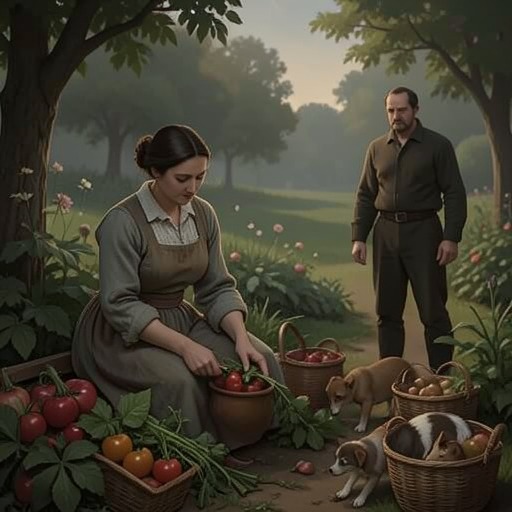
In Bruno’s description, this ancient man lived in the woods, with long hair and a beard, and was covered in leaves. He sometimes went into the villages, where people feared him. Yet they left food outside for him, thanking him for having shown them how to use rennet. The figure is therefore both an outsider and a benefactor: villagers keep their distance, but acknowledge a debt to the knowledge he brought them. The story does not explain how he learned the process or how he communicated it. Its emphasis is on the remembered exchange between an unsettling visitor and the people who depend on the craft.
When the narrator asks whether the wild man resembled a tree, Bruno refines the image: “Part man, part beast, part tree.” The description resists a clean division between human and animal, or between living creature and the woodland around it. The name Bruno supplies, Omo servadzo, belongs to the local dialect in the conversation; the account does not offer a translation beyond its association with the wild man.
Rennet, Craft, and Unease
The story’s origin for cheese-making is bound to an uncomfortable fact about its materials. Rennet comes from part of a calf’s stomach, and Bruno recognizes both its usefulness and its cost. He describes the process as right and terrible at once: without that piece, the cheese would not form. His words make the animal origin of a familiar food impossible to overlook. The wild man is not simply a charming woodland presence; he is the figure through whom Bruno imagines knowledge of a necessary but troubling practice entering human life.
That connection suits the way Bruno speaks about his work. He prefers telling the narrator about the physical closeness of milking and the mystery of rennet rather than discussing debts, bills, taxes, or mortgage rates. His account places the craft within a world of close attention to animals and materials, while its legendary explanation acknowledges that the practice cannot be reduced to a technical formula. The tale supplies no evidence that Omo servadzo is a historical inventor. It presents Bruno’s answer as a story that holds practical knowledge, gratitude, fear, and moral discomfort together.
Bruno’s Climb and the Wild-Man Image
The figure returns in the narrator’s thoughts during a climb on Grenon. Bruno takes a steep gorge toward the crest, moving on all fours and choosing hand- and footholds rapidly. He does not put his full weight on them; when the ground gives way, his momentum has already carried him onward. Watching him, the narrator thinks, “Omo servadzo: the wild man.” The earlier tale becomes a lens for recognizing a physical style, not a claim that Bruno is literally the creature.
Asked who taught him to climb that way, Bruno credits the Chamois: he had watched them and decided to try moving as they did. The answer sharpens the link between legend and lived experience. In the tale, a being imagined as part man, part beast, and part tree mediates knowledge of a pastoral craft; on the mountain, Bruno learns a movement by observing an animal. In both instances, knowledge crosses the boundary between human practice and the nonhuman world. The narrator’s association makes Omo servadzo a recurring image through which Bruno’s bodily ease in the mountains can be understood.
Narrative Significance
Omo servadzo connects two kinds of knowledge that the account keeps distinct but places beside one another: the inherited story of how a craft began, and the practical knowledge Bruno acquires through work and observation. The tale explains rennet through a feared woodland visitor and a gesture of thanks; Bruno’s climbing has a more immediate source in watching Chamois. The narrator links them, making the creature an imaginative counterpart to Bruno’s capacity to learn from the mountain without turning that resemblance into proof of the legend.
The figure also gathers the tensions within pastoral life. Rennet makes cheese possible, but its origin in a calf’s stomach unsettles the narrator and Bruno even as they acknowledge its necessity. Likewise, the wild man is welcomed as a source of knowledge but feared as an outsider. Omo servadzo thus remains deliberately between categories: a local story about the beginnings of a working practice, and an image the narrator recalls when Bruno’s movement seems to blur the boundary between person and animal.