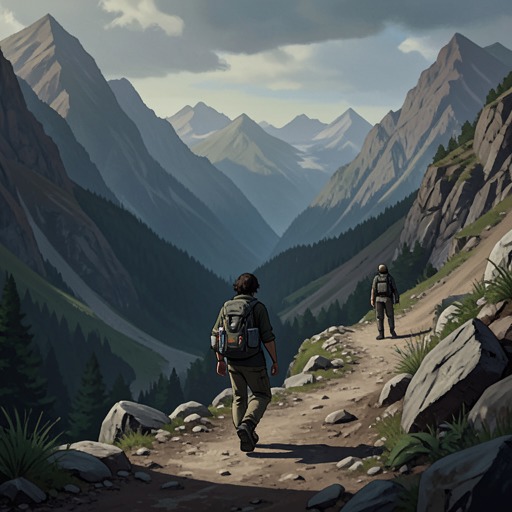
Pietro Finds His Father's Summit Log Entries
The Eight Mountains: A NovelPietro’s discovery of Giovanni Guasti’s summit log entries turns the mountains into an archive of a father he had only partly known. A map on the kitchen wall first reveals that Giovanni kept climbing with both Pietro and Bruno; then a notebook on Grenon’s summit gives that discovery a voice, preserving a timed ascent, a boast, and later, more solitary reflections. The records do not erase the distance between father and son. They let Pietro approach it by retracing the routes and reading the marks Giovanni left behind.
The Map as a Record of Shared Routes
Back in his parents’ old kitchen, Pietro finds his father’s map still thumbtacked to the wall. What he remembers as a map of valley trails has, over twenty years, become something closer to a biography: Giovanni’s felt-tip pen has reached every summit, alpine pasture, and refuge in the area, laying down such a dense web of itineraries that the map is almost illegible to anyone else. Its changing lines preserve a history not only of where Giovanni went, but of whom he went with.
The map’s three colors give Pietro a way to read that history. Remembering the occasion when he, Giovanni, and Bruno were stuck together on a glacier, he notices that the red and green routes stop at the point where the black one continues. He understands that Giovanni completed the remaining climb alone on another occasion. Black marks Giovanni’s routes, red accompanies him with Pietro to the four-thousanders, and green, by elimination, belongs to Bruno. What had looked like a private tangle of lines becomes a record of separate and shared journeys.
That record brings mixed feelings. Pietro sees many routes marked in black and green, perhaps more than in black and red, and feels a pang of jealousy. Yet he is also glad that Giovanni did not spend all those years climbing alone. His mother had told him that the two men walked together, and the map supplies a durable counterpart to her account. Pietro wonders whether it contains a message for him, but it offers no direct explanation: its meaning has to be worked out through remembered events, routes, and colors.
The Notebook on Grenon
Years later, climbing Grenon, Pietro leaves the ledge and takes the direct rocky way to the summit. Though the climb is easy, after years away from climbing he has to concentrate on handholds, footholds, and balance. He becomes absorbed in the rock face until he reaches the point where he can go no farther and realizes that he is at the top. The effort brings neither triumph nor relief. He stays only long enough to smoke, say farewell to his father’s mountain, and look across to Monte Rosa, whose glaciers are outlined against the sky.
A metal box set into the summit stones contains the Grenon summit logbook, kept in a plastic bag that has not fully protected its ruled pages from damp. Pietro estimates that the barren mountain receives no more than ten climbers a year, so the entries reach back across many years. Most climbers leave little beyond a name, a date, or a commonplace reflection. Pietro turns the pages without knowing exactly what he is looking for until he finds an entry from 1997 in handwriting he recognizes: “Climbed up from Grana in 3 hours and 58 minutes. Still in great shape! Giovanni Guasti.”
The entry gives a precise measure of the climb and lets Pietro imagine the person behind it. The water-blurred ink has faded, but the exclamation mark still seems to hold Giovanni’s good humor. From the notebook, Giovanni appears to have been alone; Pietro imagines him crossing the scree, watching the time, and hurrying to finish in under four hours. He pictures his father pleased by his strong legs and glad to see his mountain again. These details are Pietro’s reconstruction, not facts the brief entry can prove, and that gap matters: the record supplies a trace, while the son supplies a scene around it.
Pietro considers tearing out the page to keep, then decides that doing so would be like taking a stone from the summit. He wraps the notebook carefully, returns it to the box, and leaves it there. His response makes the discovery an act of preservation as much as possession: he takes the words into his understanding without removing them from the place where Giovanni left them.
Following the Other Entries
In the weeks that follow, Pietro studies the map and searches for Giovanni on lesser, neglected peaks lower in the valley. While climbers crowd the refuges and glaciers around Monte Rosa for the August bank holiday, Pietro goes where he finds almost no one, sometimes meeting only a solitary climber of his father’s generation. When he overtakes these men, the encounter feels to him like meeting Giovanni; they, in turn, welcome the younger climber with “Make way for the young!” Pietro begins stopping to talk and sometimes shares food with them. Their habit of returning to the same mountains over decades links the father’s records to a wider practice of revisiting both a landscape and one’s own past.
Pietro finds Giovanni’s signature in every notebook he discovers. The entries are sometimes laconic and always boastful. One reads, “Done this one too. Giovanni Guasti.” Another records “Ibexes, eagles, fresh snow. Like being young again.” A different entry recalls “Thick fog all the way to the summit. Old songs. Magnificent view of the interior.” Pietro knows the songs and wishes he could have been there to sing them with his father. Each note is small, but together they show Giovanni returning to the mountains in different conditions, attentive to animals, weather, songs, and the bodily feeling of being young again.
One entry changes the tone. Giovanni writes, “Came back up here after a very long time. It would be wonderful to just stay up here all together, without having to see anyone anymore, without ever having to go back down to the valley.” Pietro cannot tell who Giovanni meant by “all together,” where he was when his father wrote it, or what had prompted the wish. He wonders whether Giovanni had already begun to feel his heart weakening, but the notebook does not resolve the question. Pietro copies the words and date into his own notebook and leaves the summit book untouched. Giovanni’s private longing also recalls his dream of a house high above the valley, isolated from the world; in the records, the wish to remain in the mountains sits beside a life whose circumstances Pietro can only partly recover.
From Written Traces to a Shared Home
The records alter how Pietro understands his father. After hearing his mother’s account, he thinks about Giovanni’s way of speaking about glaciers: summer melts snow and erases memories, while a glacier holds the snow of winters long past. Pietro recognizes that the father he knew in the city and the mountain-dwelling father he had only glimpsed were, in his understanding, two different fathers. The maps and summit books help him approach the latter—not by making him fully knowable, but by preserving the paths and words through which he can be remembered.
That recovery becomes part of Pietro’s decision to finish rebuilding Barma. On a later visit, he cuts Giovanni’s name and dates into the rock and paints the inscription black: “IN MEMORY IS THE MOST BEAUTIFUL REFUGE.” His mother sees the inscription, and Bruno and Pietro sing the song for a mountain lover who has died, asking that he be allowed to keep walking in the afterlife. The summit entries have led Pietro from reading his father’s handwriting to making a memorial of his own, set into the landscape rather than kept on a page.
Pietro then tells his mother that the house should not belong to him alone: it should be his and Bruno’s, because they built it together. He believes this is what Giovanni wanted, but emphasizes that it is also what he himself wants. In that choice, the father’s scattered records become part of a living relationship and a shared home. The maps and notebooks cannot restore the years of estrangement or answer every question Pietro asks of them. They do, however, give him a way to carry Giovanni’s mountain life into the present without claiming that the surviving traces tell the whole story.