Pietro Guasti and His Father Giovanni Guasti's Father-Son Relationship
The Eight Mountains: A NovelPietro Guasti and His Father Giovanni Guasti's Father-Son Relationship is defined by a belated change in understanding: after Giovanni’s death, Pietro comes to distinguish the distant father he knew in the city from the mountain walker whose inner life he had only partly seen. Routes marked on a map, an old summit entry, and a memorial at a rebuilt house make that second relationship legible. The bond is therefore not restored through a final conversation, but reconstructed from the places and objects Giovanni left behind.
Distance and the Father's Traces
For years, Pietro’s relationship with Giovanni was marked by estrangement. When Bruno speaks of Giovanni while they work on the house, Pietro notices that he has not heard his father’s name since the funeral. Hearing Bruno say it brings relief, even as Pietro senses that the man Bruno knew and the father he had known in the city seemed almost like different people. The moment reveals that recollection is not Pietro’s alone: Bruno’s memories offer another version of Giovanni, one that Pietro can hear but has not yet fully joined to his own.
That division begins to shift when Pietro studies the map Giovanni left pinned to the kitchen wall. It has grown far beyond a practical chart of valley trails: over twenty years, Giovanni marked nearly every summit, alpine pasture, and refuge he reached, in a dense web of routes that has become almost unreadable to anyone else. Black, red, and green lines record different journeys. Pietro recognizes the colored paths from the time he, Giovanni, and Bruno became stuck together on a glacier: red ends where Pietro and Giovanni’s shared ascent stopped, while black continues, showing Giovanni’s later solo completion. Pietro identifies black with his father, red with himself, and green with Bruno. The map turns an ordinary household object into a record of companionship, separation, and return to the mountains.
Reading the routes also complicates Pietro’s view of his father. He sees many journeys marked in black and green, perhaps more than in black and red, and feels a pang of jealousy. Yet he is glad that Giovanni did not spend all those years alone. The map suggests that his father had a life of relationships and excursions that Pietro had not known, and Pietro wonders whether the accumulated lines contain a message for him. Their meaning is not a deciphered confession; it is evidence that Giovanni continued walking, with different companions, beyond the limits of the son’s memories.
The Mountain Father and the Glacier
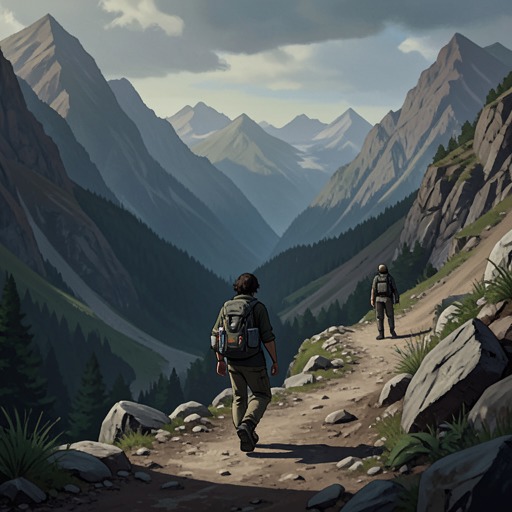
After his mother finishes recounting the family’s past, Pietro returns in thought to Giovanni’s way of speaking about glaciers. Giovanni did not like retracing his steps or dwelling on unhappy times. But in the mountains, even on peaks untouched by the death of a friend, looking at a glacier could bring something back to him. He compared summer’s erasure of memory to the melting of snow, while the glacier preserved the snow of winters long past: a memory that did not wish to be forgotten. Pietro now understands this image as more than a reflection on landscape. It offers a way to grasp the father’s concealed history: what Giovanni seldom revisited in speech remained present, held in the mountains and carried forward in his silences.
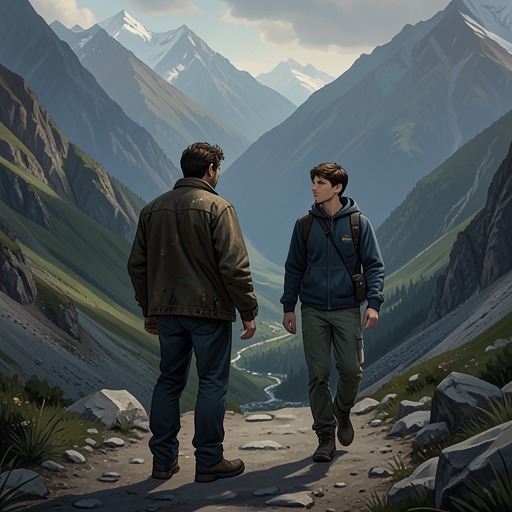
This recognition allows Pietro to name two versions of his father without pretending they had always been reconciled. One was the stranger with whom Pietro lived in the city for twenty years, before the two of them broke contact for another ten. The other was Giovanni as he existed in the mountains: the man who walked behind Pietro on the paths and loved glaciers. Pietro says he had only glimpsed this father, yet knew him better than the city stranger. The contrast does not erase the estrangement; it gives Pietro a different, more substantial way to remember the man within it.
Inheritance, Work, and Remembrance
Giovanni’s mountain life becomes especially tangible when Pietro reaches a barren summit above the house and finds its metal box and weather-damaged notebook. The book holds years of sparse climbers’ entries, with no more than ten people reaching the mountain in a typical year. Among the names Pietro finds a 1997 entry in Giovanni’s handwriting: he had climbed from Grana in three hours and fifty-eight minutes and recorded that he was still in great shape. The time, the exclamation, and Pietro’s recognition of the handwriting make the brief note vivid to him. He imagines his father hurrying to finish within four hours and arriving at the summit proud of his strength and glad to see the mountain again. These details are Pietro’s imaginative reconstruction, not information the notebook can prove; the record gives him a trace, and he supplies the scene around it. He considers keeping the page but decides that removing it would be like taking a stone from the summit.
Pietro understands the ruin he has inherited in the same way. He decides to forget the city stranger and complete the work left to him as a way of remembering the mountain father. Building the house with Bruno gives remembrance a practical form: the relationship is carried not only by recollection but by shared labor and a place made usable again. Pietro’s understanding of what Giovanni left is therefore both personal and material. The unfinished house becomes a task through which the father’s mountain identity can endure without being reduced to a written account.
A Shared Memorial
When Pietro brings his mother to see the finished house, her delight confirms the family significance of what he and Bruno have built. On the terrace she pauses over Giovanni’s name and dates, which Pietro has chiseled into the rock wall and painted black. Beneath them is the inscription In memory is the most beautiful refuge. The memorial makes the father’s name part of the mountain setting, while its words connect shelter and remembrance: the house protects those who use it, and memory offers Pietro a form of refuge from the earlier estrangement.
Pietro then tells Bruno, in front of his mother, that the house should belong to both of them. He believes this is what Giovanni would have wanted, but stresses that he wants it so because the two friends built it together. The father’s legacy thus does not become Pietro’s private possession. It becomes the basis for recognizing Bruno as a co-owner and for making the house a shared home. The relationship’s decisive change lies in this movement from a divided memory of Giovanni toward an act of continuity: Pietro can honor the father he discovered in the mountains by building something with the friend who knew him there.