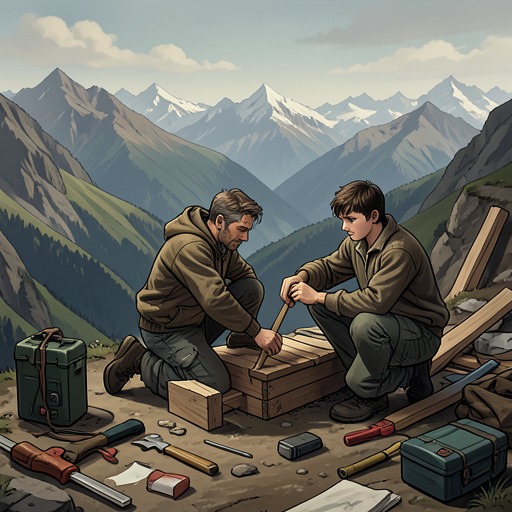
Pietro and Bruno Decide to Rebuild Barma
The Eight Mountains: A NovelPietro and Bruno Decide to Rebuild Barma is the turning point at which Pietro’s inheritance becomes a joint act of rebuilding. Pietro arrives at his father’s ruined mountain property expecting an unwelcome encounter with the past; instead, the routes marked on his father’s map and a promise entrusted to Bruno draw him into the work. As they clear the ruin and restore the house, the project shifts from fulfilling a dead man’s wishes to renewing a friendship that had been interrupted.
The Inheritance and the Father’s Clues
Pietro returns to Grana alone in his father’s car, uncertain whether the place he loved as a boy will still feel like home. The valley has changed: the road has been widened, slopes netted, trees felled, villas begun, and the river confined between cement banks. Closed hotels and idle construction machinery make the landscape seem diminished by development that has stalled. Yet snow still covers the higher mountains, and its presence consoles him. Looking up from the car, Pietro catches himself repeating his father’s characteristic gesture, leaning forward over the steering wheel to study the peaks. The resemblance makes the inheritance more than a property: it connects Pietro to a version of his father he had scarcely known in the city.
Inside the old house, his mother’s familiar arrangements and a photograph of Pietro and Bruno as boys make the past tangible. Pietro then notices his father’s map still thumbtacked to the wall. It has become a dense record of twenty years of excursions, its colored lines crossing trails, peaks, pastures, and refuges. By recalling the three of them stranded together on a glacier, Pietro deciphers the colors: black marks his father’s routes, red Pietro’s, and green Bruno’s. The combined lines reveal that his father and Bruno walked together repeatedly, perhaps even more often than his father and Pietro did. The discovery brings Pietro a pang of jealousy, but also relief: during those years his father had not been alone in the mountains.
The promise behind the building project comes from Bruno. He offers to work through the summer, explaining that Pietro’s father designed the house as he wanted it and asked Bruno to build it. The request had been made at Barma, where the two men were sitting; Bruno had promised to carry it out. Pietro recognizes that his father had arranged for the property to pass to him, but the revelation leaves the father’s purpose uncertain. Pietro has little money, and what remains of the inheritance is not enough to finance construction. Bruno, however, makes clear that this is not a job he expects to be paid for. He asks instead for someone to help: with a laborer alongside him, he thinks the work can be finished in three or four months.
Clearing the Ruin and Beginning the Work
Pietro accepts, although the undertaking would have seemed absurd to him in the lowlands, where he would have insisted he knew nothing about building. At Barma, sitting on a wall above a frozen lake at two thousand meters, he feels drawn into a task whose meaning he does not yet understand. He regards it as another of his father’s riddles, something the mountain and Bruno may teach him how to solve. They agree to begin as soon as the snow melts.
The snow disappears quickly that year. At the beginning of June, the two men climb to Barma through the thaw, carrying a spade, pickaxe, large hatchet, chainsaw, and half a tank of petrol. Water runs down through the valley, swelling the river and making the ground soft. Though Bruno carries the heavier load, Pietro has to stop every fifteen minutes to catch his breath. He recognizes that he is making the very climbing mistakes his father once taught him to avoid; the pauses are a physical reminder that the work will require him to learn rather than merely inherit.
With the snow gone, they can assess the buildings. The lower sections of the walls are firm, but the long wall leans outward under the pressure of the collapsed roof, and the shorter walls are unstable. Bruno judges that they must be demolished almost to their foundations: trying to straighten them would be pointless. First, they clear the interior. The rubble includes roof shingles, flooring, and long, sodden beams lodged in the walls or ground. Bruno tests which beams can be reused. They drag the sound ones outside over inclined planks and split the damaged timber for firewood. Because his fingers are truncated, Bruno has learned to operate a chainsaw left-handed, holding the wood down with his foot as he cuts. Pietro gathers the pieces as they fall and stacks them.
The labor also restores a familiar kind of companionship. While examining a damaged object, Bruno patiently explains how a scythe stone is carried and used to sharpen a blade. His sweeping gesture makes Pietro recognize their old game of exploring ruined buildings: entering through dangerous holes, balancing on planks, and pretending that wrecked objects were treasures. The construction site is not simply a new task imposed on two adults; it resembles the ruins they had explored together as boys. Pietro begins to understand the project differently. He had thought he was there only to obey his father’s wishes and ease his own guilt. Watching Bruno reenact the old game, he sees the inheritance as compensation and a second chance for their broken friendship. He rescues the horn Bruno has set aside for burning, keeping it in case it can be put to use later.
A House Built into a Shared Memory
The work also gives Pietro a direct way to care for something living amid the ruin. At the end of a day when he is too tired to continue, he digs a small Swiss pine out of the rubble, preserving its roots, and replants it at the edge of the clearing where it can look toward the lake. Its twisted trunk records its struggle for light. Once moved into the open, it sways in the unfamiliar wind, looking fragile rather than secure. The tree’s uncertain survival accompanies the house’s reconstruction: both have been removed from the conditions in which they endured and must now find a way to take root again.
Pietro’s understanding of his father deepens as he recalls what his mother has told him and what his father said about glaciers. His father rarely retraced his steps or revisited unhappy times, but the glaciers could bring the past back to him. He described them as snow from winters long gone, a memory that summer had not erased. Pietro comes to recognize two versions of his father: the city man with whom he had lived for twenty years and from whom he had become estranged, and the mountain man he had only glimpsed—the walker who followed him on paths and loved glaciers. The ruined house belongs to this second understanding. Pietro decides to complete it as a way of remembering that father.
By September, Bruno and Pietro have built the house. On its last day of the season, Pietro brings his mother up to see it. She climbs for two hours at her own steady pace, wearing the leather hiking boots she has had since Pietro’s childhood. Inside, Bruno has lit the stove; she drinks tea by the window and looks out at the lake, scree, and Grenon peaks. On the terrace she studies the house and its surroundings, and pauses at the inscription Pietro has carved into the rock wall and painted black: his father’s name and dates, followed by the words, “IN MEMORY IS THE MOST BEAUTIFUL REFUGE.” The memorial gives the absent father a place in the landscape they have rebuilt, while the inscription’s language makes remembrance itself a kind of shelter.
The Project’s Consequence
Pietro’s mother calls them to sing the song traditionally sung when a lover of the mountains dies, asking God to let him continue walking in the afterlife. Bruno and Pietro both know it. The ritual makes the house’s completion part of a family act of mourning, but Pietro adds a decision of his own: he says the house should not belong to him alone, but to him and Bruno together. He believes this is what his father intended, yet insists that the choice is also his because the two friends built the house together. He tells Bruno to regard it as his home as much as Pietro does.
That declaration completes the change begun when Bruno revealed the promise. The property had come to Pietro through his father, but its meaning is no longer confined to inheritance, obligation, or a son’s attempt to repair his relationship with a dead parent. The map had already shown him that Bruno shared years of mountain history with his father; the building work lets Pietro enter that history through action and recover an intimacy of his own with Bruno. By making Barma a shared home, Pietro turns the father’s unfinished wish into a continuing bond between the living. The rebuilding does not erase the ruin or restore the past unchanged. It gives their memories a place to endure, as the glacier preserves the snow of winters that have passed.