Pietro and Bruno Meet in Grana
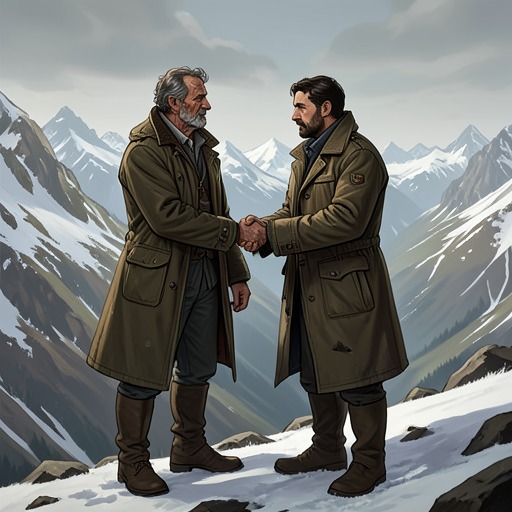
The Eight Mountains: A NovelPietro and Bruno Meet in Grana is the beginning of the friendship that shapes Pietro’s understanding of childhood, family, and the mountains. In July 1984, after Pietro’s mother brought the family to Grana mountain village, he noticed a boy tending cows beside the river. The meeting did not begin with easy conversation: the boys watched each other from a distance until Pietro’s mother intervened, and Bruno made the first invitation into their shared world of exploration.
Arrival and First Sight
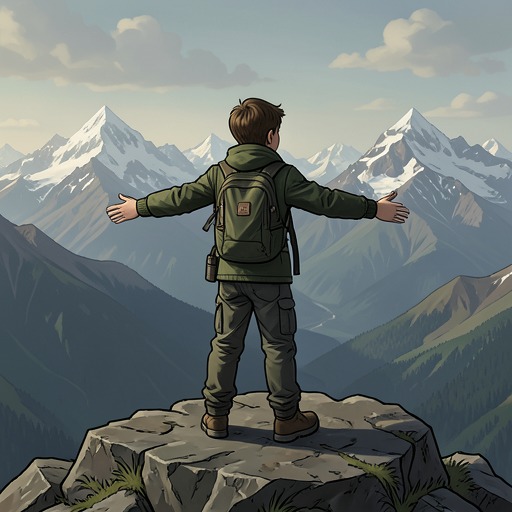
The family reached Grana by a steep dirt track that climbed in circles beneath the ruins of a tower before entering the valley. Pietro was absorbed by the river, which appeared and disappeared among the thickets below the road. His imagination turned immediately to fishing, swimming, and building a raft; he barely noticed the village as it came into view. The landscape, rather than the settlement, first held his attention, and the river would become the setting through which he and Bruno approached one another.
Pietro’s mother could watch part of the river from the house balcony, and she set limits on where he could explore: a small wooden bridge upstream and the thickets below the cliff marked the boundaries of his permitted territory. Along the banks, Pietro saw a boy grazing seven restless, chestnut-colored cows. The boy carried a yellow plastic stick with a curved handle to direct them toward the grass, chased after them when they wandered, and called them back toward the stable. When he was not tending the herd, he sat above the pasture carving a piece of wood with a penknife. Pietro knew him first as the cowherd, not as a companion.
An Encounter Arranged by Pietro’s Mother
Pietro’s mother learned that the boy was the nephew of the woman who owned their house. At first, the boys’ contact was almost nonexistent: the only time Bruno spoke to Pietro in the pasture, he told him that he could not stay there. Pietro did not understand why. At home, when his mother asked about making friends, he said that he also liked being alone. She questioned whether he was sure, then decided to help rather than leave the situation to chance.
A couple of days later, Pietro found the cowherd sitting in his chair at breakfast. His mother had invited him in. The boy introduced himself as Bruno Guglielmina, explaining that Guglielmina was shared by everyone in Grana but Bruno was unique to him. He was only a few months older than Pietro, having been born in November 1972. Bruno ate the biscuits offered to him, and Pietro realized that their mutual attention had not been one-sided: while he had been studying Bruno in the pasture, Bruno had also been watching him.
Pietro’s mother’s initiative reflected a broader commitment to intervening in other people’s lives. In Milan she worked in a newly established family clinic, supporting women during pregnancy and following infants’ development; the work of assessing children’s circumstances could weigh heavily on her, but she remained convinced of the need to act. In Grana she likewise took Bruno’s welfare seriously. Her later efforts to secure his education would depend on building an alliance with his aunt, but the first practical step was bringing the boys together at home.
The River and Their First Shared Undertaking
Bruno soon asked Pietro to follow him to the river. He led him to a place Pietro already knew, beneath the shade of the small wooden bridge, and signaled that they should approach quietly. Bruno’s manner was serious and assured; Pietro followed his gestures and looked with him toward a small waterfall and a shadowed pool. The important change was not simply that Pietro saw a familiar place from a new position, but that he was now exploring it with someone else, responding to Bruno’s lead rather than making solitary plans from the balcony’s limits.
Their shared imagination soon took a more difficult form. Bruno proposed moving a boulder so that it would roll down into the river and make fish leap out. The idea seemed both impossible and exhilarating to Pietro. Two woodcutter’s wedges had already lifted the stone slightly from the ground. Bruno used a stout stick, a pickaxe or spade handle, and a stone to drive a further lever into the gap, then asked Pietro to help. Their attempt did not move the boulder. Bruno left in frustration, but Pietro’s lasting recollection of the episode was not failure: that evening, the unfamiliar experience of doing something with another person kept him awake. He felt an intimacy that attracted and unsettled him, an opening into a territory he had not known.
As he lay awake, Pietro returned in thought to the river and its trout. He understood the water flowing downstream as the past and the water arriving from the mountains as the future: what lay ahead would bring dangers and surprises. The idea that the future was in the mountains became a way of thinking about destiny, and a response he wished he had given his father. The meeting therefore joined friendship to the book’s recurring river imagery: the boys’ first collaboration became part of Pietro’s earliest understanding of where life might lead.
The Meeting’s Afterlife
Pietro’s mother continued what she had begun by bringing Bruno to breakfast. She visited Bruno’s mother in the fields and, recognizing that she could not secure his education alone, concentrated on persuading his aunt. Eventually, Bruno was sent to school in winter and came to Pietro’s home in summer to do homework. Three times a week he studied in the kitchen, reading books aloud and practicing while he was in the pastures. Pietro sometimes felt humiliated on Bruno’s behalf when he struggled with Italian grammar, yet Bruno worked hard, aware of how much it mattered to Pietro’s mother that he learn.
The friendship that began beside the river did not require constant contact to endure. Years later, Pietro found a photograph of the two boys sitting back to back on a larch stump, arms folded in the same pose, looking like brothers. His father’s crowded mountain map also preserved the connection: Pietro deciphered its colored routes and recognized Bruno’s green among the paths his father had walked with him. After Pietro and Bruno built a house together in the mountains, Pietro told his mother that it should belong to both of them. The early attempt to move a stone had failed, but the partnership it anticipated became durable work, shared memory, and a home.