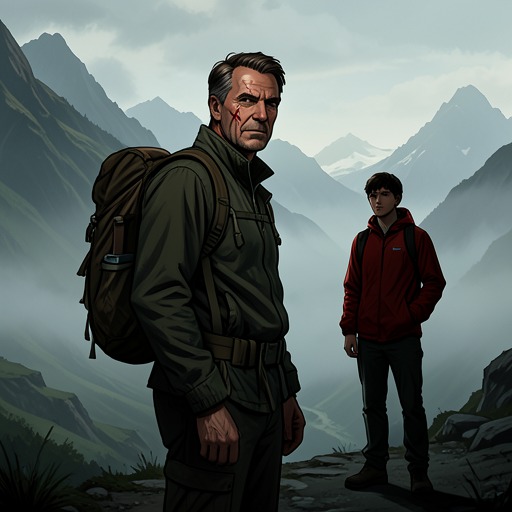
Pietro and Giovanni Guasti's Father-Son Relationship
The Eight Mountains: A NovelPietro and Giovanni Guasti’s father-son relationship is marked by a divide between city life and the mountains: Pietro grows up with a father he finds difficult to understand, yet sees him become cheerful and generous when teaching him to read a mountain map. Their shared climbs later give way to Pietro’s refusal, prolonged silences, and distance. After Giovanni’s death, objects he left behind—the map, a summit record, and a plan for a house—reveal a quieter continuity between them, which Pietro chooses to preserve by building with Bruno.
A father encountered through the mountains
In the evenings in the mountains, Giovanni spread a map across the table beside the Italian Alpine Club booklet and a glass of grappa. Pietro’s mother read, while Pietro climbed onto his father’s lap to follow the routes. Giovanni showed him how the map distinguished streams, lakes, huts, forests, meadows, scree, and glaciers; the contour lines revealed the steepness of a slope, and altitude-marked triangles identified the summits they were heading toward. The lesson was also an invitation into a version of his father that Pietro did not recognize from the city: here Giovanni was cheerful and talkative, happy to share what he knew.
Years later, Giovanni told a story about the moment he believed Pietro’s vocation had begun. One morning, while his wife was still asleep and he was lacing his boots, he saw his six- or seven-year-old son already dressed and ready to follow him. In Giovanni’s remembered version, the child said he wanted to come. Pietro’s narration leaves room for doubt: perhaps that was simply the phrase his father liked to recall. The difference matters. The memory testifies both to Giovanni’s attachment to the idea of a mountain-going son and to the uncertainty that would continue to shape their relationship: even their shared origin story reaches Pietro through his father’s account.
Refusal and growing distance
At sixteen, Pietro understood his father’s proposal to camp as more than a casual outing. Giovanni had bought a heavy army-surplus tent and imagined fishing for trout without being noticed by the forest rangers, cooking them over a fire, and staying up late. Pietro suspected the plan was meant to draw him into speaking about the family life he had begun to observe with a critical distance. He saw his parents repeating fixed roles: Giovanni emotional, authoritarian, and irascible; his mother strong, calm, and conciliatory. Pietro felt trapped in their predictable pattern but had never protested. When he refused to go, the refusal became a direct break with the mountain bond his father had hoped to renew.
Giovanni was deeply hurt. Pietro later considered whether his father, who had no father of his own, was unprepared to receive this kind of rejection. Rather than ask what lay behind it, Giovanni left the tent and sleeping bags and went for a walk alone. Pietro experienced the result as liberation, but the separation did not resolve the hurt. Giovanni resumed climbing by himself, leaving at dawn before the family was awake. He explored a barren part of the valley, with slopes rising steeply for two thousand meters and broad scree fields. Pietro imagined that the landscape might resemble his father’s state of mind. Giovanni never again invited him to join.
His mother tried to make the son take the next step. When she told Pietro to speak to his hurt father, he asked whether Giovanni should not speak to him instead. She answered that Pietro was capable of doing so and his father was not. The exchange shows the impasse from both sides: Pietro believed reconciliation should not be his sole responsibility, while his mother saw his capacity to approach as a difference between them. The relationship did not recover through a clearly described apology; for a time, the silence and the separate climbs stood in place of one.
Adulthood, estrangement, and the map
As an adult, Pietro moved from Milan to Turin at twenty-three, following the family notion that a person should leave home to develop elsewhere. The distance between him and Giovanni was not simply geographical. After Pietro abandoned his university studies, Giovanni told him he was throwing his life away; Pietro replied that Giovanni had thrown away his own. They did not speak for a year. Pietro’s trips between home and his military barracks ended with scarcely a word at parting, and neither seemed inclined to close the distance between them. Pietro regarded making a life unlike his father’s as necessary, even as the mountains remained visible on his horizon.
After Giovanni’s death, Pietro returned to the family house and found his father’s map still fixed to the wall. It had become more than a record of trails: over twenty years, Giovanni had marked so many summits, alpine pastures, and refuges that the network was nearly illegible to anyone else. The routes appeared in black, red, and green. Pietro recognized the colors by recalling the occasion when he, Giovanni, and Bruno had been stuck on a glacier: the red and green routes stopped where the black line continued. He understood black as Giovanni, red as himself, and green as Bruno. The map showed climbs Giovanni had completed alone as well as routes he had shared with each of them. Its many black-and-green combinations stirred jealousy in Pietro, but also relief that his father had not spent all those years alone. A private record of movement had become a record of relationships that Pietro had not known how to read while Giovanni was alive.
The map also altered the meaning of Giovanni’s inheritance. Pietro realized that the father who had spent his life fleeing houses had nevertheless wanted to build one in the mountains, and had left the place to his son. Bruno explained that Giovanni had designed the house and made him promise to build it. Pietro initially hesitated because his inheritance had largely gone toward settling his finances, but the design and promise made the project an expression of Giovanni’s wishes as well as a practical inheritance. The house offered Pietro a way to respond to his father after the fact, not by returning to their old pattern of climbing together, but by taking up work Giovanni had left unfinished.
Memory made tangible
Pietro’s mother’s account helped him distinguish the father he had known in the city from the one he had only glimpsed in the mountains. Giovanni did not usually revisit unhappy times, but glaciers sometimes brought something back to him. He described summer as erasing memories as it melts snow, while a glacier holds the snow of winters long past: memory that does not wish to be forgotten. Pietro came to understand that his father’s mountain self was not simply an escape from the man he had known at home. It was another part of Giovanni, preserved in the paths he walked, the glaciers he loved, and the house he had planned.
A summit record gave that preserved life a more intimate scale. On the mountain above the house, Pietro found a notebook protected in a plastic bag inside a metal box among stones. The pages recorded only a small number of climbers each year. In an entry dated 1997, he recognized Giovanni’s handwriting: his father had written that he had climbed from Grana in three hours and fifty-eight minutes and was still in great shape. Pietro imagined Giovanni hurrying to reach the summit in under four hours, pleased with the strength of his legs and glad to see the mountain again. The entry could not establish everything about the climb, but its brief, good-humored pride let Pietro picture his father alone on the same barren mountain. He considered keeping the page, then felt that removing it would be like taking a stone from the summit.
A shared inheritance
When Pietro and Bruno finished the house, Pietro’s mother climbed up from Grana in her old leather hiking boots, maintaining a slow, sure pace for two hours without stopping. She was happy to see what they had built. Inside, with Bruno’s stove lit and tea by the window, she looked out over the lake and stayed to take in the house and surrounding slopes. On the rock wall, Pietro had carved and painted Giovanni’s name and dates, 1942–2004, followed by the words, “IN MEMORY IS THE MOST BEAUTIFUL REFUGE.” The inscription turned remembrance into part of the place rather than a private recollection alone.
Pietro’s mother called them to sing the song used when a lover of the mountains dies, asking that he be allowed to keep walking in the afterlife. Pietro then told her, as a witness to the decision, that the house should belong not to him alone but to him and Bruno. He believed Giovanni had left it between them, but he also wanted the arrangement because the two men had built it together. The change in ownership gives the father-son story an ending without pretending that the earlier estrangement has been undone: Pietro does not recover the father who might have answered his adolescent refusal, but he chooses to carry forward the mountain life Giovanni left behind. The map, the summit notebook, and the inscription preserve different traces of Giovanni; the house makes that memory a shared, continuing responsibility.