Pietro's Estrangement from His Father
The Eight Mountains: A NovelPietro's estrangement from his father is built from refusals that neither man knows how to undo. A childhood decision not to follow his father into the mountains becomes a lasting pattern: each waits for the other to make the first move, while physical distance gives silence room to settle. Much later, letters from Pietro's mother reveal a more vulnerable side of his father and make reconciliation imaginable. His father's sudden death closes that possibility before either can act on it.
The First Refusal
When Pietro tells his father that he will not come along, he understands the refusal as a blow. He believes his father must have expected the day to arrive, yet expectation does not make the rejection easier to receive. Pietro also considers whether his father, who had grown up without a father of his own, lacked experience both in making this kind of emotional approach and in being refused. Whatever the reason, his father is deeply hurt. Rather than ask Pietro what he means or invite him to explain, he leaves the rucksacks, tent, and sleeping bags where they are and goes out alone. Pietro experiences the separation as liberation: he has escaped an obligation to climb with his father, even as the ease of that release exposes how little he understands the injury it causes.
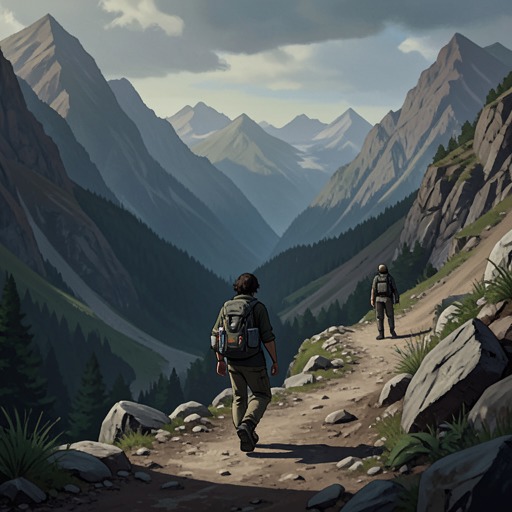
The refusal changes the shape of their mountain life. Pietro's father returns to climbing alone, setting out at dawn while the household is still asleep. Pietro sometimes checks his father's map during his absences to see where he has been. The new routes lead into a part of the valley the two had always avoided: a steep, empty landscape without villages, water, refuges, or striking peaks, only bare slopes rising for two thousand metres and extensive scree. Pietro suspects that his father seeks a landscape resembling his own state of mind, or a place in which to cool his disappointment. His father no longer invites him. In his view, the person who found the courage to refuse must now find the courage to apologize and ask to come.
Silence on the Glacier
The annual mid-August glacier outing brings their separation into sharper focus. Pietro watches his father prepare the crampons, pickaxe, and dented water bottle, imagining him as the survivor of an old Alpine expedition. His mother urges Pietro to speak because his father is hurt. Pietro counters that his father should speak first; she replies that Pietro is capable of approaching him in a way his father is not. She makes clear that his father is waiting for Pietro to ask to join the climb again.
Pietro knows what is being asked of him, but does not do it. From his room, he watches his father leave with a heavy rucksack of metal gear. He knows that the glacier is not a place to climb alone and anticipates that his father will have to seek a partner at the refuge, approaching groups of strangers until one agrees to rope up with him. The thought feels like a fitting punishment. The scene makes the estrangement more than a disagreement about climbing: Pietro sees his father's vulnerability and the practical consequence of going alone, yet chooses to let him face both. His father's hurt and Pietro's desire for independence remain locked in a contest over who should yield first.
Distance Becomes a Habit
As an adult, Pietro lives in Turin, about a hundred and twenty kilometres of rice fields from his father. The distance is not great, but crossing it requires a willingness neither has cultivated. Pietro left Milan at twenty-three, after military service, and built a life elsewhere. His relationship with his father remains strained by a later dispute over his future: Pietro had excelled at mathematics, and his father had imagined him following a path much like his own. When Pietro abandons university, his father says he is throwing his life away; Pietro replies that his father had thrown away his own. They do not speak for a year. During that period Pietro moves between home and his military barracks, leaving with scarcely a word when he returns from leave.
For Pietro, pursuing a different life elsewhere seems better for both of them. Once the distance is established, neither is inclined to close it. His relationship with his mother offers a contrast: she writes letters because he does not speak much on the phone, and he replies, telling her about his life and his plans to study documentary filmmaking. Through those letters she also tells him about his father. The correspondence gives Pietro information about a man he had known chiefly through conflict, but it does not itself bring father and son into conversation.
A Father Seen Differently
Pietro learns from his mother's accounts that his father is working relentlessly during a financial crisis at the factory, after a thirty-year career. He drives long distances between plants, returns home exhausted, and wakes at night to work again. His anxiety reaches beyond the factory: he worries about growing old, about his wife's illness, and about Pietro's health, sometimes asking his wife to telephone Pietro even when it means waking him. These details complicate the father's familiar severity. They show a man who cannot easily stop or slow down, even when his body and circumstances seem to demand it.
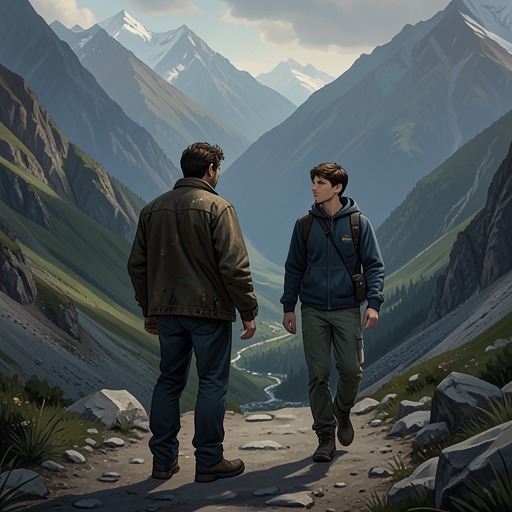
Pietro begins to recognize a fragile side of his father that he had glimpsed but not understood. He recalls his father's instinctive grab at his trouser belt when Pietro leaned over a rock, and his greater alarm when Pietro became sick on the glacier. What once registered as an aspect of his father's difficult authority can now be seen alongside concern and fear. Pietro wonders whether this more vulnerable father had always been beside him, unnoticed because the harder version was so difficult to face. For the first time, he thinks that he could try to build bridges between them.
Reconciliation Interrupted
That possibility lasts only until March 2004. Pietro's mother calls to say that his father has suffered a heart attack on the motorway. He has managed to pull into a lay-by and turn on the hazard lights; no accident has occurred. His heart has failed while he sits in the car, engine off, still wearing his seat belt and with his hands on the wheel. The image is painfully in keeping with a life of driving and work, but it also gives the estrangement its final consequence: the conversation Pietro had begun to imagine cannot take place.
His father is sixty-two when he dies; Pietro is thirty-one. At the funeral, Pietro realizes that he has reached the age his father was when Pietro was born, while their lives have followed very different courses. The recognition does not resolve their history. Instead, it makes its unfinished quality unmistakable: the earlier refusals, the year of silence, and the unasked invitation to return to the glacier remain part of a relationship for which Pietro only found a possible new beginning after his father's death.