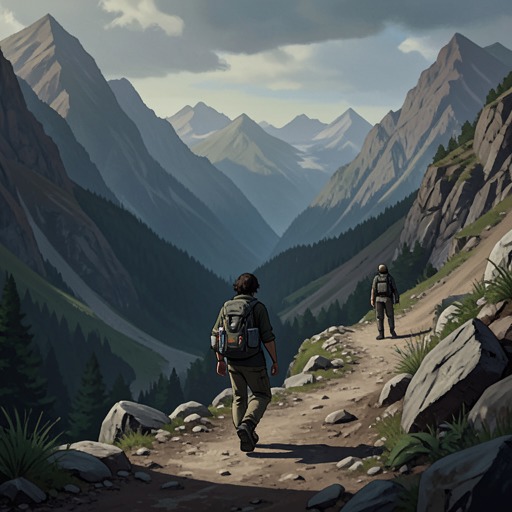
Pietro's First Journey to Nepal
The Eight Mountains: A NovelPietro's first journey to Nepal takes him toward Annapurna with a film camera and four Italian mountaineers, but his attention keeps turning from the climbers' anticipated ascent to the people and daily life of the valleys. The expedition begins as a well-paid documentary assignment; it becomes a discovery of a thriving mountain civilization and of an altitude at which he feels unexpectedly at home. Nepal does not replace the mountains of his past. Its glaciers, rivers, and villages give him another landscape through which to consider what the mountains have taught him and what kind of life he wants to pursue.
The Assignment and the Road into the Valley
Pietro sets out for the Himalayas in autumn, excited by the chance to film a mountaineering expedition and observe how a group of men responds to extreme conditions. For several weeks he shares a tent with four Italian climbers, carrying his camera as they walk toward Annapurna's base camp. The job seems fortunate from the beginning, but the expedition's purpose does not hold his interest as completely as he expected. As they approach the mountain, he has already decided to stay on after the expedition and make an independent journey through the lower regions.
The approach begins a day's drive from Kathmandu. Less than two hundred kilometers from the city's crowds, a narrow, irregular valley opens beneath wooded slopes. Its villages sit above a river that can be heard below but not seen, connected by steep mule tracks and narrow rope bridges over streams cutting across the valley sides. Terraces and rice paddies step down the slopes, each smallholding bounded by low dry-stone walls. Pietro arrives in October, during the harvest, and watches women working in the fields, men threshing grain in village yards, and older women spreading and sifting the rice. Children help plow with emaciated oxen, a sight that brings back Bruno's yellow cane from their first meeting in the mountains.
The material life of the villages makes a strong impression on him. Wooden plows, river stones used to sharpen scythes, and wicker porter baskets suggest an old mountain way of life that has disappeared in his own region, even as trainers, radios, and televisions show that Nepal is not cut off from modern life. The contrast is not simply between old and new: Pietro sees a living agricultural culture, not a picturesque remnant. Along the route, he does not encounter a single derelict building, unlike the abandoned structures that mark the decline of settlements in the mountains he knows.
A Mountain World Observed on Foot
On the second day of walking, at the end of the valley, the Himalayan summits come into view. Their sharply cut forms seem to Pietro newly made, not yet worn down by time. Their snow lights the valley from heights of six or seven thousand meters; waterfalls plunge from overhangs, and landslides of reddish earth break from the cliffs and froth into the rivers. Above this movement, glaciers overlook the landscape. Pietro's attention moves from the spectacle of the peaks to the water descending from them and sustaining life below.
The climbers are impatient to leave the villages behind and begin using their ice axes and crampons on the shining ice. Pietro instead walks among the porters, asking about the crops, the wood used for cooking, and the small shrines beside the path. This difference in attention gives the journey its distinctive shape: the expedition may be directed toward a high mountain, but Pietro's encounter with Nepal happens through observation, questions, and walking among the people who live along the approach.
The vegetation continually unsettles his expectations. He finds no firs or larches in the woods, but contorted trees he cannot identify until a porter names them as rhododendrons. The plant is his mother's favorite because its flowers color the mountains for only a few days at the beginning of summer; here, rhododendrons grow as trees five or six meters tall, with flaky black bark and oily leaves. Higher up, the forest gives way not to willow or juniper but to bamboo, growing at three thousand meters. Young men carry bundles of it on their backs. In the villages, split bamboo forms roofs, with concave and convex halves arranged to channel monsoon rain; stone walls are set with mud. The unfamiliar materials and construction also remind Pietro of the practical knowledge he had already acquired about mountain houses.
At the wayside shrines, porters leave a pebble or a flower bud gathered from the woods and advise Pietro to do the same. The path enters sacred territory, where killing or eating animals is forbidden. Domestic animals disappear from the route, while wild animals occupy the slopes: blue sheep browse on ledges, monkeys move through bamboo thickets, and vultures cross the sky. Pietro encounters an ecology and a set of customs unlike those at home, yet the unfamiliar landscape produces recognition rather than estrangement.
Belonging at Altitude
As the expedition climbs, Pietro feels increasingly absorbed by the living valley and its changing environments. He imagines the rice fields flooded in spring and reflecting the light, and notices details that the climbers' impatience to reach the ice might leave behind: the water channels, shrines, plants, houses, and work of the porters. His documentary interest in the mountaineers' behavior under pressure gives way, in part, to a wider attention to the people and distinct mountain communities of Nepal.
When he steps onto the first snow, he recognizes the altitude as a place where he feels at ease. His sense of being at home emerges not from resemblance to the Alps but from bodily familiarity with the transition from forest to grass and scree, and from the feeling of belonging to the mountain heights. The journey therefore enlarges, rather than erases, his sense of place. Nepal is distant from the valleys of his childhood, but it gives him another mountain world in which he can recognize himself.
That recognition remains entangled with memory. Before the Nepal journey, Pietro had returned to the old kitchen and studied his father's map, which had grown from a trail map into a dense record of two decades of mountain routes. He deciphered its colors: black marked his father's walks, red accompanied Pietro on their high climbs, and green identified Bruno. Seeing how many routes his father had shared with Bruno stirred jealousy as well as relief that his father had not always gone alone. The map suggested to Pietro that the mountain journeys held a message for him.
He also found his father's handwriting in a summit logbook: a 1997 entry recording a climb from Grana completed in three hours and fifty-eight minutes. Pietro imagined his father hurrying to reach the summit in under four hours, pleased by his strength and by the return to his luminous mountain. These traces helped him understand the father he had known in the mountains as distinct from the distant figure of his city life. A later memorial at the house he built with Bruno gave that memory a lasting form: Pietro carved his father's name and dates into the rock and inscribed the words that memory is the most beautiful refuge. The Nepal journey unfolds within this accumulated history, carrying the absent father into a new landscape without making Nepal merely an extension of the Alps.
From Expedition to a Wider Project
The first journey's paid assignment supplies a beginning, not a final definition of Pietro's purpose. Near Annapurna, he is already drawn toward a more independent exploration of the lower levels, and his attention to the valley's people anticipates a broader project. In a later conversation with Bruno, he describes securing enough funding in Milan to spend at least a year away, with plans to portray the different groups living in the Himalayan valleys. He has given up his home in Turin and does not want another there; if the work in Nepal goes well, he is prepared to stay longer. This later plan marks the widening of an impulse first visible on the expedition: Pietro wants not only to film climbers approaching the ice, but to understand the varied human worlds of the mountains.
The journey's significance lies in that change of emphasis and in the continuity beneath it. The climbers pursue the glittering heights; Pietro is equally compelled by the villages, the porters' knowledge, the sacred path, and the living systems of water and cultivation below. His first step onto Himalayan snow confirms that he feels at home at altitude, while the valleys show him how many different forms mountain life can take. The journey opens a route outward, but the memories carried from Grana—his father's mapped itineraries, summit handwriting, and mountain presence—remain part of the way he reads the new world.