Rebuilding the Barma Mountain House
The Eight Mountains: A NovelRebuilding Barma is the work through which Pietro and Bruno turn a mountain ruin into a usable house and a shared inheritance. Its practical details—ropes, rock bolts, timber, and a roof designed for winter snow—develop alongside Pietro’s recognition of his father’s life in the mountains. The finished house becomes not simply a refuge from the weather but a place where family memory can be kept and shared.
From Ruin to Building Site
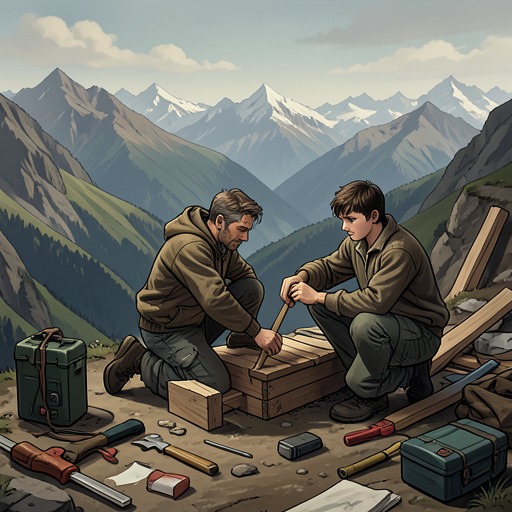
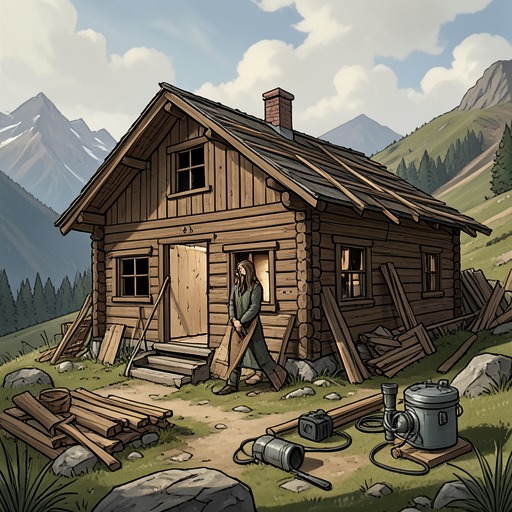
The reconstruction begins with the old structure’s walls and proceeds to the roof. In July, Pietro collects eight steel brackets from the village blacksmith. Bruno has designed them, and the load also includes several dozen foot-long expansion screws, a small generator, petrol, and Pietro’s old climbing gear. A mule carries the supplies to Barma. To reach the rock face, Pietro secures himself to one of the larch trees above it, lowers himself partway down on a double rope, and drills where Bruno directs him from below.
Each bracket requires four screws, so the work means drilling thirty-two holes into the rock. The brackets must be fixed at regular intervals four meters apart in height. Their number and placement are not incidental: Bruno has considered how much snow the roof will have to bear, and he insists on doubling the design against uncertainty in the snow’s weight. The labor is exacting and physically demanding. Pietro repeatedly climbs back up the rope to move his anchor point, then descends again to drill the next position. By evening, all eight brackets are secured.
Once the brackets are in place, the roof’s skeleton spans between the rock face and the long wall. Eight beams sit at a thirty-degree incline, supported in the middle by a long larch beam. Pietro brings planks to the terrace, where the white, resin-scented pine stacks up beside the construction. Bruno has shaped the stones around the two north-facing windows with mallet and chisel, making them arched; they face the lake, while the door faces west. The planned interior consolidates the old building’s stable and living room into one taller, more spacious structure rather than preserving its former two-floor arrangement.
Engineering a Shelter
By August, the roof is finished as a layered system. Two courses of planks enclose a metal sheet and insulation. Outside, overlapping larch shingles have grooves to carry away water; inside, spruce matchboards help retain heat. The builders decide against a skylight, keeping the interior shaded even in midsummer. Although the windows face north and receive no direct sunlight, the mountains across the lake reflect light into the house. Their arrangement makes the building’s reverse-facing aspect part of its design: the distant slopes supply the light that the windows themselves do not receive.
The roof also has to meet the rock face closely enough to keep water from entering. Bruno molds a strip of lead piece by piece with a hammer, fitting it to the rock’s hollows and protrusions. The careful shaping makes the soft metal appear almost joined to the stone, so the roof and rock form a continuous surface. The episode’s construction is consequently not just the raising of a roof but an adaptation to the particular hazards of the site: winter snow pressing on the structure and rainwater running down the rock.
In September the completed house has one wooden room and one stone room. The larger, warmer wooden room contains a stove, table, two stools, and a larder. Some furnishings are salvaged from other ruins and cleaned by Pietro; Bruno makes others from old floorboards. A loft against the rock face, reached by ladder, is the warmest and most enclosed corner. The smaller stone room remains cool and serves as cellar, workshop, and storeroom for equipment and leftover wood. There is no bathroom, running water, or electricity. The front door has a latch but no lock, and the wooden room is left open in the customary manner of mountain refuges, so a passerby in difficulty can take shelter. Only the stone room, where equipment might be stolen, is locked.
The House and the Father’s Memory
The rebuilding takes place as Pietro’s understanding of his father changes. In the old kitchen he finds Giovanni Guasti’s mountain map still pinned to the wall. What had once been a map of valley paths has become, over twenty years, a dense record of routes to summits, alpine pastures, and refuges. Pietro works out its color code: black marks his father’s routes, red accompanies Pietro to the four-thousand-meter peaks, and green represents Bruno. The combined lines show that Giovanni and Bruno walked together often. The map brings Pietro jealousy as well as relief: while he was away, his father’s mountain life continued with Bruno, but the record also shows that Giovanni did not spend all those years alone.
Pietro’s mother later tells him that his father had not liked retracing unhappy experiences, yet glaciers could bring the past back to him. The glacier, in Giovanni’s way of understanding it, held the snow—and the memory—of winters long gone. Pietro comes to distinguish the father he knew in Milan from the mountain-going father he had only glimpsed. The ruin at Barma becomes a task through which he can remember that second father. A summit notebook provides a separate, public trace: at the top of Grenon, Pietro recognizes Giovanni’s 1997 entry, recording an ascent from Grana in three hours and fifty-eight minutes and the note that he was still in great shape. Such marks in a map, a logbook, and finally the rock at Barma let the absent man’s mountain life remain present without making memory dependent on Pietro’s recollection alone.
Completion and Shared Inheritance
On the final day, Pietro brings his mother up from Grana. She climbs in her old leather hiking boots at a steady pace, without stopping, and is delighted to see the house Bruno and Pietro have built. Inside, Bruno lights the stove, and they drink tea by the window. Before leaving, Pietro’s mother looks over the terrace, lake, scree, and Grenon peaks, attending to the place as if to remember it. She also studies the inscription Pietro has chiseled into the rock wall and painted black: Giovanni Guasti’s name and dates, 1942–2004, followed by the words In memory is the most beautiful refuge.
Pietro and Bruno then sing the song used when a lover of the mountains dies, asking God to let him continue walking in the afterlife. The act of remembrance leads Pietro to make explicit what the joint labor has been moving toward: he says that the house should belong not only to him but to both of them, because they built it together and because he believes his father left it between them. Bruno asks if he is sure; Pietro confirms that he is, and Bruno thanks him. The decision gives the rebuilt refuge a shared future rather than treating it as Pietro’s private possession. They put out the stove’s embers, close the door, and set off toward Grana with Pietro’s mother leading at her own pace.