The Alps
The Eight Mountains: A NovelThe Alps are more than the setting for Pietro’s climbs: they hold the places, traces, and repeated journeys through which he comes to understand his family and his friendship with Bruno. Their landscape changes sharply with altitude and season, from shadowed woods to bare rock and glaciers, while maps, summit records, and a house rebuilt among the mountains preserve memories that would otherwise remain elusive. The Alps offer no single, settled idea of home; they become a landscape that different people inhabit and remember in different ways.
Terrain and Ways of Moving
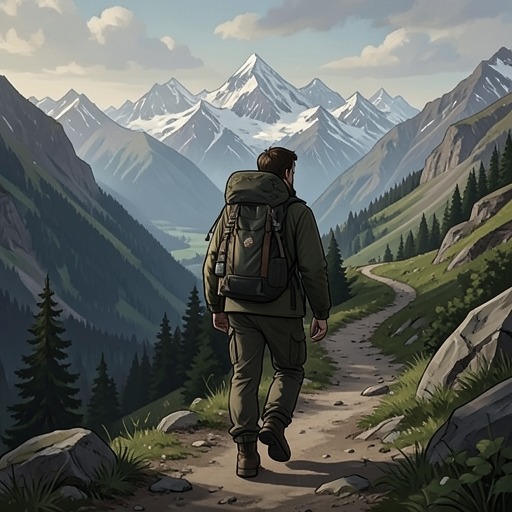
Pietro first learns his father’s approach to the mountains on excursions to villages at the foot of Monte Rosa. The routes pass through tourist settlements—villas, early-twentieth-century hotels in an “Alpine” style, later condominiums, and riverside caravan sites—before leaving the built valley for a steep path into the woods. His father sets a strict pace and rules: keep walking, do not talk, and choose the uphill path at a fork. The woods are not an end in themselves for him, but access to the high country. Crosses, plaques, and small shrines along the way briefly give the forest the feeling of a cemetery, and the silence between father and son changes into a form of respect.
The ascent also reveals distinct mountain zones and distinct ways of belonging to them. The woods around fifteen hundred meters, with spruce, larch, junipers, blueberries, and rhododendrons, are associated with Pietro’s mother. Pietro is drawn higher, to meadows, torrents, wetlands, herbs, and grazing animals; above these, vegetation gives way to snow, gray quartz-veined rock, and yellow lichen. After hours of walking, the path reaches scree, glacial lakes, avalanche-cut gorges, and icy streams. This is the terrain where his father becomes visibly happier and lighter on his feet. Pietro, by contrast, is exhausted and nauseated as the climb approaches three thousand meters. The same ascent that restores his father makes every further meter a struggle for his son.
Hidden Paths and Human Traces
Bruno’s knowledge of the Alps offers a different way into the landscape. When the two boys go into the mountains, their destination is not necessarily a peak: Bruno leaves the beaten track for gorges, dense fir woods, fissures in rock, and narrow ledges that Pietro would not have recognized as passages. Bruno reads the land through signs of its earlier use. Rusted cable-lift machinery, fire-blackened earth, excavations, and ruins mark the work of miners and woodcutters. He explains these traces alongside the local names for trees, rocks, and the sunny and shaded sides of a valley, teaching Pietro to experience the mountains through tangible things rather than books.
The Alps also retain traces of movement on a larger timescale. Across the river from the boys’ familiar haunts, a wood of wild pines shelters enormous monoliths that the glacier had carried there in the distant past. Moss, earth, and trees have partly covered them; young climbers have brushed some clean, given them names, and devised rope-free routes up their faces. Pietro joins them, attracted to a form of climbing that contrasts with his father’s prohibition against places where he would have to depend on his hands. The boulders are thus both geological remnants and a setting for a new practice brought from the city into the mountains.
Routes as Memory
The mountains become legible to Pietro through records as well as paths. When he returns to his parents’ old house, he finds his father’s map still pinned to the wall, transformed by twenty years of marked routes into something like a biography. Its dense lines reach across summits, pastures, and refuges. Pietro works out that black marks his father’s solo journeys, red the routes he shared with Pietro, and green the ones he shared with Bruno. The colors reveal that his father continued to climb with Bruno as well as alone, and that their shared mountain history was larger than Pietro had known. The map records excursions, but it also unsettles his understanding of who had accompanied his father through the years.
A summit notebook makes that record more intimate. On a barren mountain above the house, Pietro finds a metal box containing a weather-damaged notebook, where climbers have left names, dates, and brief remarks. Its pages show that fewer than ten people a year reach the summit. Among the entries he recognizes his father’s handwriting: in 1997, Giovanni Guasti recorded that he had climbed from Grana in three hours and fifty-eight minutes and was still in great shape. The note supplies a precise, ordinary trace of his father’s life in the mountains. Pietro imagines him timing the ascent and arriving alone, but does not tear out the page; removing it would feel like taking a stone from the summit.
The House and the Work of Remembering
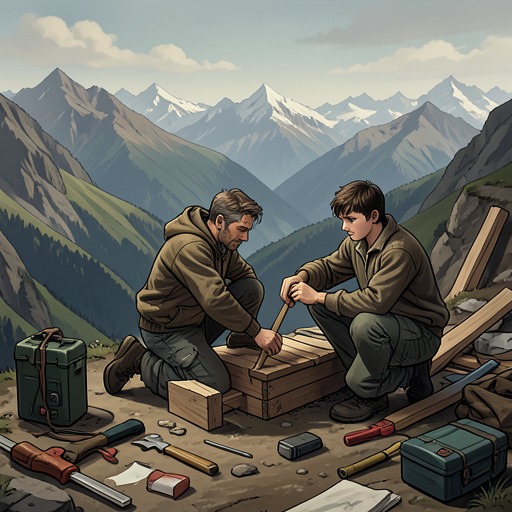
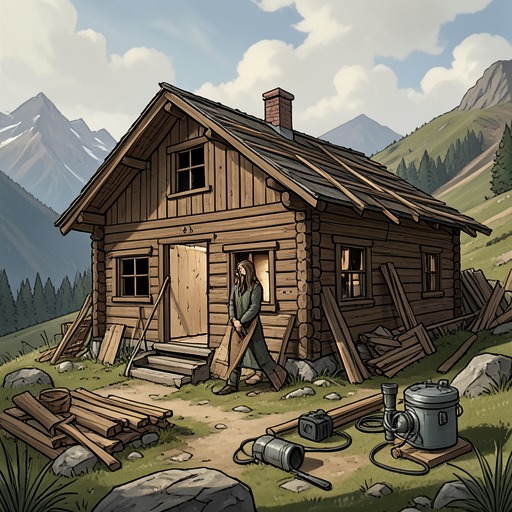
The Alps are also the setting for a shared act of rebuilding. At the beginning of June, during a fast thaw, Pietro and Bruno carry a spade, pickaxe, hatchet, chainsaw, and half a tank of petrol up to the ruins they call Barma. Snowmelt swells the river, sends water down the valley, and softens the earth. The surviving lower sections of the walls are solid, but the upper long wall has been pushed outward by the collapsed roof, while the short walls are unstable. Bruno judges that they must be demolished almost to their foundations rather than straightened. The work begins by accepting the ruin’s actual condition, not by pretending the old structure can simply be restored.
When the house is finished, its practical details connect it to the mountain-refuge tradition: the equipment room is locked, but the wooden room is left open so that a passerby in difficulty can find shelter. Pietro’s mother climbs up in her old leather boots and, on a short September day, takes in the lake, scree, peaks of Grenon, and the house. On the rock wall, Pietro has carved and painted Giovanni Guasti’s name and dates, followed by the words “IN MEMORY IS THE MOST BEAUTIFUL REFUGE.” He and Bruno sing the song for a dead lover of the mountains. Pietro then tells Bruno that the house should belong to both of them. The Alpine house becomes a memorial to Pietro’s father and a home whose future is shared with his friend.
Seasons, Distance, and Home
The Alps keep changing after the house is built. On Pietro’s return from Nepal, prayer flags in blue, white, red, green, and yellow hang between two larch trees, visible from the house’s window. Their colors represent ether, air, fire, water, and earth; in the Alpine wind, they make Pietro’s memories of Nepal vivid against the desolate sight of derelict huts and ruins around Grana. The flags do not erase the difference between mountains. They bring one mountain world into view from another, while the Alps remain the place where Pietro’s personal history is most readable.
Seasonal change gives that history a harsher edge. In October, drought and frost turn Grana’s valley ochre, while larches blaze gold and bronze against dark pines. Ice forms slides and galleries over the river stones, trapping dry grass. Bruno’s farmstead has been carefully prepared for winter: the stable is sealed, shutters closed, wood stacked, troughs overturned, and manure spread across the meadows. The orderly signs of his departure contrast with the farm’s former noise and life. In the winter of 2014, the Western Alps receive their heaviest snow in half a century; ski resorts record three meters by the end of December, six by the end of January, and eight by the end of February. This accumulation buries the woods and Barma. When Bruno cannot be found, rescuers dig through the snow to the roof, but the house is empty and no tracks can be found. The Alps that have preserved routes and inscriptions also make a person disappear from view, leaving the landscape at once a home, an archive, and an uncertain refuge.