The Decline and Abandonment of Alpine Settlements
The Eight Mountains: A NovelThe decline and abandonment of Alpine settlements are made visible in the novel through buildings left behind, agricultural works falling out of use, and vegetation reclaiming cultivated land. The change is not a single catastrophe but a gradual alteration of the mountain landscape and the lives built around it. Pietro encounters its traces in Grana and the higher settlements, while Bruno’s effort to revive a farm shows both the appeal of restoring mountain life and the difficulty of making that restoration endure.
Evidence of Depopulation
As children, Pietro and Bruno explore abandoned buildings in Grana: stables, haylofts, granaries, a shop with empty shelves, and an old bread oven. Some kitchens still contain tables, benches, plates, glasses, or pans, remnants of ordinary domestic life amid disuse. The contrast between these intact objects and the buildings’ abandonment makes the village’s decline tangible. In 1984, only fourteen people lived in Grana, although the village had once held as many as one hundred. The school, a comparatively large and prominent building, has been turned into a place for raising rabbits; its classroom retains the crucifix and desks, even as its former public purpose has disappeared.
The settlements higher on the mountain appear still more depleted. Pietro’s father points out the labor that once made them habitable: land leveled for cultivation, stones gathered into piles, irrigation and drainage ditches, and riverbanks terraced for fields and vegetable gardens. He attributes this work to people who arrived from the north of the Alpine region in the Middle Ages and describes their capacity to live through winters in relative self-sufficiency. The ruins are therefore not merely empty structures. They record a system of sustained work and practical knowledge, whose disappearance leaves Pietro unable to imagine fully how anyone could have chosen such a demanding life.
Reclamation and Physical Change
The prospect of abandonment is voiced by Luigi Guglielmina, who calculates that his small Alpine farmstead no longer makes economic sense at current prices and under the regulations facing cattle breeders. He continues working from passion, but predicts that within ten years of his death the land will return to forest. Pietro begins to picture weeds and shrubs covering the pastures and eventually obscuring drainage ditches, dry-stone walls, paths, and houses. The prediction gives the changing landscape a longer timescale: what appears as an established human environment may be only a temporary clearing maintained by repeated labor.
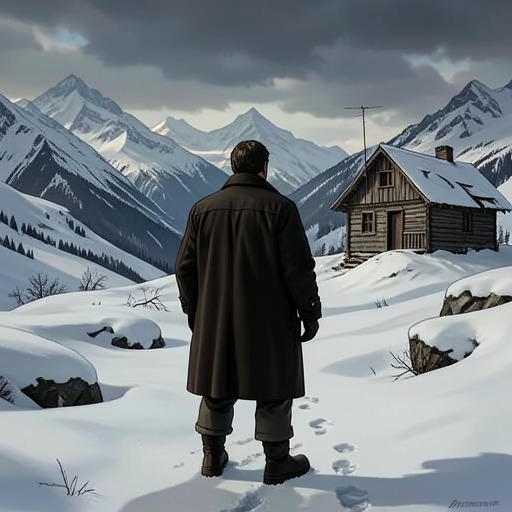
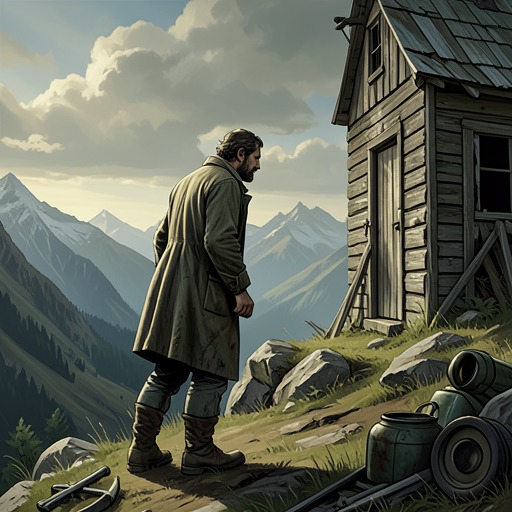
The later condition of the farmstead bears out part of that expectation. A hut roof has caved in, its supporting wall pushed out; doors have come off their hinges, and a bath left outside has rusted. Larch saplings are growing across the pastures. Beyond the cabins, a landslide has carried down a section of the mountain, trees, and rocks. Four years later, its unstable ground still shifts underfoot, and the route that once led through the area is gone. Bruno continues along the damaged terrain, saying that few people had used the path even before and that he may now be its only visitor. The flood and landslide do not account for the original abandonment, but they accelerate the loss of access and make the altered landscape harder to traverse.
Other ruins preserve different stages of that history. Near the lake, Pietro finds one small building with a partly collapsed roof, vandalized interior, discarded crockery, and a stove he intends to salvage before another collapse buries it. A second ruin is much older: a large Alpine farmstead of separate structures, with external stone staircases and massive roof beams, reduced to rain-scoured standing walls. The contrast between the two sites suggests successive forms of settlement and construction, while both now stand outside the routines that once gave them use.
Attempts at Renewal
Abandonment is not presented as an irreversible condition in every instance. After spending time rebuilding Barma with Pietro, Bruno plans to buy his uncle’s farmstead. His cousins are willing to sell, and Bruno uses his savings for a down payment, intending to borrow the remainder from a bank. He believes his months at Barma have tested his capacity for the work. The plan is to rebuild the huts, acquire cattle, and establish a functioning farm over the following years. His project turns the ruins from evidence of a finished past into a possible site of renewed labor, although its success depends on money and an economic future the plan cannot guarantee.
The following June, Bruno brings twenty-eight pregnant dairy cows up from Grana. Pietro, Bruno’s mother, and Lara help contain the animals in the village square before the herd sets out along the mule track, accompanied by two shepherding dogs. The animals pass derelict huts, stone walls, and the remains of felled larches. To Pietro, the movement of the herd makes the valley seem briefly alive again: an active agricultural use returns to ground that had been losing its human presence. The scene is a concrete counter-image to the spreading ruins, but it does not establish that the wider process of abandonment has been reversed.
Limits and Significance
The novel keeps the labor and economics of mountain life in view alongside its emotional pull. Bruno’s farm is eventually not viable, and Lara later recalls that other options had been available: selling the cows, renting out the farmstead, and seeking work elsewhere. Bruno refuses to imagine an alternative life. Lara concludes that his attachment to the mountain has taken precedence over her and Anita and over the future they had tried to build there; she begins to imagine leaving with their daughter. The farm’s failure thus carries consequences beyond the land itself, contributing to the breakdown of a family as well as exposing the limits of a private attempt to resist decline.
At the same time, the mountain settlements are not depicted as empty scenery waiting to be restored. Their terraces, ditches, walls, paths, and buildings embody generations of maintenance, while the return of shrubs and trees marks the fading of that work. Pietro also encounters newer changes: a mobile-phone mast beside the ruins of a tower and a cement dam interrupting the river, with an excavator removing mud from an artificial reservoir. The altered valley therefore bears both abandonment and modern intervention. Across these details, the decline of the settlements becomes a history written into land and infrastructure: human presence recedes unevenly, natural processes continue, and individual efforts at return can revive a place without resolving the economic and familial conditions that made it vulnerable.