The Eight Mountains
The Eight Mountains: A NovelThe Eight Mountains is a parable about two ways of knowing the world: traveling among its many mountains or climbing the one at its center. An elderly chicken carrier in Nepal gives Pietro this image by drawing a wheel in the dirt. Years later, Pietro redraws the mandala for Bruno, and the story becomes a language for their contrasting lives and for a loss that neither journeying nor staying can undo.
The encounter and the drawing
Pietro hears the legend beneath Everest, while the old man is carrying live hens up a valley toward refuges where they will become chicken curry for tourists. His load is a portable cage divided into a dozen cells, carried by a band across his forehead. When Pietro asks to photograph it, the man sets it down on a low wall, removes the carrying band, and poses beside the chickens. The encounter begins with a concrete object of mountain travel: not a climber’s equipment but a cumbersome, living cargo moving along the same routes as supplies for visitors.
Their conversation turns from the region the man comes from to Pietro’s own attachment to mountains. Pietro explains that he grew up beside a mountain to which he remains attached, and that this bond made him want to see the most beautiful mountains in the world. The chicken carrier interprets that desire as a recognizable undertaking: “You are doing the tour of the eight mountains.” The phrase makes Pietro’s personal impulse sound like a pilgrimage with a shape and destination, although he has not previously heard of the eight mountains.
Asked whether he has seen such a drawing, Pietro answers, “In mandalas.” The old man draws with a small stick, first making a circle and then dividing it into eight spokes. Pietro notices that he himself would have begun with a cross, and thinks of the circle-first design as typical of an Asian approach. That reaction belongs to Pietro’s perspective, not to an explanation offered by the man; the important exchange is that Pietro recognizes the form as a mandala, while the carrier uses it to set out a whole cosmology.
Eight mountains around Sumeru
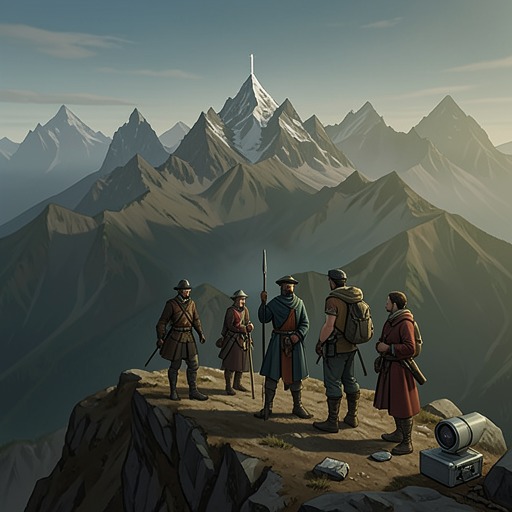
The carrier explains that, in his account, a tremendously high mountain called Sumeru stands at the earth’s center, surrounded by eight mountains and eight seas. As he speaks, he adds a small peak at the end of each spoke and a wave between each neighboring pair. At the center he draws a crown that Pietro takes to represent Sumeru’s summit. The picture is at once a diagram and a small enacted lesson: its ordered rings place the surrounding world in relation to a single, central height.
The question that gives the story its force is not simply which peak is tallest. Pointing to the center, the man asks, “who has learned most, the one who has been to all eight mountains, or the one who has reached the summit of Sumeru?” The alternatives distinguish breadth of experience from concentrated ascent. One life moves outward through a circle of places; the other aims toward the highest point at the center. The question leaves their value open rather than declaring one path superior.
Pietro is amused and believes he has understood the story’s meaning, but the drawing stays with him after the man rubs it away. The contrast between a durable lesson and an erased picture is built into the encounter: the diagram exists only briefly in the dirt, yet Pietro carries it forward as a memory and as a story to tell Bruno. Its survival depends not on the drawing itself but on retelling.
Pietro redraws the legend for Bruno
When Pietro later sees Bruno in a low state, he remembers the chicken carrier’s legend as a possible way to reach him. Pietro tries to reproduce not only its words but its gestures, scratching the mandala into a wooden tile with a nail. The change of surface matters to the retelling: the old man’s wheel had been drawn on the ground and wiped away, while Pietro marks the image into a tile as he brings it into the friendship’s private history.
Bruno recognizes the contrast as a description of the two friends. He asks, “So you’re supposed to be the one who journeys to the eight mountains, and I’m the one who climbs Sumeru?” Pietro agrees: “It looks like it.” Their exchange assigns them different positions within the parable without making either position an achievement in itself. Pietro is the one who goes from place to place; Bruno is associated with the central, highest ascent. Bruno then asks which of them achieves something good. The legend has become more than an anecdote about Himalayan belief: it lets the friends test their divergent lives against a question neither can settle by simply naming a winner.
The legend after loss
Late in the book, Pietro recalls what his father had taught him: some people have mountains to which they can never return. For lives like his and Bruno’s, he says, there can be no return to the mountain at the center of everything, the one at the beginning of one’s own story. The eight mountains then acquire a sorrowful meaning. Wandering among them is what remains for people who have lost a friend on the first and highest mountain.
This final use does not cancel the old man’s open question; it changes its emotional weight. The tour is no longer only an expansive curiosity about beautiful mountains, and Sumeru is no longer merely the destination of an imagined climber. The center represents an origin bound up with friendship and memory, but it cannot be recovered by going back. Pietro’s later wandering in the Himalayas—choosing an unfamiliar region, leaving the trail out of curiosity, and lingering by a river—recalls the way he and Bruno used to be in the mountains together. He thinks that continuing to travel in this manner may preserve their secret, even as the damaged house at Barma comes to mind from far away. The legend thus holds together movement and attachment: the friend who goes on wandering carries the lost central mountain with him, but cannot return to it.