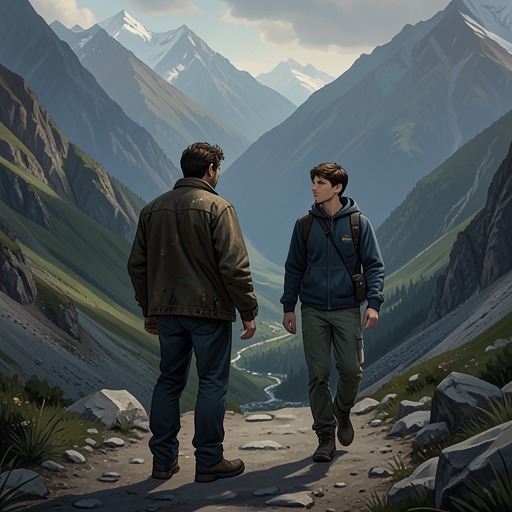
The Father's Rules for Climbing
The Eight Mountains: A NovelThe Father's Rules for Climbing are Giovanni Guasti’s code of movement in the mountains: set a pace, do not stop, keep silent, and take the uphill route when the path divides. More than practical instructions, they express his competitive, impatient approach to climbing and shape the physical and emotional terms of his relationship with Pietro. Their legacy survives in remembered gestures and marked routes, even as Pietro ultimately chooses a different understanding of what the mountains can hold.
A Code of Pace and Effort
Giovanni’s mountain manner is defined by forward motion. He climbs headlong, without pacing himself, and treats a steep shortcut as preferable when the trail seems too long. On climbs with Pietro, he forbids stopping to complain about hunger or cold. A good song is permitted, particularly in a storm or thick fog, as is whooping while sliding down a snowfield; otherwise, the climb is governed by exertion rather than contemplation.
The rules become especially precise on walks near Monte Rosa. Giovanni lets Pietro walk ahead while he follows one step behind, close enough for Pietro to hear his instructions and his breathing. The essentials are to establish a pace and maintain it without stopping, to refrain from talking, and to choose the uphill branch at a fork. Though smoking and sedentary office work leave Giovanni puffing harder than his son, he will not allow a break for at least an hour—not to recover their breath, drink, or look around.
That discipline also determines what counts as scenery. Pietro’s mother teaches him to recognize plants and trees, but Giovanni regards the woods chiefly as a way through to the mountains. He and Pietro concentrate on the rhythm of their legs, lungs, and hearts. Yet the silence is not always simply a demand for effort: when they pass crosses, plaques, or small shrines, it takes on a respectful character, as though quiet is the proper way to move past them.
The Climb as Pursuit
The rules belong to a competitive style of climbing. Giovanni’s mother recalls that, even as a boy, he waited for nobody and pursued anyone he saw ahead. On the mountain paths with Pietro, that impulse turns the ascent into a race. After they pass August pastures, isolated alpine farms, cows, growling dogs, and nettles that sting Pietro’s bare legs, Giovanni directs him to cut across a slope that is too gentle and go straight uphill.
The steep final slopes bring the pair up to men of Giovanni’s age who have been trying to stay ahead. Their formal manner of stepping aside gives the encounter the air of an older climbing code. When one remarks on how quickly Pietro can run, Giovanni replies that the boy sets the pace and he follows. The answer gives Pietro a role in their pursuit, but does not undo the underlying contest: the son is drawn into his father’s way of measuring a climb through speed and endurance.
Years later, a summit notebook supplies another measure of that same drive. Pietro finds Giovanni’s 1997 entry on a mountain above Grana: he had climbed up from the village in three hours and fifty-eight minutes and recorded that he was still in good shape. The short, upbeat note makes the climb legible as an achievement timed against a four-hour threshold. Even when alone, Giovanni’s mountain practice remains organized around pace, physical capacity, and the satisfaction of reaching the summit quickly.
Rules, Conflict, and Refusal
The code offers little room for Pietro to voice resistance. At sixteen, he recognizes that a camping trip his father proposes is out of character: Giovanni has bought a heavy surplus tent and planned fishing, a fire, roasted trout, and a night together by a small lake. Pietro suspects the outing is also meant to draw him into saying what he has kept unspoken about their family life. The shared trip, with its promise of intimacy, feels to him like another situation already arranged by his parents’ familiar roles.
When Pietro finally refuses to go, he understands the refusal as a decisive blow. Giovanni leaves the rucksacks, tent, and sleeping bags where they are and walks out alone; for Pietro, declining the climb brings liberation. This rupture reveals the cost of a relationship in which the mountain has often provided the terms of contact, but not necessarily the means for discussing what either person needs. The rules can organize a journey; they cannot make his son willing to follow.
What the Mountains Preserve
Although Pietro later breaks with his father for years, the climbing code remains visible in the record of Giovanni’s routes. Looking at the map Giovanni left behind, Pietro finds that it has become a dense record of excursions: black, red, and green lines cross trails, summits, alpine farms, and refuges. Pietro deciphers black as Giovanni’s routes, red as his own shared climbs with his father, and green as Bruno’s. At places where the red and green trails end but the black continues, the map shows that Giovanni completed a climb alone on another occasion. It preserves both the father’s solitary effort and the different company he found in the mountains.
Pietro eventually comes to understand his father in two parts: the man he knew in the city and the mountain walker he had only glimpsed, who followed behind him on the path and loved glaciers. The distinction does not erase their estrangement, but it changes what Pietro can inherit. He rebuilds the ruin his father left him with Bruno, and makes clear that the resulting house is to belong to both of them. At its completion, Pietro carves Giovanni’s name and dates into the rock and adds the memorial words that memory is the most beautiful refuge. The mountain inheritance thus shifts from a rule-bound pursuit to a shared place of remembrance and shelter.