The Marriage of Giovanni Guasti and Pietro's Mother
The Eight Mountains: A NovelThe Marriage of Giovanni Guasti and Pietro's Mother begins in the Dolomites, where the couple’s love of the mountains became both the setting of their courtship and the founding story of their family. They married there in 1972, then left for Milan with a pregnancy and a new job ahead of them. Their later life brought together markedly different temperaments: Giovanni’s competitive, solitary approach to the world and his wife’s attentive, socially engaged care. After his death, the mountains and the memories attached to them help their son understand the father he had only partly known.
Courtship and the mountain wedding
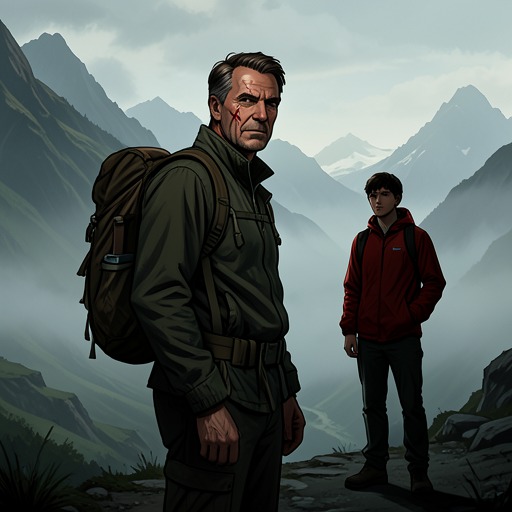
The couple had known the Dolomites as their first mountains and their first love. A priest took them there as adolescents, and it was the same priest who later married them. Their wedding took place on an October morning in front of a small chapel at the foot of Tre Cime di Lavaredo. The bride’s parents boycotted the ceremony, for reasons the son never learns; a handful of friends attended instead, dressed in anoraks rather than wedding clothes. The newlyweds spent their first night as husband and wife at the Auronzo refuge, while snow already shone on the ledges of Cima Grande.
The wedding’s mountain setting was not simply a picturesque backdrop. For the family, it became a foundational story that joined the parents’ courtship to the landscape they had loved before moving to the city. The ceremony also marked an ending: the following day, they packed their leather climbing boots and plus fours into the car and set off for Milan. They carried with them both a pregnancy and the contract for Giovanni’s new job. They were in their early thirties, leaving behind the Veneto countryside where Pietro’s mother had been born and where Giovanni had grown up as an orphan of the war.
Two ways of remembering the mountains
Their contrasting responses to climbing reveal a difference that persisted within their shared attachment to the mountains. Giovanni climbed headlong, refused to stop, and treated the ascent as a contest against whoever or whatever lay ahead. His wife, by contrast, might pause in a meadow, soak her feet in a stream, or name the herbs and flowers. At a summit she preferred to look toward distant peaks and remember where she had been and with whom; Giovanni, once at the top, could feel disappointed and want to go home. The son understands these as opposite expressions of a shared nostalgia, rather than evidence that one parent loved the mountains and the other did not.
The Dolomites remained present in their city life through remembered names and family images. When Giovanni named peaks such as Sassolungo, his wife’s eyes would light up. At home the couple continued to speak the dialect of the Veneto, which their son experienced as a private language carrying an echo of an earlier life. Photographs of her family and of relatives in mountaineering gear gave that past a visible place in the Milan home. The marriage thus linked migration and urban life to a landscape neither parent had simply left behind.
Marriage in Milan: solitude and care
In Milan, their differences took on a daily shape. Giovanni worked as a chemist in a large factory and returned home angry about events at work and in the wider world. At supper he watched the news in silence, and conversations with the few colleagues he invited home often ended in arguments. His political independence left him isolated: workmates eventually stopped visiting. He slept poorly, used earplugs and headache pills, and sometimes erupted in rage. His wife would step in to calm him, taking on the work of muffling the conflict between her husband and the world around him.
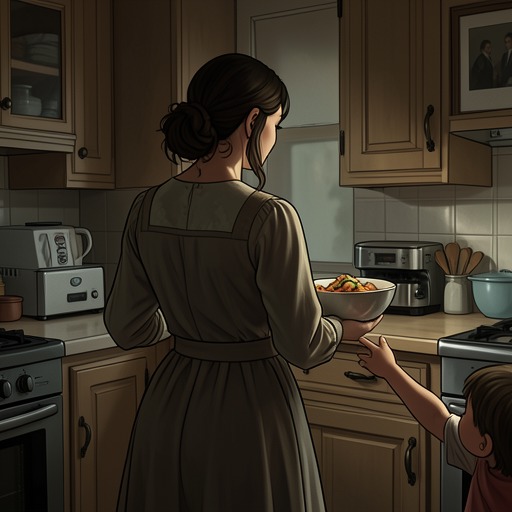
Her own working life reflected a contrasting orientation toward other people. A nurse in the Veneto, she found a health-worker position in Milan’s working-class Elms district, supporting women during pregnancy and following infants through their first year. On visits to assess children’s circumstances, she could be deeply affected by what she encountered. When serious concerns required referral to the juvenile court, the decisions caused her anguish and sometimes brought insults and threats, but she remained convinced that she had acted rightly. The account presents this work as part of her life in the city, not as a simple resolution to the strains of the marriage: Giovanni remained a loner, while she cultivated professional and communal ties.
That difference also surfaced in their response to a child’s education. In Grana, she pursued help for Bruno, who had stopped attending school and had not advanced beyond primary level. Giovanni cautioned that she could not rescue everyone, but she answered by invoking the fact that someone had helped him and that he himself had been able to study. His brief response turned toward his own childhood, a subject the couple rarely discussed; he shook his head and let it drop. The exchange exposes an unresolved part of their shared history without explaining it away. It also shows her persistence and his reluctance to revisit painful experience.
After Giovanni: memory and inheritance
After Giovanni’s death, Pietro’s mother’s way of sustaining relationships becomes newly visible to her son. Friends take turns keeping her company through the summer, and he sees the quiet intimacy she shares with one woman in the old house. He contrasts this network of care with Giovanni’s isolation and the sparse funeral, where his father seemed to have no friend to mourn him. The comparison does not erase their marriage; it makes clearer how differently the two parents had lived among other people.
The mountains also continue to hold traces of Giovanni that were unavailable to his son during the years of estrangement. His father’s mountain map, still pinned to a wall, has become a dense record of routes accumulated over two decades. Pietro recognizes that its colored lines distinguish climbs with his father, with Bruno, and alone; the map reveals a mountain life extending beyond the father he knew in the city. Later, a summit notebook supplies another precise trace: an entry by Giovanni records a climb from Grana in 1997, completed in three hours and fifty-eight minutes. These records allow the son to imagine his father in the mountains without claiming that the marriage or family life was free of distance.
When Pietro’s mother visits the rebuilt house, she looks carefully at the lake, scree, peaks, and the inscription commemorating Giovanni. The words on the rock call memory the most beautiful refuge. She then joins Pietro and Bruno in singing a song for a mountain lover who has died. In her presence, Pietro says that the house should belong to him and Bruno together, not to him alone. His mother’s role as witness joins the marriage’s family legacy to a new act of shared belonging: the mountain home does not undo the parents’ departure for Milan or the son’s estrangement from Giovanni, but it gives their history a place where it can be remembered and carried forward.