The Mountain Heights Each Person Prefers
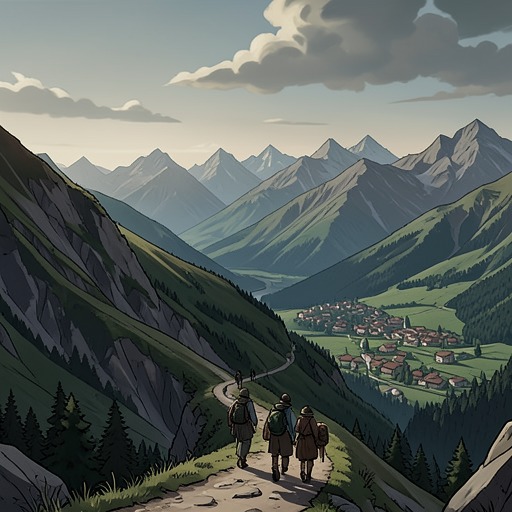
The Eight Mountains: A NovelThe Mountain Heights Each Person Prefers is the idea that each family member has a landscape and altitude in which they feel most at home. For the narrator’s mother, that place is the inhabited, wooded mountain; for Pietro, it lies among alpine meadows and torrents; for his father, Giovanni Guasti, it begins higher still, where vegetation gives way to rock, snow, and glaciers. The contrast gives physical shape to their different temperaments and to Pietro’s gradual understanding of the father he knew most fully in the mountains.
A Family’s Different Mountain Worlds
Pietro’s mother resists the glacier and regards three thousand meters as the mountain’s limit. That height corresponds to the range she knows in the Dolomites, but her attachment is not to summits: she loves the woods at about fifteen hundred meters, as well as the lower villages of wood and stone. Her preferred mountain life includes walking, drinking coffee in a village square, reading in a meadow, and exchanging a few words with a passerby. She endures the family’s repeated moves between holiday lodgings, but would rather have a home of their own and a village to return to. Her sense of belonging is rooted in human settlement and continuity.
Pietro is more drawn to the band above the woods: alpine meadows, torrents, wetlands, high-altitude herbs, and grazing animals. His attraction to this landscape does not mean that he shares his father’s ease at altitude. As the path climbs toward three thousand meters, the terrain grows rougher and less legible, marked by cairns and painted signs. Pietro struggles with exertion and lack of oxygen, while his father walks ahead, absorbed in the high country. The distinction is between the landscape that calls to Pietro and the bodily cost of following his father farther into it.
The High Country and Giovanni Guasti
Above the meadows, vegetation disappears beneath lingering snow, and gray rock veined with quartz and yellow lichen becomes the prevailing scene. After hours of walking, woods and pasture give way to scree, glacial-basin lakes, avalanche-cut gorges, and streams of icy water. This harsher, more exposed country is where Giovanni becomes happy. His step seems lighter there, as if the mountains restore an agility that has been lost elsewhere. The mountain is not simply scenery he enjoys: it is the setting in which Pietro sees him become a different and more vivid person.
The ascent also exposes the distance between father and son. Giovanni leads the expedition and may call Pietro’s attention to ibex on the ridge, but he does not reliably turn back to check how his son is coping. For Pietro, reaching the summit brings relief rather than triumph; it offers no special reward, and he would have preferred a river or a village. The summit’s meaning therefore differs by person. Giovanni finds happiness in the high landscape itself, while Pietro’s attention remains divided between its appeal and the effort required to reach it.
Routes as a Record of Belonging
Years later, Pietro reads his father’s thumbtacked mountain map as something more than a guide to trails. Two decades of marked routes have made it resemble a biography: its black, red, and green lines preserve journeys that Pietro gradually learns to distinguish. Black records Giovanni’s routes, red accompanies Pietro on their climbs to four-thousand-meter peaks, and green identifies Bruno. Where the red and green routes end but the black line continues, Pietro understands that his father completed the climb alone on another occasion. The map shows that Giovanni’s high-country life continued both with companions and apart from them; its dense network becomes a material record of the mountains that mattered to him.
A summit notebook makes that record more personal. On the barren mountain above his house, Pietro finds Giovanni’s 1997 entry: he had climbed from Grana in three hours and fifty-eight minutes and noted that he was still in great shape. The brief, upbeat inscription gives a specific measure of his father’s speed and enduring attachment to the ascent. Pietro imagines him reaching the summit alone, intent on coming in under four hours. The mountain that once meant difficult exertion to the son had also been a familiar arena in which his father could test his strength and take pleasure in being there.
Memory, Home, and Different Paces
The differing preferences do not resolve into a single ideal of mountain life. Pietro’s mother’s steady pace and affection for a settled home coexist with Giovanni’s restless routes into the heights and Pietro’s attraction to the middle slopes. When she visits the house Pietro and Bruno have built, she climbs for two hours without stopping, keeping her own sure rhythm. She is happy to see the house and takes time to look from its terrace at the lake, scree, peaks of Grenon, and the building itself. Her visit brings her into a higher landscape without erasing the slower, more settled way she moves through it.
At the house, Pietro has carved Giovanni’s name and dates into the rock and added the words, “IN MEMORY IS THE MOST BEAUTIFUL REFUGE”. The inscription and the routes on the map turn mountain places into records of family memory. For Pietro, learning that his father’s life had extended across so many paths helps distinguish the stranger he knew in the city from the man he glimpsed on the mountain trails. The family’s preferred heights remain different, but the landscape preserves their separate ways of belonging—and gives Pietro a way to remember the father he came to understand there.