The River as a Metaphor for Time
The Eight Mountains: A NovelThe River as a Metaphor for Time gives physical direction to an abstract question: where the past and future lie in relation to the present. In a conversation with his father, Pietro initially assumes that time moves like river water downstream. Later, imagining the current as a trout might experience it, he reverses that answer. The change becomes more than a clever solution to a riddle: it joins the river’s flow to the mountains, and links the son's understanding of time with his growing understanding of his father.
A Question Beside the River
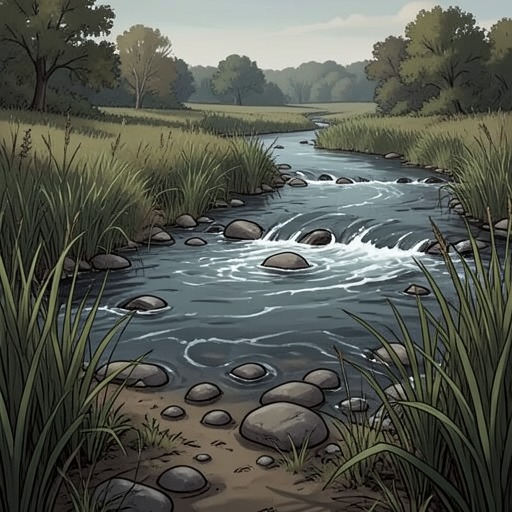
While preparing to leave, Pietro's father asks whether the past can happen again, then points to the river and proposes that its water represent time passing. If their present position is the present, he asks where the future would be. Pietro gives what seems to him the obvious answer: downstream, where the water goes. His father calls that answer wrong, adding, “Fortunately.” The exchange ends amid the practical business of carrying suitcases, but the question remains unresolved for Pietro.
The scene presents time first as a problem of orientation. Pietro takes the river’s direction of travel as the direction of the future: water moves away from where they stand, so the future must lie ahead of it. His father’s brief correction unsettles that simple mapping without explaining the alternative. The difference between the boy’s confident answer and the father’s unexplained response leaves Pietro with a riddle to work through later.
The Trout’s Point of View
That evening, unable to sleep, Pietro returns to the river in thought. His childhood has been solitary, and he has not been accustomed to doing things with others; the day has brought an unexpected intimacy that attracts and frightens him. To settle himself, he pictures familiar features of the water: a pool, a small waterfall, trout holding position against the current, and leaves and twigs carried onward. He also imagines trout darting toward prey. These details shift the metaphor from an observer’s view of the river to the experience of an animal waiting within it.
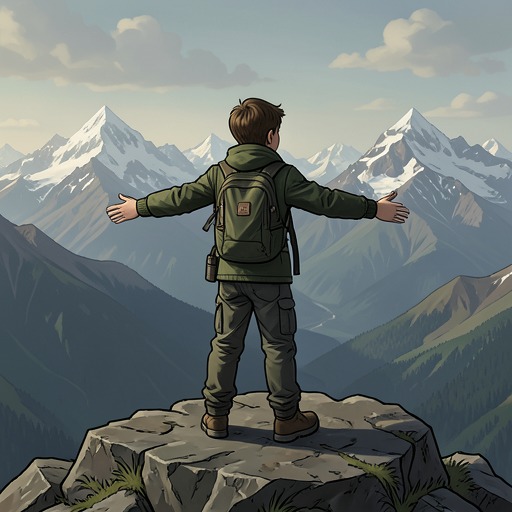
From a trout’s perspective, what matters comes from upstream. Insects, branches, and leaves arrive from above, so the fish looks toward the source of the current rather than toward the water’s destination. Pietro uses that reversal to answer his father. The present is the place where a person is immersed in the river; the water that has already passed and gone downstream becomes the past, while water arriving from above becomes the future. It carries dangers and surprises, not merely the promise of what lies ahead. Pietro’s conclusion is expressed in the image “The past is in the valley, the future in the mountains.” The river no longer points toward the future by flowing away: its source, and the future’s approach, are above.
From Direction to Destiny
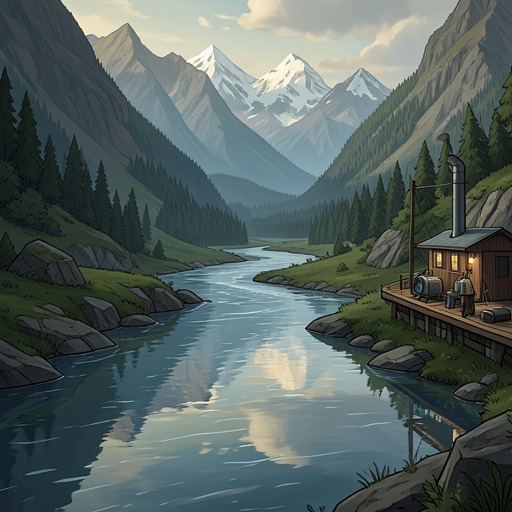
The revised image also alters the scale of the question. The river connects a particular present to the landscape around it, and the landscape gives time a vertical axis. What has passed descends into the valley; what is still to come belongs to the mountains towering over Pietro and his father. Pietro concludes that whatever destiny may be, it resides in those mountains. This does not make the future predictable. In his formulation, it comes down from above bearing dangers and surprises; the mountains mark its direction, not its certainty.
The answer also shows how Pietro learns: he does not simply retrieve his father’s intended solution but reconstructs it through observation and analogy. His first response follows the visible flow. His later one depends on imagining how a fish encounters the current, with food and other materials arriving from upstream. The metaphor thus turns a familiar river into a change of perspective: the same movement looks different depending on where one stands within it.
Riddles, Maps, and Mountain Memory
Years later, the father's mountain map prompts a related act of interpretation. Pietro finds that it has changed from a trail map into a dense record of routes made over two decades, with black, red, and green lines. Treating the markings as a riddle of the kind his father used to pose, he works out that black records his father's routes, red accompanies Pietro on climbs, and green marks Bruno's. The map does not repeat the river metaphor, but it renews the same pattern: a physical trace must be read to recover relationships and events that are not immediately visible.
The story later places this way of thinking beside the father's account of glaciers. After hearing his mother speak, Pietro recalls that his father regarded the glacier as the snow of winters long past, a memory that summer's melting cannot entirely erase. Pietro understands that he has known two versions of his father: the stranger of their city life and the mountain walker he had only glimpsed. These passages distinguish the river’s movement through time from the glacier’s retention of what came before. Together, they frame time not only as loss and passage, but also as something that can leave traces in the landscape and in family memory.
An Answer Carried into the Present
Pietro encounters such a trace on a mountain above Grana, in a summit notebook kept in a metal box. Among its entries he recognizes his father's handwriting from 1997: Giovanni Guasti had recorded climbing up from Grana in three hours and fifty-eight minutes, adding that he was still in great shape. The old entry makes the absent father present through a specific record of his movement in the mountains. Pietro imagines the climb, but the notebook itself establishes only the written time, words, and signature; the distinction between record and memory matters to the way the past is recovered.
The family’s later memorial acts continue this work of reading and preservation. At the house built by Pietro and Bruno, Pietro inscribes his father's name and dates on the rock wall and adds, “IN MEMORY IS THE MOST BEAUTIFUL REFUGE.” He then says the house should belong to both him and Bruno, believing this is what his father wanted while also stating that he wants it himself. The river image does not prescribe that outcome, but its movement from a childhood riddle toward a mature understanding of memory helps illuminate the progression: the past cannot simply be made to happen again, yet what has passed can still shape the life and places that follow. The future remains in the mountains—not as a settled destination, but as what approaches from beyond the present.