Winter of 2014
The Eight Mountains: A NovelWinter of 2014 is the season in which extraordinary snowfall transforms the mountains around Grenon from familiar terrain into a landscape of burial and rupture. Its decisive events include an avalanche that tears through the gorge and shatters the frozen lake, followed in March by Bruno’s disappearance from Barma beneath snow too deep for the rescue team to search safely. The season’s record measurements give scale to the danger, but its most lasting force lies in the uncertainty it leaves behind: Bruno is gone, and Pietro cannot tell Lara what happened to him.
Record Snowfall and Mountain Conditions
The winter’s severity is established through figures that Pietro reads while in Nepal. In the Western Alps, the snow accumulation at the highest ski resorts reached three meters at the end of December, six meters at the end of January, and eight by the end of February. The records were the heaviest for half a century. From far away, Pietro struggles to imagine what eight meters of snow would mean in the high mountains; the measure becomes legible through its consequences, enough snow to bury woods and more than enough to cover a house.
The contrast between the distant statistics and the experience at Barma shapes the season’s narrative. The snowfall is not merely a background condition but a force that changes what can be seen, reached, or known. A house can disappear beneath it, tracks can vanish, and the mountain’s familiar routes can become dangerous or inaccessible. The snow’s accumulation also sets the conditions for the avalanche season that follows: rescue itself must be weighed against the threat of further slides.
The Avalanche on Grenon
During a visit to the Barma mountain house, Pietro and Bruno hear an avalanche descend nearby. Its sound first resembles an airplane or distant thunder, then rapidly becomes a deafening rumble that shakes the glasses on the table. A crash follows, and the noise fades. The two men realize that the avalanche has not passed over the house, but its nearness has frightened them both. In the darkness they cannot see what has happened; after returning inside, neither wants to talk. Later, Pietro hears Bruno get up to put wood in the stove and pour himself a drink.
The next morning reveals the scale of the event. The avalanche began three or four hundred meters above, at the steepest point of Grenon’s main gorge—the same gorge Bruno had skied down only hours earlier. As it plunged, it gouged into the ground, stripping away rock and dragging earth and gravel with it. The gorge is left looking like a dark wound. After falling five hundred meters into the basin, the snow strikes the lake at the foot of Grenon with enough force to break through its frozen surface. The lake’s smooth winter expanse has become dirty snow and blocks of ice.
The damage continues below the visible slope. The surface ice, about half a meter thick, has been overturned and shattered; underneath, a new, thin layer of dark, transparent ice has already begun to form. Crows gather over the debris, drawn to the small silver fish thrown out of the water while they were hibernating. Pietro watches the birds quarrel over one fish, then drives them away with a few steps and a kick. The image makes the avalanche’s violence concrete: a catastrophe that has passed over the mountain has abruptly exposed and killed life hidden beneath the lake’s winter surface.
Bruno’s Disappearance and the Search
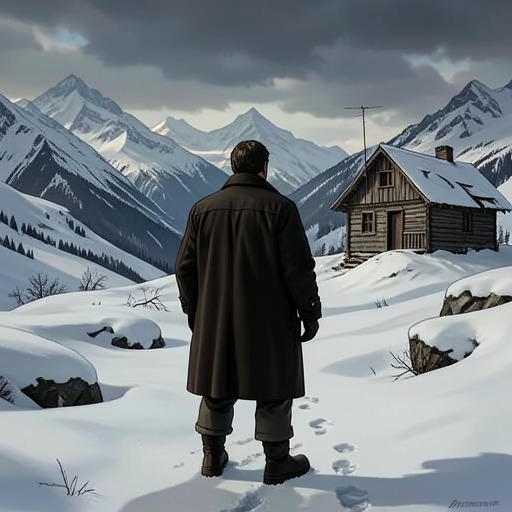
In March, Lara writes to Pietro and asks him to call as soon as possible. Bruno cannot be found. His cousins have gone up to check on him, but no one has cleared the snow at Barma for some time. The small house has vanished beneath it, and even the rock face is barely visible. A helicopter carries a rescue team to the site. They dig down to the roof and make a hole in the tiles, expecting that Bruno might be inside, ill or dead from hypothermia. The house is empty. Recent snowfall has also erased any tracks in the surrounding area.
Because Pietro was the last person to see Bruno, Lara asks whether he has any ideas. He suggests checking whether a pair of skis remains in the storeroom; it does not. That absence gives the search a possible direction but no answer. The mountain rescue team searches with dogs, and Pietro calls every day for a week, waiting for news. The snow on Grenon is too deep, while the arrival of spring brings the worst avalanche conditions.
The search takes place amid a wider disaster. That winter, avalanches in the Italian mountains have killed twenty-two people, and the account says that little attention is paid to a local man lost in a deep valley above his own home. Lara and Pietro do not insist that the search continue indefinitely. They assume Bruno will be found when the snow thaws, perhaps in a gorge in midsummer, and imagine that the crows will find him first. This is not a confirmed account of his fate, but a grim expectation shaped by the conditions around them.
Narrative Significance
The season’s events move from the sound of an avalanche, whose damage cannot yet be seen in the night, to its exposed aftermath in morning light, and finally to a disappearance that remains unresolved. At each stage, the mountain withholds information: darkness conceals the slide’s path, snow conceals the house and tracks, and the avalanche risk limits the search. Pietro can describe what the storm has done to the lake and gorge in exact physical detail, but that precision cannot establish what happened to Bruno.
Lara asks Pietro whether he thinks Bruno wanted this outcome. Pietro answers that he does not, while the narration makes clear that he is lying. The lie leaves the central question unsettled rather than resolving it: Bruno’s absence may invite speculation, but the evidence in this winter offers no certainty about his intentions or final moments. Against the record-breaking snowfall and the visible destruction on Grenon, the human loss remains difficult to measure. Winter of 2014 is therefore both a specific period of exceptional weather and the setting for the book’s starkest limit of knowledge: a mountain can leave abundant traces of what it has damaged while hiding the person who has disappeared into it.