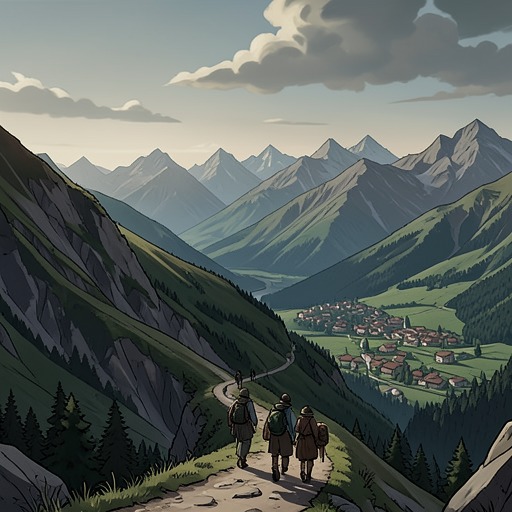
“The beauty of the reverse side”
The Eight Mountains: A Novel“The beauty of the reverse side” is Pietro’s name for the appeal of the mountain’s less inhabited face. The phrase turns the geographical contrast between sunlit slopes and shaded forest into a way of seeing: beauty here is not tranquillity or open prospect, but privacy, difficulty, and a somber sense of power.
A landscape divided into two sides
In the mountain dialect Bruno teaches Pietro, each valley has an adret and an envers. The adret faces the sun and holds villages and fields; the envers lies damp and shadowed, given over to forest and wildlife. The terms do more than label opposing slopes: they make the valley legible through distinct conditions of light, habitation, and wildness. Although the sunny side might seem the more inviting, the boys prefer the reverse side.
That preference has a practical dimension. In the forested envers, they can go undisturbed and search for treasure in old mines around Grana. Their expeditions lead into boarded-up tunnels, some of them winding and pitch-black, where the possibility of finding gold competes with the danger of cave-ins and the need to turn back. The reverse side is therefore neither a decorative wilderness nor an untouched refuge: it bears traces of past work and human risk, even as it offers the boys a world apart.
From terrain to feeling
The phrase acquires its fullest emotional force in a scene where rain begins as something between rain and snow. The sky seems caught between winter and spring, and it hides the mountains, stripping the landscape of its visible mass. Yet the obscured view does not diminish the place. Pietro senses its beauty precisely as a somber and bitter presence, conveying awesome power rather than tranquillity, along with anguish.
This description deepens the earlier distinction between the adret and the envers. The reverse side is not beautiful because it is simply picturesque or comfortable; its dampness, shadow, and remoteness belong to the attraction. The weather makes that attraction legible by withholding the familiar outline of the mountains. What remains is an impression of force and unease, a beauty that resists the consolations of a clear view.
A name for a place and a way of seeing
After describing this beauty, Pietro asks whether the place has a name. Bruno recalls that his mother called it Barma drola and trusts her memory of such names. The exchange distinguishes the landscape’s remembered local name from Pietro’s phrase: Barma drola identifies the place, while “The beauty of the reverse side” expresses what its character means to him.
The expression also gathers together the boys’ recurring relation to the mountains. They favor the shadowed side, where they can roam beyond ordinary paths, read old traces in the woods, and pursue imagined treasure. Later, the same reverse-side beauty is felt not as uncomplicated freedom but as a combination of attraction and anguish. The phrase thus holds both the intimacy of a chosen landscape and its refusal to become tame or reassuring.