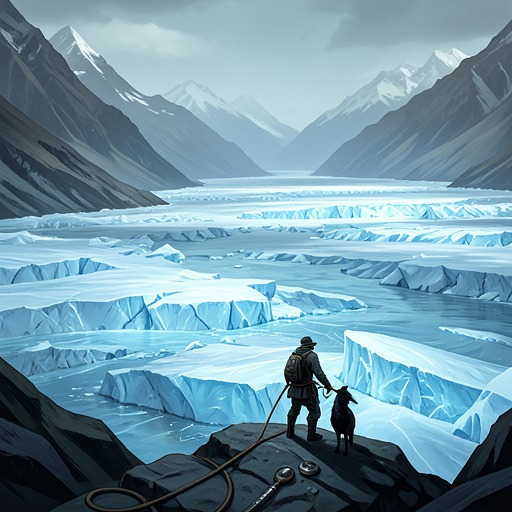
“The glacier is the memory of past winters”
The Eight Mountains: A NovelThe glacier image joins scientific explanation to inherited memory: successive winters are preserved in ice, just as a past that seemed erased can remain present and become legible later. Giovanni Guasti first explains the glacier to his son as a physical archive; years afterward, the son recognizes that the image also describes his father and their estranged relationship. Its force comes from that double meaning: the glacier stores traces, but it also moves, changes, and eventually melts.
A scientific account of stored winters
On the climb toward the Mezzalama refuge, Giovanni describes the glacier as “the memory of past winters which the mountain safeguards for us.” He explains that above the level of permanent snow cover, summer cannot melt all the winter snowfall. Snow left behind is buried by the next winter’s snow and gradually becomes ice. Each successive layer, he says, resembles a tree’s growth rings and can be counted to establish age. The glacier is therefore not an unmoving storehouse: its weight and the smooth rock beneath it make it slide down the mountain toward a level warm enough to melt it.
The explanation makes the abstract process visible in the terrain. Walking over a sandy moraine, the group sees ice and rubble jutting below the path, with rivulets collecting in an opaque, metallic-looking lake. Giovanni tells Pietro and Bruno that its water did not come from that year’s snowfall but from snow stored by the mountain, perhaps from a hundred winters earlier or more. The image of stored time rests on a material claim: old snowfall persists in altered form, travels downhill, and emerges as water.
A lesson shared on the mountain
The image belongs to a particular relationship as well as to a lesson in glaciology. Giovanni draws on his studies in physics and chemistry, but he presents the glacier through a myth-like comparison that Pietro can carry beyond the climb. Rather than simply giving him an answer, he asks him to think about why the ice moves. The teaching combines explanation with an invitation to infer, in keeping with the father’s habit of offering clues rather than solutions.
Bruno is present for part of the lesson. He asks whether the water might come from snow a hundred winters old, and Giovanni replies that it could be older, while noting that its exact age would be difficult to determine without accounting for incline and friction. The conversation keeps the metaphor tied to uncertainty and observation: the mountain preserves evidence, but reading it takes work and may not yield an exact answer.
The image returns as an understanding of the father
Much later, after hearing his mother’s account of the family’s past, Pietro thinks again about the glaciers and the way Giovanni spoke about them. He recalls his father’s formulation that summer erases memories as it melts snow, while the glacier is “the snow of winters long past” and “a memory of winter that does not wish to be forgotten.” What had once sounded like an explanation of ice now helps him understand why something of his father could return through mountain places and recollections, even though Giovanni disliked retracing his steps or thinking about unhappy times.
Pietro’s recognition changes his picture of their history. He understands himself to have had two experiences of his father: the distant man with whom he lived in the city, and the mountain walker who kept behind him on the paths and loved glaciers. The latter had been only partly known to him, yet now feels more intelligible. The glacier image does not undo their estrangement or make the past simple; instead, it gives Pietro a way to recognize that an obscured part of their relationship endured and could still be recovered.
Memory held in objects and places
The story extends the glacier’s work of preservation into human records. In the old kitchen, Pietro discovers that his father’s map has become, over twenty years, a dense record of routes across summits, alpine pastures, and refuges. Its black, red, and green lines distinguish Giovanni’s excursions alone and with his son or Bruno. Pietro deciphers the colors by recalling their shared glacier outing, then sees that the map records a life and relationships that he had not fully known. Like the glacier’s layers, its markings accumulate; unlike a natural record, they require someone to interpret them.
A summit notebook offers another fragment. On a barren mountain above his house, Pietro finds Giovanni’s 1997 entry: “Climbed up from Grana in 3 hours and 58 minutes. Still in great shape!” The water-blurred page preserves not just a name and date but the humor and physical confidence Pietro recognizes in his father. He imagines Giovanni making the ascent alone, but the notebook itself does not establish every detail of that imagined climb. Pietro considers removing the page, then leaves it in place, unwilling to take part of the summit away.
The same impulse to preserve memory becomes deliberate when Pietro and Bruno finish their house. Pietro carves Giovanni’s name and dates into the rock wall and adds the inscription “IN MEMORY IS THE MOST BEAUTIFUL REFUGE.” His mother studies the inscription and the surrounding view, then joins the two men in a song for a dead lover of the mountains. Pietro makes the house not solely his but Bruno’s as well, saying that they built it together and that he believes this is what his father wanted. The glacier’s image thus develops into an ethic of remembrance: the past cannot be restored unchanged, but it can be carried forward through places, shared work, and records that others can read.