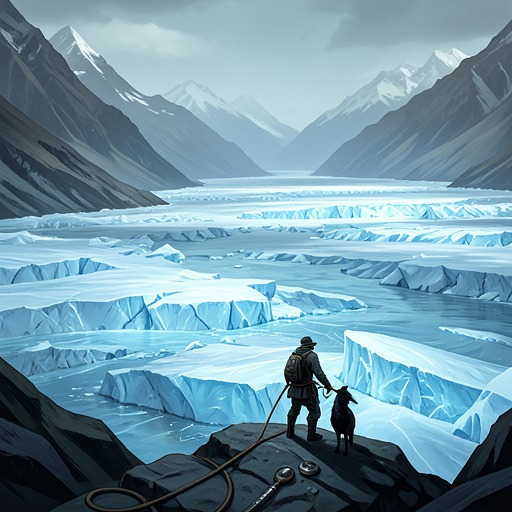
“The glacier is the snow of winters long past”
The Eight Mountains: A Novel“The glacier is the snow of winters long past” names the way Giovanni Guasti’s memories endure beneath the passage of time. For Pietro, the image becomes more than his father’s way of describing a mountain: it helps him recognize a previously obscured part of their relationship and gives him a way to remember the man through places and objects left behind.
The Image and Its Meaning
The expression emerges when Pietro thinks back on how his father spoke about glaciers. Giovanni did not usually retrace his steps or revisit unhappy times, but in the mountains a glacier could make something resurface—even on a mountain where no friend had died. His comparison joins the seasonal melting of snow to the fading of memory, then sets against it the glacier’s persistence: “the summer erases memories, just like it melts the snow; but the glacier is the snow of winters long past; it is a memory of winter that does not wish to be forgotten.” The glacier holds what summer seems to erase.
The phrase therefore describes memory as something preserved, not simply recovered at will. The past returns through particular encounters—with a mountain, a route, or a record—rather than through Giovanni’s deliberate retelling. Pietro hears his mother’s account before he can understand what the glacier meant to his father. Only then does he recognize that he has known two versions of Giovanni: the city-dwelling father from whom he had become estranged, and the mountain walker, lover of glaciers, whom he had only glimpsed but felt he knew better.
The Map as a Record of Shared Pasts
That recognition changes how Pietro sees his father’s mountain map. Returning to the old kitchen, he finds it still thumbtacked to the wall, but it is no longer merely a map of valley trails. Over twenty years, Giovanni had marked summits, alpine pastures, and refuges until the overlapping itineraries made the sheet nearly illegible to anyone else. Black, red, and green lines form a private code: black marks Giovanni’s routes, red accompanies Pietro as far as their four-thousand-meter peaks, and green identifies Bruno.
Pietro deciphers the colors by remembering the three of them stuck together on a glacier. The red and green routes end at that point, while the black continues; he understands that Giovanni completed the rest of the climb alone on another occasion. The many routes traced in black and green reveal that his father had often gone into the mountains with Bruno. Pietro feels a pang of jealousy, but also relief that Giovanni had not spent all those years alone. The map suggests that a relationship and a life persisted beyond what Pietro had known, and he wonders whether his father has left him a message in its dense network of lines.
The Summit Record and a Father's Presence
On a later ascent of the mountain above his house, Pietro finds a notebook inside a metal box set into a mound of stones. The damp-affected pages preserve the names and brief remarks of the few climbers who reach the barren summit, sometimes fewer than ten in a year. Among them he finds two lines dated 1997, written in Giovanni’s recognizable hand: “Climbed up from Grana in 3 hours and 58 minutes. Still in great shape! Giovanni Guasti.”
The entry gives Pietro a precise trace of his father’s presence: the route from Grana, the time, and the exclamation that conveys his good humor. The water-blurred ink has made the signature less legible than the words before it. Pietro imagines Giovanni climbing the scree alone, hurrying to reach the summit in under four hours, and taking pride in his strength and in seeing his mountain again. He considers tearing out the page, then rejects the idea as sacrilegious as taking a stone from the summit. The notebook matters not because it explains Giovanni completely, but because its surviving marks let Pietro encounter him in a place they share.
From Memory to Commemoration
The metaphor’s movement from preserved past to present action culminates at the house Pietro and Bruno have built. When Pietro brings his mother there, she looks carefully at the lake, the scree, the peaks of Grenon, and the house, as if committing them to memory. On the rock wall, Pietro has made an inscription with a mallet and chisel, then painted it black: “GIOVANNI GUASTI / 1942–2004 / IN MEMORY IS THE MOST BEAUTIFUL REFUGE.” His mother pauses to read it, and then calls Pietro and Bruno to sing the song for a lover of the mountains who has died, asking that he be allowed to keep walking in the afterlife.
Pietro makes the house itself part of this act of remembrance by telling Bruno, in his mother’s presence, that it should belong to them both. He believes Giovanni would have wanted the inheritance shared, but also insists that he wants this himself because the two friends built it together. The glacier image thus connects private memory to tangible forms of keeping: a route drawn on a wall map, a name preserved in a summit notebook, an inscription cut into stone, and a home made shared. It does not undo Pietro’s estrangement from the father he knew in the city; it enables him to remember the mountain father and to carry that memory forward.